





An outdoor air conditioning condenser unit positioned on a concrete pad next to a blue-sided house, surrounded by green shrubs and flowering hydrangeas at sunset.

AC Maintenance in Abilene, KS

Tell us about the job

Takes about a minute. No obligation.

Tune-up, service, or cleaningCentral ACDickinson County, KS
Step 1 of 2

What ZIP code is the job in?

Your air conditioner runs about five months a year here, May through September. Afternoons average 89 degrees across June, July and August, and the dew point sits around 64°F, which keeps the air feeling heavy even after the sun goes down. That combination keeps the compressor cycling longer and the coil working harder to pull moisture out of the air. The outdoor unit takes a beating too. Dickinson County has seen 96 hail events and 84 damaging wind events between 2015 and 2024, and a unit that sits through that kind of weather wears in ways one in a calmer climate doesn't. A weak capacitor or a dirty coil shows up sooner here, and it tends to turn into a bigger problem before you'd notice it on your own.

5 months
May through September, your air conditioner is on duty
89°F
the average summer afternoon it cools against
96 hail events
in ten years, and hail bends the fins on outdoor coils
84 wind events
in ten years, and wind drives debris into outdoor units
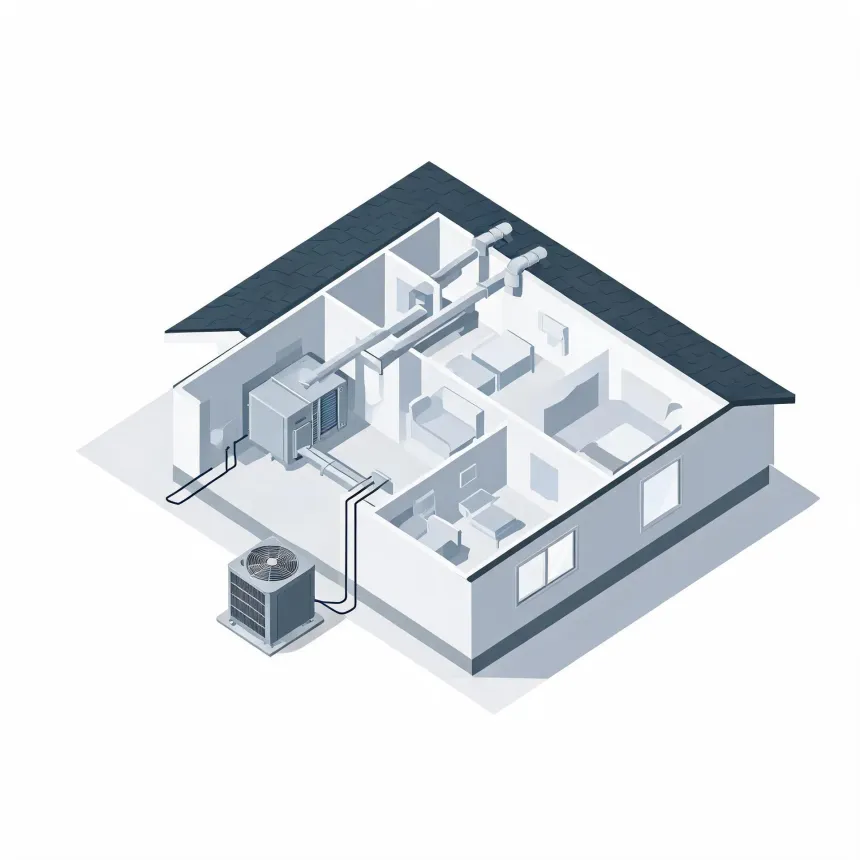
Isometric cutaway illustration of a single-story house showing interior rooms, ceiling ductwork, an indoor air handler, and an outdoor condenser unit connected by lines, in gray and white tones on a white background.
Your air conditioner works hardest from June through August.

NOAA nClimDiv, 1991–2020 normals

Half the homes in Dickinson County were built in 1956 or earlier.

A system in a house that old has had a lot of years to pick up small problems that a yearly check would catch.

Power here runs 15.12 cents a kilowatt-hour, and a neglected system burns more of it

Power here costs 15.12 cents per kilowatt-hour
Climate zone 4A
Cooling runs May through September

May is when cooling starts here, and that's when your air conditioner goes straight to work. Book the tune-up in April, before that first hot stretch hits. A technician checking the system cold catches a weak capacitor or a low refrigerant charge before it has to run on it. Wait until May and you're finding out what's wrong the day you need the air on.

Get it checked before it has to work this hard

A tune-up before May catches what the summer here would otherwise turn into a breakdown. A technician can check the capacitor, the coil and the refrigerant charge while the system is idle, not while it's fighting a stretch of afternoons in the high 80s.

Find a contractor
A man in a dark cap, gray shirt and tan work pants walks up porch steps toward a red front door, carrying a worn canvas tool bag in his right hand beside a potted shrub in a red planter.
A gray residential air conditioner condenser unit mounted on a concrete pad in an open grass field.

A system with years on it needs eyes on it every year

If the system in your house dates back to when the house was built, a yearly check is the only way to catch a problem while it's still small. A tune-up isn't just about this summer. It's a chance for a technician to look at a system that's already logged a lot of run time and flag the part that's starting to go before it takes the rest down with it. That matters more the longer a system has been in place.

Keep the filter clean

A dirty filter chokes the airflow across the coil. When that happens the coil can ice over even though the house feels warm, and the compressor ends up running longer to make up for it. Check the filter once a month during the summer and swap it when it looks gray or clogged. This is the one job that's really on the homeowner, since everything after the filter needs a technician's tools to check properly.

Leave the rest alone

Don't pull panels off the outdoor unit or touch the wiring inside it. The capacitor holds a charge even with the power off, and the refrigerant lines aren't something to open up without gauges. What you can do from outside is keep leaves and grass clippings away from the outdoor unit and make sure nothing is stacked against it blocking airflow. Past that, a strange noise or a smell is a sign to call someone, not a project to take on yourself.

Aerial view of a gray central air conditioning condenser unit on a concrete pad next to a house with vinyl siding.

Book your AC tune-up in April, before homes here start needing cooling in May.

  1. Jan
  2. Feb
  3. Mar
  4. Apr
  5. May
  6. Jun
  7. Jul
  8. Aug
  9. Sep
  10. Oct
  11. Nov
  12. Dec

A tune-up checks the refrigerant charge, cleans the coils, tests the capacitor and tightens the electrical connections.

A tune-up starts with the capacitor and the contactor, since those parts age whether the system runs hard or not and a failing one takes the compressor down with it. The technician checks refrigerant charge against the manufacturer's numbers, not by feel, because too little or too much both make the compressor work harder than it should. The condenser coil gets cleaned so it can actually shed heat instead of holding onto it. Inside, the evaporator coil and the blower wheel get checked for dirt buildup, since a coated coil can't pull heat out of the air the way a clean one does. The drain line gets checked too, because a clog there backs up and can shut the system down on its own. Electrical connections get tightened, since a loose one generates heat and that heat damages the parts around it over time.