A snow-covered small-town street at dusk, with lit white clapboard houses, bare trees, and a grain elevator silhouetted against an orange and blue twilight sky.

AC Maintenance in Holton, KS

Tell us about the job

Takes about a minute. No obligation.

Tune-up, service, or cleaningCentral ACJackson County, KS
Step 1 of 2

What ZIP code is the job in?

Swap or rinse the filter

A dirty filter chokes airflow across the coil and makes the whole system work harder to cool the same air. Check it by holding it up to a light. If light does not pass through easily, replace it or rinse it if it is a reusable type. Do this on a schedule instead of waiting for a problem to show up.

Keep the outdoor unit clear

The condenser outside needs open air around it to shed heat. Grass clippings, leaves, and mulch piled against the cabinet block that airflow and make the compressor run harder than it should. Walk out and clear anything growing or piled within a couple feet of it, and skip the power washer, since bent fins hurt airflow more than dirt does.

4 months
June through September, your air conditioner is on duty
87°F
the average summer afternoon it cools against
41 hail events
in ten years, and hail bends the fins on outdoor coils
42 wind events
in ten years, and wind drives debris into outdoor units
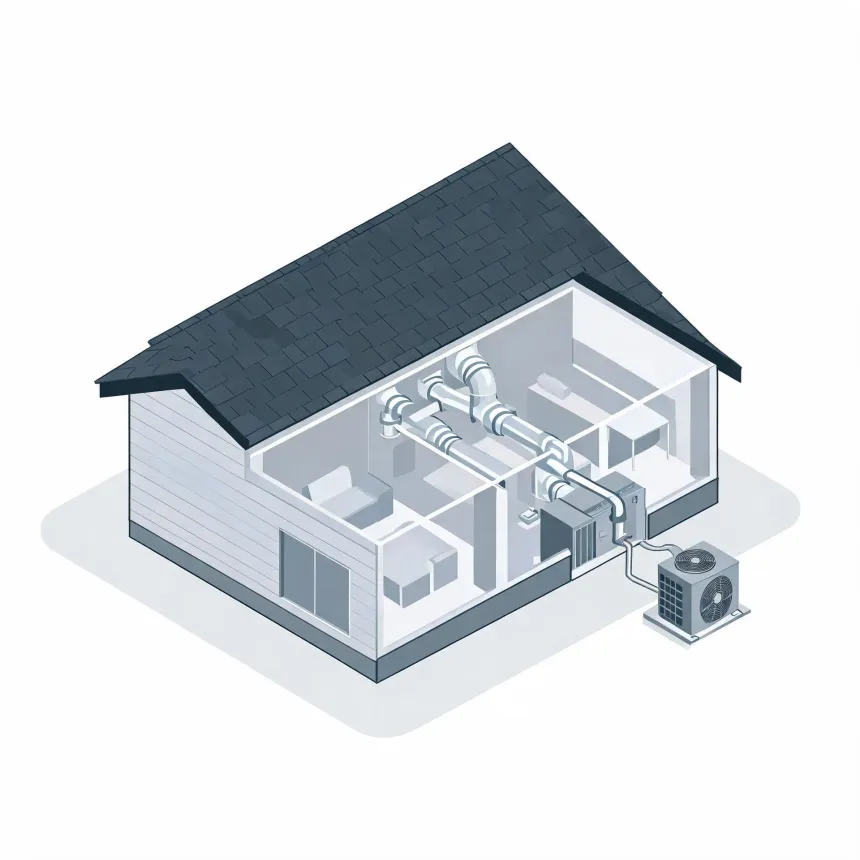
Isometric cutaway illustration of a house with a dark shingled roof, showing interior ductwork connected to an indoor air handler and an outdoor condenser unit beside the building.
Your air conditioner works hardest from June through August.

NOAA nClimDiv, 1991–2020 normals

June is when cooling starts in Jackson County, and it starts hard, not easing in.

Have the AC checked in May, before it has to run hard every day.

One system, one summer stretch, one check a year

Half the homes here were built by 1976
Cooling runs June through September
Summer afternoons average 87°F

Jackson County saw 98 severe weather events between 2015 and 2024, mostly wind and hail rather than tornadoes. None of that changes what an AC checkup covers, but it does mean a system here takes more hits than one in a calmer county, a branch against the condenser, hail denting the cabinet, a power blink during a storm that doesn't always let the compressor restart clean. A yearly check catches that kind of wear before the system has to run hard every day. One visit a year is still enough. It just shouldn't be skipped.

One visit a year is enough

One checkup a year covers it. A system that's been looked at doesn't have to work as hard to cool the same air, and in Kansas homes, where electricity ran 14.15 cents per kilowatthour in 2024, that matters. No second visit needed to get it.

Find a contractor
A man in a cap, dark T-shirt and tan work pants walks up porch steps toward a red front door, carrying a worn canvas tool bag, with a potted plant beside the door.
A gray cylindrical air conditioning condenser unit mounted on a concrete pad next to a light-colored vinyl-sided house exterior.

The strain shows up after the system has been running a while, not before

An air conditioner either runs or it sits idle. There's no in between, no gentle warm up. Every time it kicks on, the compressor takes the hardest hit of the whole cycle, and it takes that hit the same way whether the system was serviced last month or hasn't been touched in years. What changes over a long running stretch is how much strain builds up around that compressor. Refrigerant pressures drift off spec. Electrical connections loosen from the heat cycling through them. A capacitor that's been fine for seasons starts to weaken and the compressor has to work harder just to start. None of that shows up as a sudden failure. It shows up as the system running longer to hit the same temperature, then one day not starting at all. A check during a long stretch of running catches the drift before it becomes a stop.

Checking the gauges, not just the filter

A thorough visit puts gauges on the system and checks refrigerant pressure against what that unit calls for. It means pulling the panel and looking at the capacitor and contactor instead of only glancing at them. A quick visit swaps the filter, glances at the thermostat, and calls it done without ever confirming the charge is right.

A low charge or a weak capacitor doesn't announce itself

A system can run on a low charge or a weak capacitor for months before it fails outright, so a rushed tune-up can look fine at the time and still miss the thing that strands you in the middle of summer. Ask what was actually tested, not just what was touched.

An outdoor central air conditioning unit mounted on a concrete pad beside a blue-sided house at sunset.

Book your AC tune-up in May, before homes here start needing cooling in June.

  1. Jan
  2. Feb
  3. Mar
  4. Apr
  5. May
  6. Jun
  7. Jul
  8. Aug
  9. Sep
  10. Oct
  11. Nov
  12. Dec

A tune-up checks the refrigerant charge, cleans the coils, tests the capacitor and tightens the electrical connections.

A real tune-up starts outside at the condenser. The tech pulls the cabinet if needed and checks the fan motor and the coil fins for dirt packed down between them, because a coil caked with grime can't shed heat no matter how strong the compressor is. Inside, it means checking the blower wheel for buildup and confirming the evaporator coil isn't frosting over, which usually points to airflow trouble or a charge that's off. The refrigerant lines get checked for insulation that's cracked or missing, since bare line hurts efficiency even when everything else is right. None of this is guesswork. Each reading gets compared against what that specific unit is built to run at, not just checked off a list.