






A snow-covered small-town street at dusk, lined with illuminated two-story houses and a grain elevator on the horizon.

AC Maintenance in Liberal, KS

Tell us about the job

Takes about a minute. No obligation.

Tune-up, service, or cleaningCentral ACSeward County, KS
Step 1 of 2

What ZIP code is the job in?

Summers here run long. The system cools from May through September, cycling on most afternoons that whole stretch. In June, July and August the afternoon high averages 91 degrees, so the compressor and fan aren't just working hard on the worst days, they're working near their limit for most of the summer. That steady load wears on a capacitor or a contactor faster than it would somewhere milder. Seward County also gets hit with hail and damaging wind on a regular basis, and an outdoor unit sitting through that takes a toll on the coil and cabinet whether or not the damage shows right away.

5 months
May through September, your air conditioner is on duty
91°F
the average summer afternoon it cools against
70 hail events
in ten years, and hail bends the fins on outdoor coils
126 wind events
in ten years, and wind drives debris into outdoor units
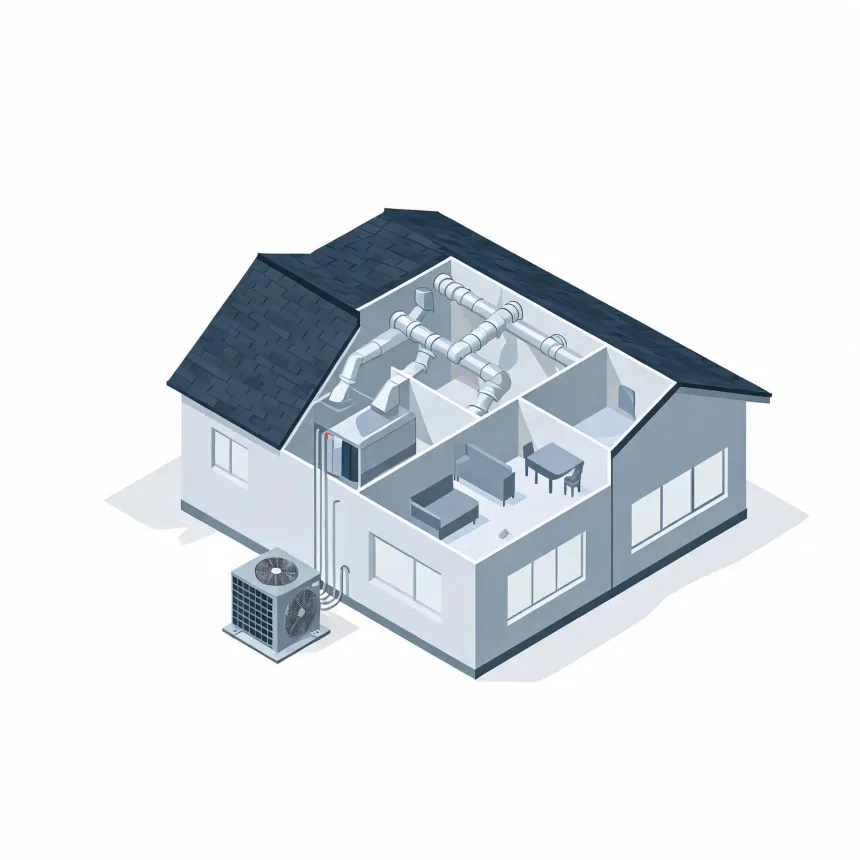
Isometric illustration of a cutaway single-story house showing attic ductwork, an indoor air handler, interior rooms with furniture, and an outdoor condenser unit connected by lines, on a white background.
Your air conditioner works hardest from June through August.

NOAA nClimDiv, 1991–2020 normals

A quick tune-up checks that the system turns on and blows cold.

A thorough one pulls the capacitor readings and checks refrigerant pressure, because that's what tells you what's about to fail.

This county sees its share of storms, and the condenser sits outside through all of it

215 severe weather events from 2015 to 2024
19% of homes statewide lost power a day or more in 2024
126 damaging wind events from 2015 to 2024
May is when it starts workingCooling runs May through September here. Have it looked at in April.

Half the homes in Seward County were built in 1973 or earlier. An AC system that old has usually been replaced at least once, but whatever's out there now is likely older than what you'd find in a newer development. Age by itself doesn't fail a system. What fails it is a worn part nobody caught in time, and that's harder to catch on a system that's been through more summers. A yearly check on an older setup gives a contractor the same baseline every year, so a capacitor reading or a refrigerant pressure that's drifted shows up as a number that moved, not a guess.

Have it checked before May

Cooling runs May through September here, and the compressor and fan work near their limit most of those afternoons. A check now catches the capacitor or contactor before the season puts a real load on it.

Find a contractor
A man in a brown jacket, cap, dark pants and work boots walks up concrete steps toward a red front door, carrying a waxed canvas tool tote with a hammer inside.
A gray metal air conditioning condenser unit mounted on a concrete pad in a flat grassy field under a partly cloudy sky.

Ask for last year's numbers, not just this year's

If your system has been checked before, ask the contractor to pull last year's capacitor and pressure readings alongside this year's. On an older system that's the part worth paying for. One reading tells you where things stand today. Two readings, a year apart, tell you whether something is drifting toward failure.

Keep the airflow clear

The filter is the one part that's on the homeowner, not the contractor. A clogged filter starves airflow across the coil, and a coil that can't shed heat makes the compressor work harder to do the same job. Check it monthly during cooling months and swap it when it looks dirty. Outside, keep the area around the condenser clear of grass clippings, leaves and anything piled against the cabinet, since it needs open space on all sides to move air through the coil.

What to leave alone

Don't take the cabinet apart or go near the electrical panel on the condenser. The capacitor inside can hold a charge even with the power off, and refrigerant lines aren't something to open up without gauges and training. If the system is short cycling, blowing warm, or the outdoor unit is making a new noise, that's a sign to get it looked at, not a repair to attempt between visits.

Overhead view of a gray outdoor AC condenser unit on a concrete pad beside a mulched garden bed and a house with vinyl siding.

Book your AC tune-up in April, before homes here start needing cooling in May.

  1. Jan
  2. Feb
  3. Mar
  4. Apr
  5. May
  6. Jun
  7. Jul
  8. Aug
  9. Sep
  10. Oct
  11. Nov
  12. Dec

A tune-up checks the refrigerant charge, cleans the coils, tests the capacitor and tightens the electrical connections.

A proper tune-up starts outside, with the condenser coil. A technician washes it clean of dirt and grass so it can shed heat the way it was designed to. They check the refrigerant charge against the system's rating, since too little or too much either way makes the compressor work harder for the same cooling. The capacitor and contactor get tested under load, not just looked at, because a capacitor can read fine sitting still and still fail the moment the compressor tries to start. Fan motors get checked for noise and for play in the bearings. Inside, the technician checks static pressure across the coil and blower, which catches airflow problems a dirty filter alone won't explain. None of that takes long, but skipping it means the first sign of trouble is the system not turning on at all.