






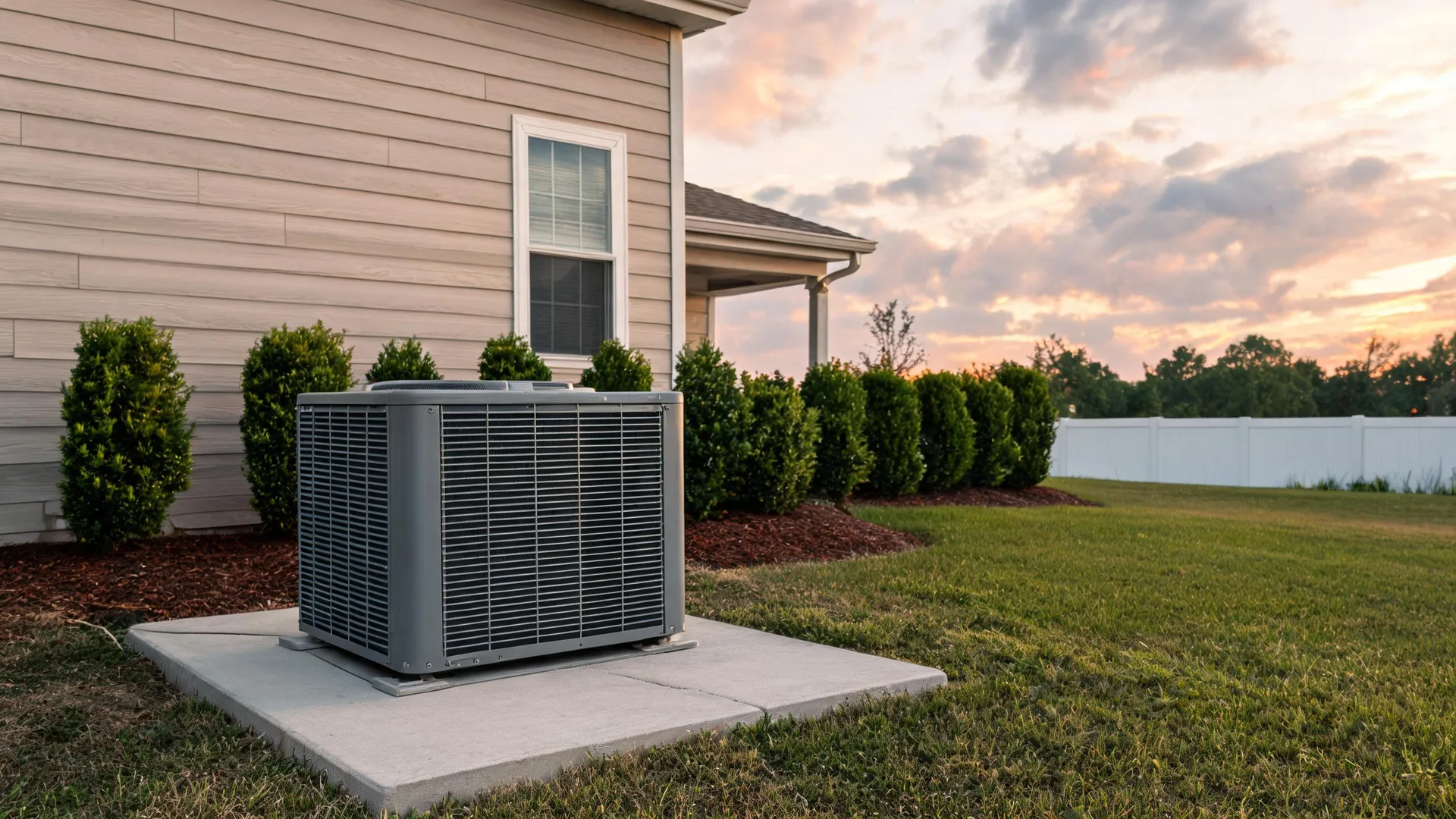
An overhead view of a residential air conditioning condenser unit mounted on a concrete pad next to a house with vinyl siding.

AC Maintenance in Marysville, KS

Tell us about the job

Takes about a minute. No obligation.

Tune-up, service, or cleaningCentral ACMarshall County, KS
Step 1 of 2

What ZIP code is the job in?

Marshall County saw 172 severe weather events between 2015 and 2024. Most of that was wind and hail, 83 damaging wind events and 68 hail events in that same stretch, with 10 tornadoes on top of it. An outdoor condenser sits outside through all of it, taking whatever blows through or falls out of the sky. Hail dents the fins and bends them shut, and wind carries branches and grit into the coil where you can't see it. None of that shows up as a breakdown right away. It shows up as the system working harder than it should until the day it doesn't work at all.

4 months
June through September, your air conditioner is on duty
87°F
the average summer afternoon it cools against
68 hail events
in ten years, and hail bends the fins on outdoor coils
83 wind events
in ten years, and wind drives debris into outdoor units
Isometric line illustration of a cutaway house showing interior rooms with ductwork, an indoor air handler, and an outdoor condenser unit connected by lines, on a white background.
Your air conditioner works hardest from June through August.

NOAA nClimDiv, 1991–2020 normals

A quick visit checks the refrigerant pressure and calls it done.

A thorough one pulls the panel, washes the coil, and checks the capacitor and contactor before anything gets called good.

Half these homes were built in 1959 or earlier, and the AC inside is often just as old

Half the homes here were built by 1959
Climate zone 4A
Power here costs 15.36 cents per kilowatt-hour
June Starts Hot HereCooling runs June through September, so book the check in May.

If your AC has been out there since before anyone thought to replace it, a yearly check is how you find out before the heat does. A tech can look at the wiring for cracked insulation, check that the capacitor is still holding its charge, and see how much the coil has corroded over the years it's been sitting outside. None of that tells you the unit is about to fail. It tells you where it stands, so you're not finding out when the heat is at its worst. If the system came with the house, it's worth asking the tech its age outright. They can read it off the data plate faster than you can find the paperwork.

Have the outdoor unit checked before storm season leaves its mark

After a storm, grit and branches end up in the coil where you can't see them, and hail can bend the fins shut without leaving a mark you'd notice from the yard. A tech can clean the coil and check it for that kind of damage before the system has to work through a stretch of hot days on a coil that's already struggling.

Find a contractor
A gray residential air conditioner condenser unit mounted on a concrete pad in an open grass field.

What You Can't See From the Yard

A refrigerant gauge only tells you pressure. It won't tell you that the contactor points are pitted from months of cycling, or that the start capacitor is reading weak and about to leave the compressor trying to start on its own. Those are things a tech finds by pulling the panel and testing each part on its own, not by watching a dial. The blower wheel is another one. Dust builds up on the blades a little at a time, and it throws the airflow off long before anyone notices the house feels different. A tech can see it the moment the panel comes off. Left alone, a dirty coil or a weak capacitor doesn't fix itself. It makes the compressor work harder every time it starts, and that's the part nobody wants to replace.

The system starts talking before it quits

A unit losing its grip gives warning first. It runs longer than it used to to hit the same temperature. It cycles on and off more than it should. The air coming out of the vents feels less cold than it did a season back. None of that is a breakdown. It's the compressor and coil working harder to make up for something, and a tech can usually find that something before it becomes a no-cool call.

Some signs only show up with the panel off

A burning smell, a tripped breaker, water pooling by the indoor unit, those are the signs anyone would catch. But a frayed wire, a capacitor losing its charge, a blower wheel caked in dust, none of that is visible from where the homeowner stands. Catching those early is the point of a check before the season gets hot enough to expose them the hard way.

An outdoor air conditioning condenser unit on a concrete pad next to the gray vinyl siding of a residential home.

Book your AC tune-up in May, before homes here start needing cooling in June.

  1. Jan
  2. Feb
  3. Mar
  4. Apr
  5. May
  6. Jun
  7. Jul
  8. Aug
  9. Sep
  10. Oct
  11. Nov
  12. Dec

A tune-up checks the refrigerant charge, cleans the coils, tests the capacitor and tightens the electrical connections.

A real tune-up starts outside at the condenser. The tech pulls the panel, not just the top grille, and looks at the wiring for cracked insulation or scorch marks before touching anything else. The capacitor gets tested under load, not just eyeballed, since a capacitor can look fine and still be weak. The contactor points get checked too, because pitted contacts make the compressor work to start every single cycle. Inside, the blower wheel comes out from under the dust it's collected, and the coil gets washed rather than wiped, since caked fins choke airflow in a way you won't see from across the room. Refrigerant charge gets checked last, against both pressure and the temperature split across the coil, not pressure alone. A visit that skips most of that and just checks the pressure isn't wrong, it's just not finished.