A two-story black-clad house with a dark shingled roof and covered porch stands in front of a dense row of tall conifers, viewed across a green lawn shot from ground level under an overcast sky.

AC Maintenance in McPherson, KS

Tell us about the job

Takes about a minute. No obligation.

Tune-up, service, or cleaningCentral ACMcPherson County, KS
Step 1 of 2

What ZIP code is the job in?

Change the filter

A dirty filter is the one thing you can check yourself without a wrench. Pull it and hold it up to a light. If light barely gets through, swap it. A clogged filter starves the coil of airflow, and a starved coil can ice over even on a hot day. Check it once a month and change it when it looks dirty, not on a fixed schedule.


Keep the outdoor unit clear

The outdoor unit needs open air on all sides to shed heat. Grass clippings, leaves, and shrubs crowding the cabinet make the compressor work against itself. Keep a couple feet clear around it and rinse the fins off with a hose if you see dirt caked on them. Never run the condenser with the panels off or reach inside it.

5 months
May through September, your air conditioner is on duty
90°F
the average summer afternoon it cools against
90 hail events
in ten years, and hail bends the fins on outdoor coils
115 wind events
in ten years, and wind drives debris into outdoor units
Isometric line illustration of a cutaway house showing interior rooms with furniture and ceiling ductwork, connected to an outdoor condenser unit with a fan beside the building.
Your air conditioner works hardest from June through August.

NOAA nClimDiv, 1991–2020 normals

Cooling starts in May around McPherson.

Get the tune-up done in April, before the heat load hits.

McPherson County logged 221 severe weather events between 2015 and 2024, and the condenser outside your house sat through all of it. Damaging wind hit the county 115 times in that span, hail 90 times. Hail dents fins and can dent the cabinet, and bent fins choke airflow the same way a dirty filter does. Wind throws branches and yard debris into the unit even in storms that leave no mark you'd notice walking past. A tune-up is a reason to pull the panels and look at the coil and fins for damage the yard view won't show you.

Your AC earns its keep here. Make sure it can keep up.

Five months of cooling here, May through September, with afternoon highs averaging 90°F across June, July and August. The dew point averages 63°F those same months, so the air stays heavy on top of the heat. That is a long stretch of hard running for a compressor. Parts that would hold up fine on a lighter schedule wear down faster under this one, and the first sign is usually small: weaker airflow, a longer run time, a sound that was not there last year. Catching that before the season is in full swing beats catching it on the hottest day of July.

Find a contractor
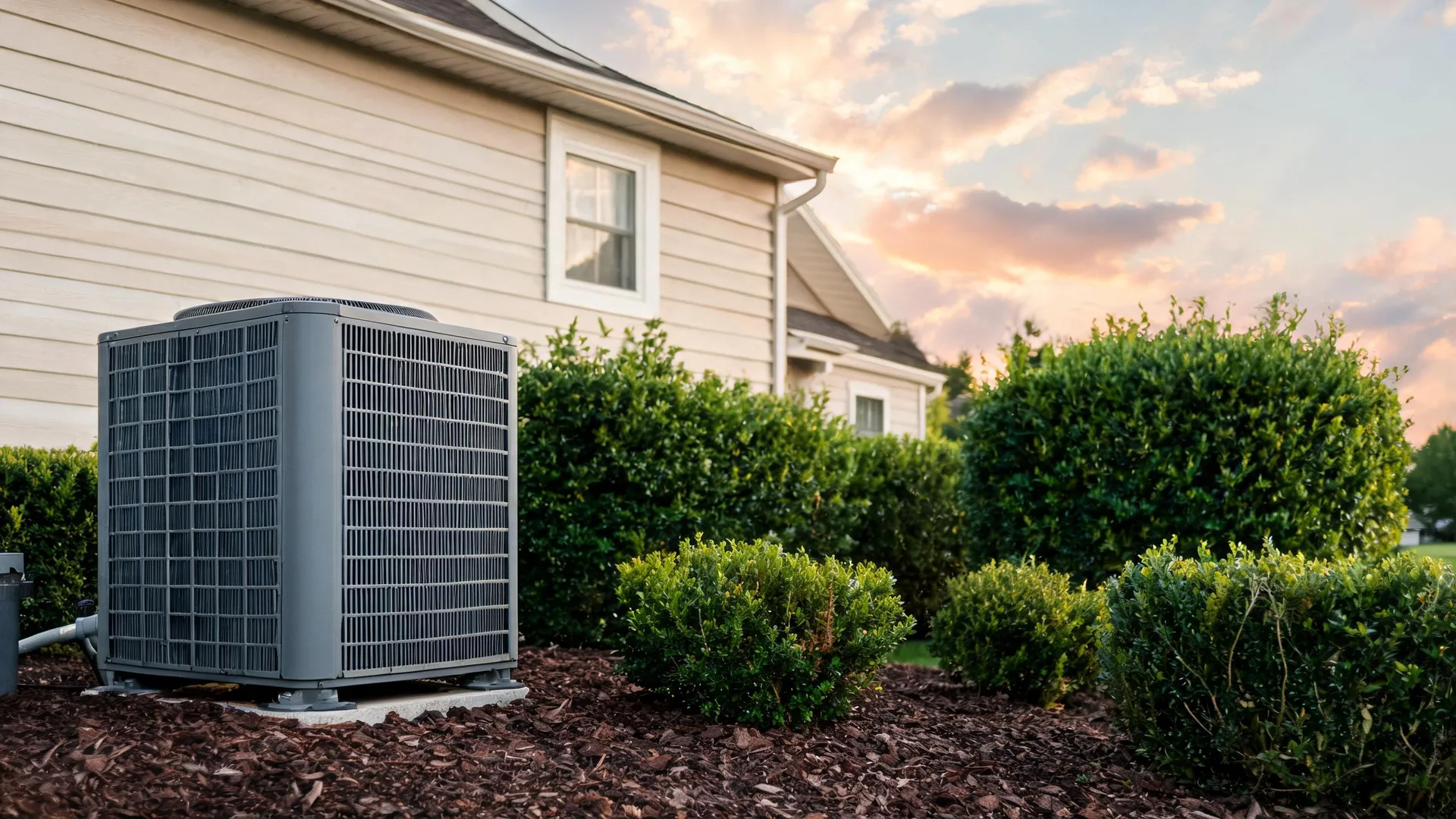
A gray residential air conditioning condenser unit mounted on a concrete pad outdoors, surrounded by green grass under a partly cloudy blue sky.

The difference is what gets touched, not how long it takes

A quick tune-up means someone swaps the filter, glances at the gauges, and leaves. A thorough one means they take the panels off. They wash the coil, not just look at it, because dust and grime on the coil fins work like a blanket and the unit has to run longer to push through it. They check refrigerant by weighing what the system actually holds against what it's supposed to hold, not just by feel at the valve. They check the capacitor's actual rating under load, since a capacitor can test fine sitting still and still be weak once the compressor draws on it. They tighten electrical connections, because a loose one heats up and eventually burns. They check the contactor for pitting, clean the condensate drain so it doesn't back up later, and check that the blower wheel is spinning true and isn't caked with dust that throws it off balance. None of that shows up from across the yard. If the visit is done before you've finished a cup of coffee, most of that list didn't happen.

What's hiding behind the numbers

A system can blow cold air and still be losing ground. Refrigerant charge drifts low from a slow leak that hasn't failed anything yet. A capacitor reads close enough at idle but sags the moment the compressor pulls hard. None of that shows up as a temperature change at the vent, not for a while. A gauge set and an amp reading catch it before the compressor does, because the compressor is the part that can't be replaced cheap.

Why the inside of the cabinet matters

Dust doesn't stop at the filter. Some of it rides past and settles on the blower wheel, inside the cabinet, on the relays and contactor points. A blower wheel caked with dust pulls out of balance and strains the motor bearing. A contactor with pitted points arcs a little more each time it closes, until one day it doesn't close reliably at all. Pulling the panels and looking at these parts directly is the only way to catch wear before it becomes a no-cool call.

Overhead view of an air conditioning condenser unit on a concrete pad next to a house with asphalt shingle roofing and vinyl siding.

Book your AC tune-up in April, before homes here start needing cooling in May.

  1. Jan
  2. Feb
  3. Mar
  4. Apr
  5. May
  6. Jun
  7. Jul
  8. Aug
  9. Sep
  10. Oct
  11. Nov
  12. Dec

A tune-up checks the refrigerant charge, cleans the coils, tests the capacitor and tightens the electrical connections.

A tune-up has an order to it because each step depends on the one before. Static pressure gets checked first, since airflow problems throw off every reading taken after. The evaporator coil gets inspected along with the condenser, because a system can have one clean coil and one filthy one and still run poorly. Refrigerant lines get checked for rubbing or chafing against the cabinet, not just for leaks at the fittings. The thermostat gets tested against the actual temperature in the room, not just its own display, since a miscalibrated sensor will short-cycle a perfectly healthy system. Drain lines get flushed even if they aren't backed up yet, because algae builds slowly and shows up as water damage only after it's done. A technician who skips the order and jumps straight to the parts people worry about, the capacitor, the refrigerant, is guessing at a system they haven't actually looked at yet.