A dark-painted two-story wood-sided farmhouse with a wraparound porch and gabled roof stands behind a wire fence, backed by tall deciduous trees and fronted by a wide mown lawn.

AC Maintenance in Newton, KS

Tell us about the job

Takes about a minute. No obligation.

Tune-up, service, or cleaningCentral ACHarvey County, KS
Step 1 of 2

What ZIP code is the job in?

The charge gets checked, not just the air

A tech hooks up gauges and checks the refrigerant charge against what the system calls for. A unit low on charge can still blow cold air at the vents while the compressor works harder than it should, and that strain is what shortens its life.


A capacitor failing doesn't ask first

The run capacitor helps the compressor and fan motor start and keep turning. It weakens slowly with no sign from inside the house, then gives out, usually on the hottest day it's asked to work hardest. A tune-up catches the weak ones before that happens.

5 months
May through September, your air conditioner is on duty
90°F
the average summer afternoon it cools against
59 hail events
in ten years, and hail bends the fins on outdoor coils
91 wind events
in ten years, and wind drives debris into outdoor units
Isometric cutaway illustration of a small home interior with furniture and ducting, showing an indoor air handler connected by lines to an outdoor condenser unit on a pad.
Your air conditioner works hardest from June through August.

NOAA nClimDiv, 1991–2020 normals

Warm air from the vents when the thermostat is set low enough means the system is losing ground.

A system that can't keep up now will only fall further behind as it keeps running that way.

Cooling starts in May here. Have it checked in April.

Cooling runs May through September
Summer afternoons average 90°F
91 damaging wind events from 2015 to 2024
Newton homes have had time to put miles on an AC systemHalf the homes in Harvey County were built in 1970 or earlier.

A dirty coil or a weak capacitor makes the compressor work harder to do the same job, and that shows up on the power bill before it shows up as a breakdown. Kansas homes paid 14.15 cents per kilowatthour in 2024, and a system that runs all summer at a higher draw adds that up fast. A tune-up brings the system back to the draw it was built for. That's the whole case for doing it before the heat sets in, not after.

Five months of 90 degree afternoons. Get it looked at first.

May through September, the afternoon high here averages 90 degrees, and the system runs the whole stretch without a break. That kind of season wears down a capacitor or a coil faster than it would somewhere milder. A check now finds the weak part before July asks the system to work through a 90 degree afternoon on it.

Find a contractor
A man in a cap, dark jacket and tan work pants carries a worn duffel bag as he steps up onto a porch toward a red front door, with a potted shrub beside the entry.
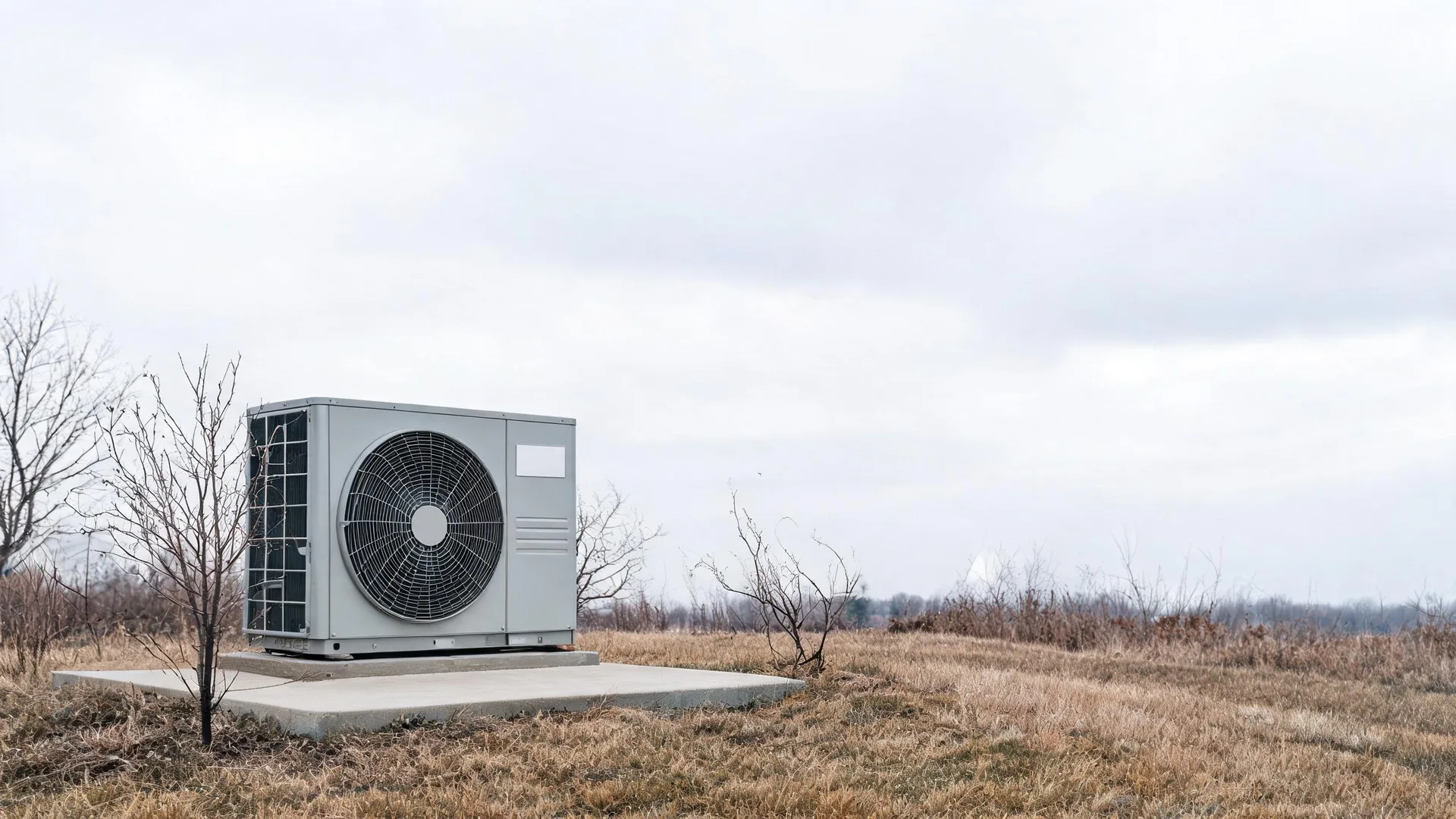
A gray residential air conditioning condenser unit mounted on a concrete pad outdoors, surrounded by green grass under a partly cloudy blue sky.

It doesn't break down. It wears down.

A dirty filter or a dirty coil doesn't stop the system, it just makes it run longer to do the same job. Longer run times mean more hours on the compressor and the fan motor, and both wear by the hour, not by the calendar. Dust and grime also build slowly. Nothing changes overnight, so there's no moment where the system tells you it's falling behind. A yearly check is what catches that drift before the parts worn down by it start failing.

Change the filter yourself

A dirty filter is the one part of the system the homeowner can see and reach without taking anything apart. Slide it out, hold it to the light, and if you can't see through it, swap it. A clogged filter starves the coil of airflow, and that's the same strain a tech is checking for on a visit.

Leave the refrigerant and the electrical alone

The charge, the capacitor and the wiring need gauges, meters and training to check safely. Opening the cabinet to look at them risks a shock or a cut coil, and guessing at the charge by feel does nothing but waste refrigerant. Between visits, the outside of the unit and the filter are the whole job.

Aerial view of a residential air conditioning condenser unit mounted on a concrete pad next to a house with vinyl siding and a sliding glass door.

Book your AC tune-up in April, before homes here start needing cooling in May.

  1. Jan
  2. Feb
  3. Mar
  4. Apr
  5. May
  6. Jun
  7. Jul
  8. Aug
  9. Sep
  10. Oct
  11. Nov
  12. Dec

A tune-up checks the refrigerant charge, cleans the coils, tests the capacitor and tightens the electrical connections.

A tune-up starts outside, at the condenser coil. That coil has to give up heat to the outside air, and it can't do that through a layer of grass clippings, pollen or dust. A tech straightens bent fins and washes the coil out so it can shed heat the way it's supposed to. From there it's the drain line, checked clear so condensation has somewhere to go instead of backing up into the pan. Electrical connections get checked too, since a loose one runs hot and burns a terminal over time. None of this is guesswork. It's the same handful of points checked the same way, because those are the points that fail.