A row of similar two-story houses with gray and beige siding and covered porches, seen across a mowed lawn with concrete walkways, with a chain-link fence in the left foreground and tree branches overhead.

AC Maintenance in Osage City, KS

Tell us about the job

Takes about a minute. No obligation.

Tune-up, service, or cleaningCentral ACOsage County, KS
Step 1 of 2

What ZIP code is the job in?

Five months of real heat

An air conditioner in Osage City runs from May through September, and afternoons average 88°F through June, July and August. The dew point sits around 66°F that whole stretch, so the air stays heavy and the system has to pull more moisture along with the heat. That is a long stretch of hard running every single year.


Parts wear ahead of schedule

A unit working that hard that long shows wear sooner than one in a milder climate. Capacitors weaken, contactors pit, coils get dirty faster, and the signs show up earlier than you'd expect. Osage County also saw 71 damaging wind events and 70 hail events between 2015 and 2024, and an outdoor unit sits outside taking that weather directly.

5 months
May through September, your air conditioner is on duty
88°F
the average summer afternoon it cools against
70 hail events
in ten years, and hail bends the fins on outdoor coils
71 wind events
in ten years, and wind drives debris into outdoor units
Isometric line illustration of a cutaway house showing interior rooms with furniture, ceiling ductwork, an indoor air handler, and an outdoor condenser unit connected by lines.
Your air conditioner works hardest from June through August.

NOAA nClimDiv, 1991–2020 normals

Winter storms hit this county nine times between 2015 and 2024, on top of the wind and hail.

Have the outdoor unit checked for damage before summer asks it to run.

May is month one of summer here, not a warm-up. Have it checked in April.

Cooling runs May through September
Summer afternoons average 88°F
71 damaging wind events from 2015 to 2024

A tune-up is the time to get eyes on the outdoor unit after a season of weather sitting on top of it. A technician can check the fins for hail dents, clear out leaves and branches lodged in the coil, and make sure nothing shifted against the cabinet in a windstorm. Seven tornadoes touched down in this county between 2015 and 2024, and while a direct hit is rare, the wind that comes with smaller storms is not. None of that damage announces itself. A bent fin or a cracked line can sit there quietly until the unit is running flat out, and by then it costs you cooling right when you need it most. Catching it before the unit has to work is the whole point of having someone look.

Get it looked at before May puts it to work

Five months of hard running starts in May. A tune-up before then catches the worn capacitor or the dirty coil while the unit is still idle, not after it's been carrying the load for weeks.

Find a contractor
A person in a dark shirt, tan work pants and boots climbs porch steps toward a red door, carrying a worn canvas tool bag beside a potted shrub.
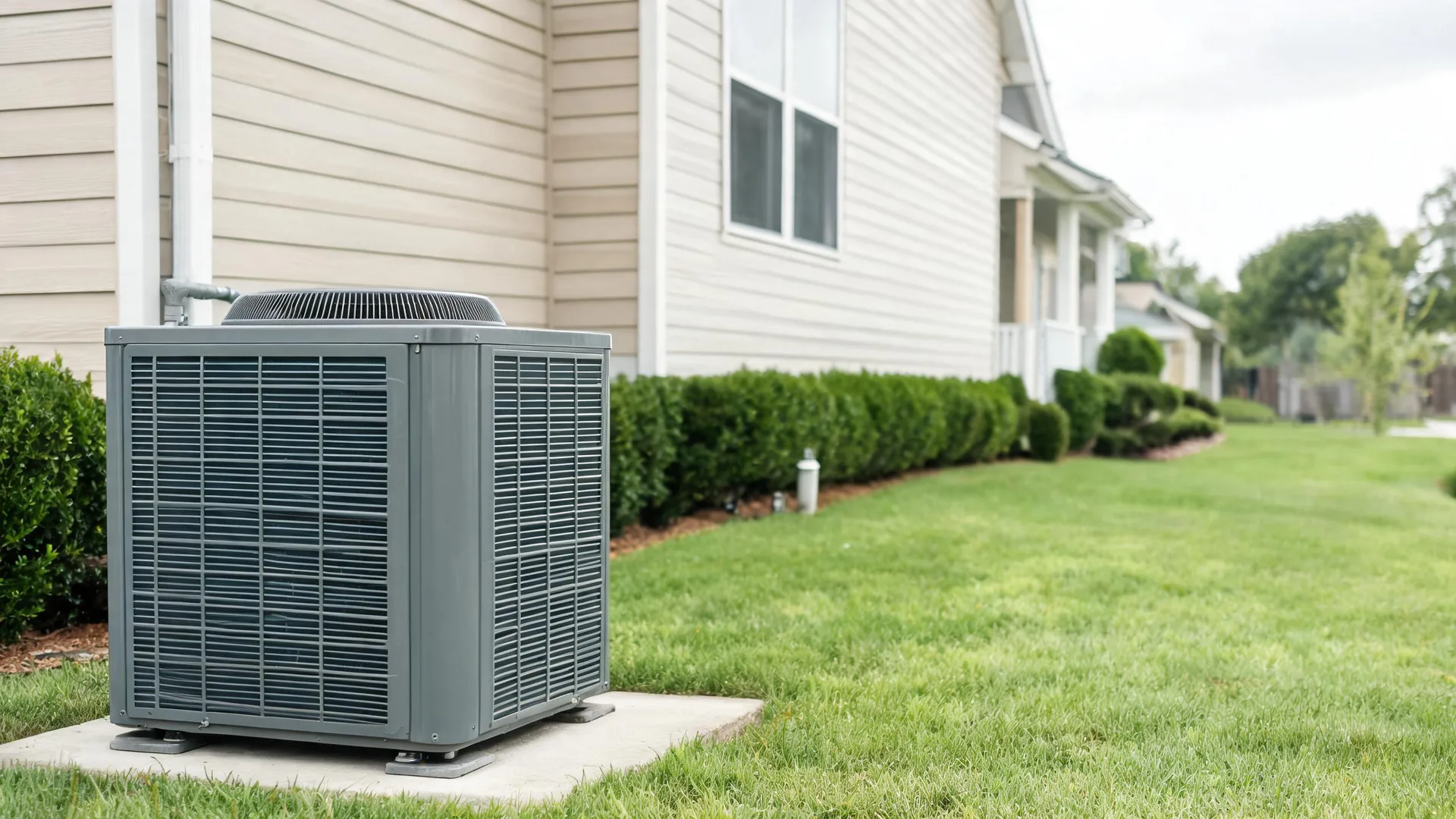
A gray residential air conditioner condenser unit mounted on a concrete pad in an open grass field.

What a tune-up finds before the unit tells you itself

A capacitor doesn't fail all at once. It weakens a little every time the compressor starts, and a weak capacitor makes the compressor start harder than it should. You can't see that from the thermostat. What you'll notice, eventually, is the unit struggling to kick on, or short cycling, or not cooling the way it used to. A tune-up catches it before that by testing the capacitor's output against what it's rated for, not just checking that the unit runs. Refrigerant charge is the same kind of hidden problem. A system can be low on charge and still blow cold air at the register, just not as cold as it should, and not for as long before it has to cycle again. The only way to know the charge is right is to check pressures against the manufacturer's numbers. Contactors pit and burn a little every time they open and close, and a pitted contactor can stick, which runs the compressor longer than it needs to run or keeps it from shutting off at all. None of these show up by looking at the unit from across the yard. They show up when someone pulls the panel, tests the parts against what they're supposed to read, and catches the one that's drifting before it quits.

The filter is doing more than you think

A dirty filter chokes the airflow across the indoor coil. Starve that coil of air and it can get cold enough to frost over, and once ice builds up the system stops cooling at all until it thaws. The coil also has to be clean itself. Dust and grime coat the fins and work like insulation, so the refrigerant inside can't pull heat from the air the way it should. A tune-up includes checking both: the filter for airflow, the coil for buildup that airflow alone won't fix.

The drain line decides where the water goes

Cooling humid air pulls moisture out of it, and that water has to go somewhere. It drips into a pan and runs out through a condensate line. Algae and dirt build up inside that line over time and can clog it. Once it's clogged, the pan backs up and overflows, and that water doesn't stay outside, it lands wherever the indoor unit sits. Clearing that line before it clogs is part of the job, not an afterthought.

Overhead view of an air conditioning condenser unit on a concrete pad next to a house with asphalt shingle roofing and vinyl siding.

Book your AC tune-up in April, before homes here start needing cooling in May.

  1. Jan
  2. Feb
  3. Mar
  4. Apr
  5. May
  6. Jun
  7. Jul
  8. Aug
  9. Sep
  10. Oct
  11. Nov
  12. Dec

A tune-up checks the refrigerant charge, cleans the coils, tests the capacitor and tightens the electrical connections.

A tune-up also covers the parts of the system that don't fail dramatically, they just drift out of spec. The blower motor gets checked for bearing wear and for how freely it spins, since a motor working harder than it should pushes less air for the same electricity. Belt-driven blowers are rare now; most pull air with a direct-drive motor, so what matters is the wheel itself staying clean and balanced, not a belt. A technician checks the thermostat's calibration against an actual thermometer, because a thermostat reading a few degrees off will short cycle the system or run it longer than needed without ever throwing an error. Electrical connections get tightened, since a loose connection at the disconnect or inside the unit builds resistance, and resistance makes heat. Every one of these is a small thing on its own. Together they're the difference between a system that holds up and one that nickels and dimes you with repairs.