










AC won't turn on in Kansas City, KS

RepairCentral ACWyandotte County, KS
Step 1 of 2

What ZIP code is the job in?

Why won't my AC turn on in Kansas City, KS?

Your AC won't come on and the heat outside isn't waiting. You've checked that it's plugged in or at the breaker, maybe bumped the thermostat down a few degrees, and nothing. In Wyandotte County summers run long and sticky, so a dead AC is more than an inconvenience. Before you call anyone, it helps to know what actually stops a unit from starting and whether it's something you can rule out yourself.

Usually a tripped breaker, a blown thermostat battery, or a failed part inside the unit

Most of the time the AC itself is fine and something feeding it power isn't. A tripped breaker is the first thing to check, since a hard-working compressor on a hot day is enough to trip one. Dead batteries in the thermostat will leave the display blank and the system silent, same as it does any time of year. If power and the thermostat check out, the problem is usually inside the unit itself: a failed capacitor, a bad contactor, or a safety switch that's shut the system down on purpose. That last one matters here. A clogged outdoor unit or a dirty filter can overheat the system on a 95 degree day and trip a safety switch, and the unit won't restart until someone finds out why it tripped and fixes that.

  1. Thermostat calls for cooling and sends power to the contactor.

  2. Contactor pulls in and sends power to the outdoor unit.

  3. Capacitor kicks the compressor and fan motor into motion.

  4. Compressor pressurizes refrigerant and sends it through the coils.

A gray-haired bearded man in a dark green sweater sits on a light gray sofa in a sunlit living room with a potted plant, framed picture, and dark shelving in the background.
A man in a dark green sweater sits on a light grey sofa in a sunlit living room, looking to his left, with a shelving unit, houseplants, framed art and a large window behind him.
A man with greying hair and a beard in an olive sweater sits on a sofa in a living room, looking to his left, with an armchair, round side table and large glass doors onto trees behind him.
A middle-aged man with grey hair and a beard, wearing a grey knit sweater, sits on a light sofa in a sunlit living room with a houseplant, wooden cabinet and framed landscape picture behind him.

A Kansas City summer afternoon doesn't slow down because your system quit. Upstairs rooms heat up first, and by evening the whole house feels it. Some of what you notice can mislead you. The fan might still be running, pushing warm air through the vents, while the compressor outside never kicks on at all. That's not the system halfway working. It's one part doing its job while the part that actually cools the air sits dead. If the breaker trips again after you reset it, that's usually not a fluke. It means something is drawing more power than it should, and resetting the breaker again just repeats the cycle without fixing what caused it. The longer it sits, the more that weak part gets pushed past what it can handle, especially with the kind of heat Wyandotte County sees most of the summer. Meanwhile the fridge is working harder to stay cold in a hot kitchen, and anyone in the house who doesn't do well in heat is the one who feels it first.

What a dead AC costs you

  • A house that sits at 85 degrees through a Kansas City afternoon gets uncomfortable fast, especially upstairs where heat collects.
  • A compressor that tries to start and can't finish the job can trip the breaker again, so the same fix keeps undoing itself.
  • Food in the fridge and anyone in the house sensitive to heat are both at risk the longer a no-cool stretch drags on through a Wyandotte County summer.
  • A fan that runs while the compressor stays silent still pushes air through the vents, which can fool you into thinking the system is partly working.
  • Leaving a dead system alone for days of 90-degree heat puts more strain on whatever part was already weak, since nothing about the underlying fault fixes itself.
  • A system that's completely silent, no hum, no click, no fan, usually points to power not reaching the unit at all rather than a worn part inside it.
An outdoor air conditioning condenser unit on a concrete pad beside a house with horizontal lap siding, with an electrical disconnect box and conduit on the wall and a green shrub to the right.
A unit like this one, clean and clear on its pad, starts when the thermostat calls because nothing is blocking the airflow or the electrical.
An outdoor air conditioner condenser unit on a concrete pad beside a house with horizontal siding and a lower concrete foundation wall, with coiled refrigerant lines at right.
Years of dirt packed into the louvers and fan grille choke the airflow a compressor needs to start and keep running.
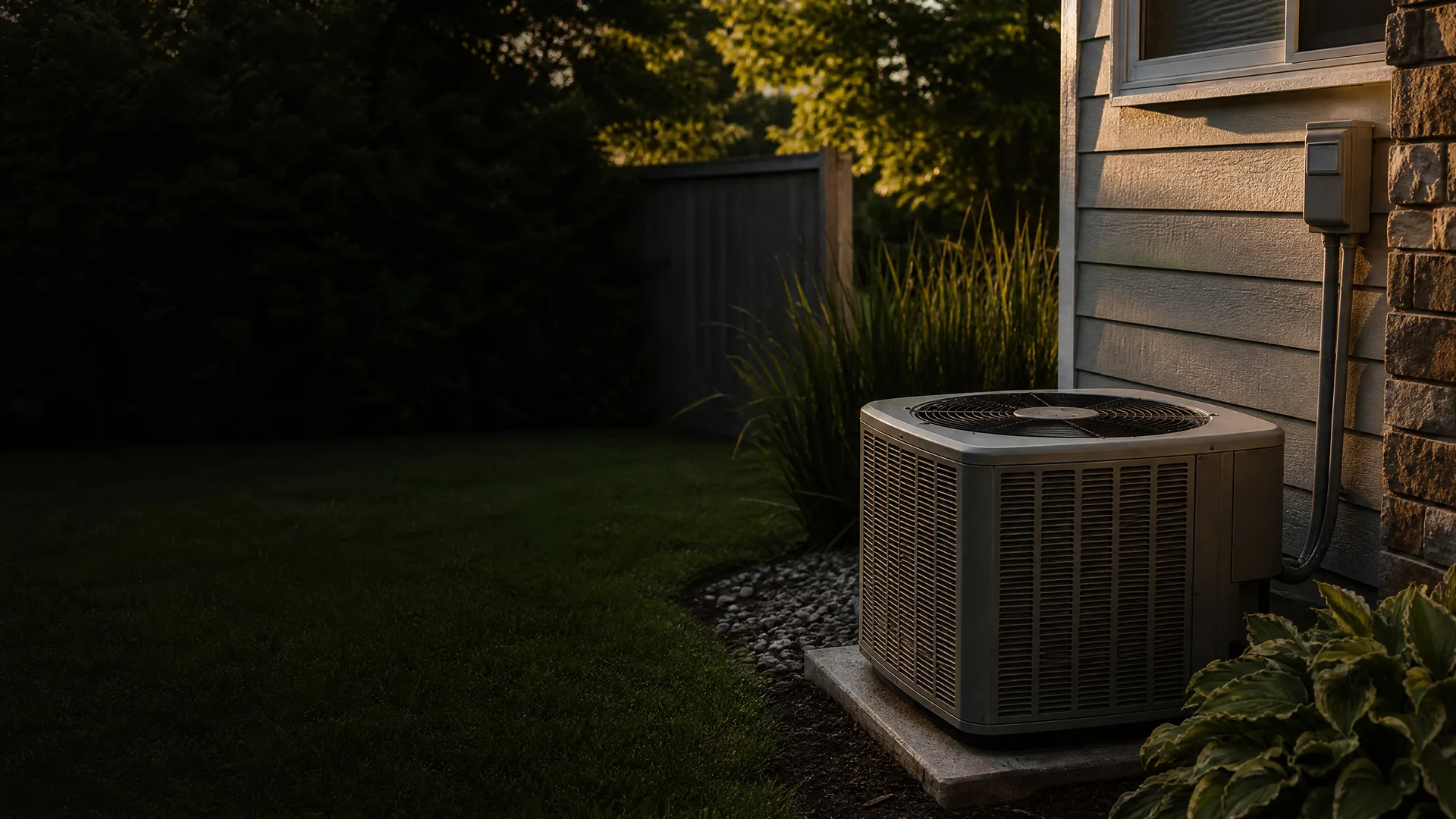
An outdoor air conditioning condenser unit sits on a concrete pad beside a house with horizontal siding and a stone-faced corner, next to a lawn, ornamental grasses and a wooden fence at dusk.

The sun is low over the fence line, throwing that heavy gold light across the yard. You're standing by the condenser because the house has gone warm and sticky, the kind of evening Wyandotte County gets a lot of in August. You crouch down and look at the fan through the grille. It isn't moving. No hum, no click, nothing working inside the unit even though the thermostat is set low. A few feet away a kid's bike is tipped over in the grass, left there before dinner. The cicadas are loud. You already tried the breaker once. You're done guessing what's wrong with it, and you've got the form pulled up on your phone, ready to hand this off to someone who'll know by looking at it.

One request and it's handed off

A licensed pro who works in Wyandotte County gets your request.

No fee to send it, and nothing to sign.

A capacitor that's failing doesn't always quit all at once. It can still kick the fan on while leaving the compressor to hum and trip the breaker, which is why the outdoor unit can seem half alive.

That's also why jiggling the breaker back on rarely holds. The breaker isn't the problem, it's reacting to one, and it'll trip again the moment the compressor tries and fails to start.

An outdoor air conditioner condenser unit on a concrete pad beside a house wall with stucco lower section, horizontal siding above, and a white downspout to the right.
Before you get your air conditioner repair
A gray outdoor air conditioning condenser unit on a concrete pad beside a house with horizontal lap siding, with a wall-mounted electrical disconnect box and refrigerant lines, shrubs, mulch and lawn around it.
After you get your air conditioner repair

Trying the breaker again yourself

Resetting the breaker is free and takes a minute, so it makes sense to try once. If the unit was tripped by something minor, like a breaker that just worked loose, that can be the end of it. But if the compressor is drawing too much current trying to start, flipping the breaker back on sends it through the same failed attempt again. It'll trip a second time, maybe a third, and each attempt puts strain on a compressor that's already struggling. You lose the time without gaining anything, and the house stays warm while you find that out.


Having a contractor diagnose it

A licensed contractor working in Wyandotte County checks the contactor, the capacitor and the compressor itself before touching the breaker again, so the unit isn't restarted into the same failure. That matters because a capacitor that's going bad can still spin the fan while the compressor hums and trips, which looks like several different problems from outside the unit. One contractor means one visit instead of fielding calls from several companies. It costs you the time to make the call, but it stops the guessing and gets the actual part replaced instead of the breaker reset over and over.

Cooling runs May through September

Five months of that is a long stretch to be without cooling if something quits in July. Your system gets used hard and steady from May on, so a part already working its way toward failure usually gives out mid-summer, right when the house needs it most.

NOAA nClimDiv 1991-2020

A gray outdoor air conditioning condenser unit on a composite pad beside a house with horizontal lap siding, with a wall-mounted disconnect box, refrigerant lines, and a wooden fence and shrubs to the left.

Unit running clean

This is what a working condenser looks like: sitting quiet on its pad, lines and conduit running straight up the wall to the disconnect. When the thermostat calls, the fan spins up and the compressor hums along without a fight.

An outdoor air conditioning condenser unit on a concrete pad beside a house with light vinyl siding, with electrical conduit running to a wall-mounted disconnect box and a shrub in mulch to the right.

Unit in trouble

This one looks fine from the yard, same pad, same conduit, same wiring into the box. But nothing's running. Whatever's keeping it off, a tripped breaker, a bad capacitor, a stuck contactor, won't show from the outside.

A woman with shoulder-length brown hair, wearing a beige knit cardigan, white top and a small gold pendant necklace, sits in a light upholstered armchair and looks toward a window with green foliage outside; shelves with framed photos are behind her.
A woman and a child wrapped in a knitted blanket sit together on a couch in a dimly lit room with a glowing table lamp behind them.
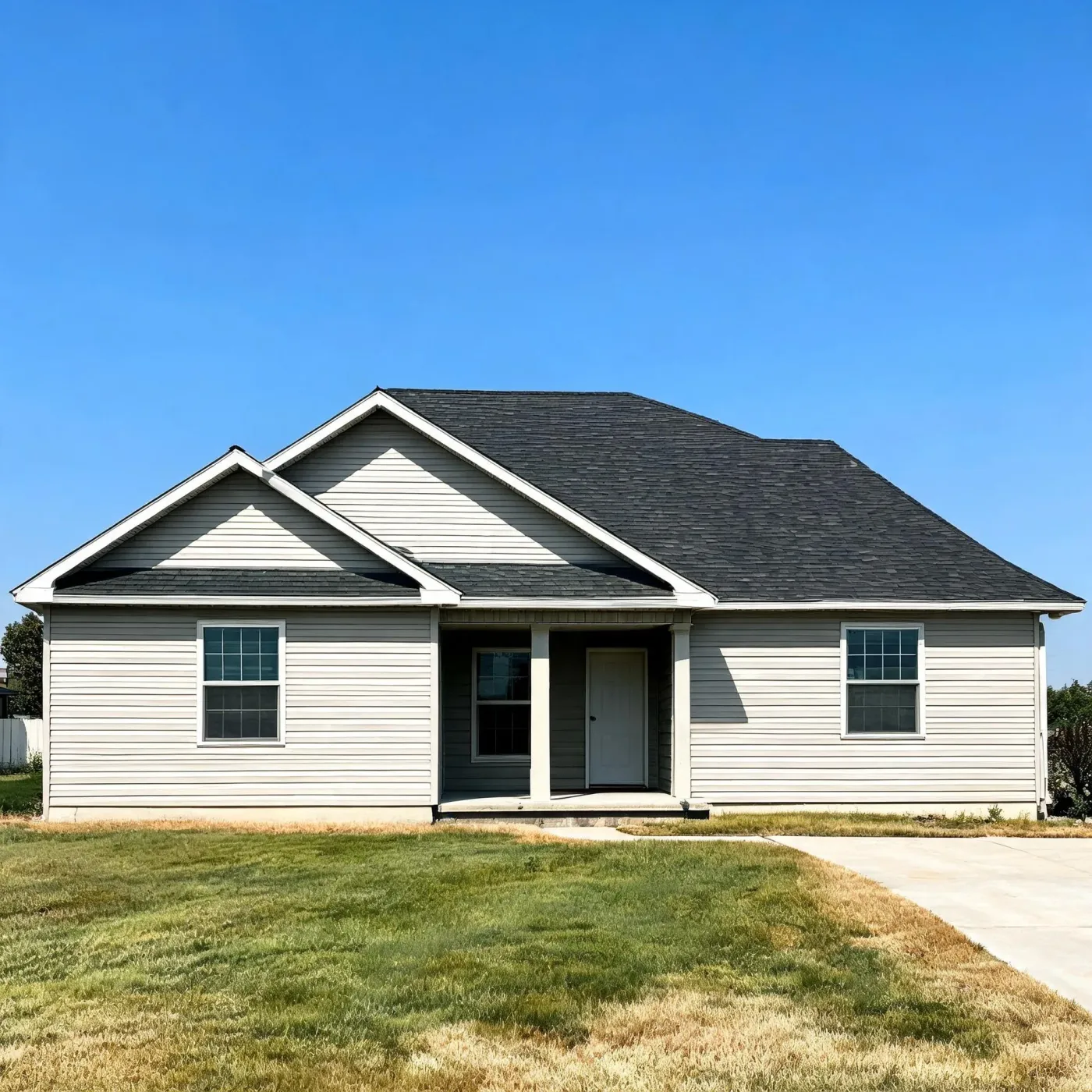
A single-story house with light beige vinyl siding, dark gray gabled shingle roof, a small covered front entry, and two windows, fronted by a patchy green and brown lawn with a concrete driveway at right under a clear blue sky.

That stickiness you feel outside most summer days isn't just the temperature. Across June, July and August, Wyandotte County runs a dew point around 65°F, per NOAA climate data, which is the point where air starts to feel heavy instead of just warm. Your AC is built to pull that moisture out along with the heat, and it's working two jobs at once whenever it runs here. That's more strain on the compressor over a season than a dry climate would put on it, and it's part of why a weak part tends to give out in the middle of summer rather than some milder month.

NASA POWER T2MDEW

Why does the house feel worse than the thermostat says

You set it to 72 and the house still sits closer to 80. The air coming out of the vents feels warm, or there's no air moving at all. Upstairs is worse than downstairs. The breaker panel shows the AC breaker tripped, or it holds for an hour and trips again. Outside, the condenser fan might be spinning while the unit hums without really running, or it's dead quiet. None of that fixes itself by waiting. A house that sits hot and humid for days gives mold somewhere to start, and anyone inside who doesn't handle heat well has fewer hours before that becomes a real problem.

A gray outdoor air conditioning condenser unit sits on a concrete pad beside a house with horizontal siding, connected by insulated lines to a wall-mounted disconnect box, with a shrub and gravel bed to the right.

Unit running clear

The pad is clean and the fins on the coil are open to the air. Lines and conduit run straight up the wall to the disconnect box, nothing blocking them. A compressor pulling air through a clean coil doesn't have to work to breathe, so it starts when the thermostat calls and keeps running.

An outdoor air conditioning condenser unit sits on a concrete pad beside a house with horizontal vinyl siding, with a gray electrical disconnect box and insulated refrigerant line on the wall above, surrounded by bare mulched ground.

Unit caked in grime

Years of dirt have packed into the coil fins and the housing, the kind that builds up slow enough you stop noticing it. That buildup blocks the airflow the compressor needs to cool itself and start clean. An older unit in this shape is also more likely to have a capacitor or contactor wearing out underneath the dirt.

A unit that won't start is almost always one of three things: a breaker that won't hold, a capacitor that can't kick the compressor over, or a coil so choked with dirt the compressor can't breathe. Figuring out which one takes someone who opens up units like yours all season long and knows which part tends to give out first. A licensed contractor near you in Wyandotte County sees this exact problem through the hot months and can tell what's wrong before the parts are even off the unit. You'll be matched with one contractor, not a handful of companies competing for the job, so you're not stuck fielding calls while your house sits at 85 degrees. Once that unit is running again, the fix holds. Cool air moves through the house, the compressor runs without tripping anything, and the long stretch of summer ahead stops being something you have to worry about.

A dark gabled roof peak in the foreground with spruce trees behind it and a flat snow-covered plain extending to the horizon under a pale sunset sky.

Done looking for an air conditioner pro

Let a pro reach out

Sending the form costs nothing.

A unit that sat dead through one more 90 degree afternoon isn't going to fix itself overnight. Sending the request now means a local contractor who works on these units all summer gets your situation instead of you waiting to see if it comes back on its own. That's one less thing on your plate tonight.