Clean condenser
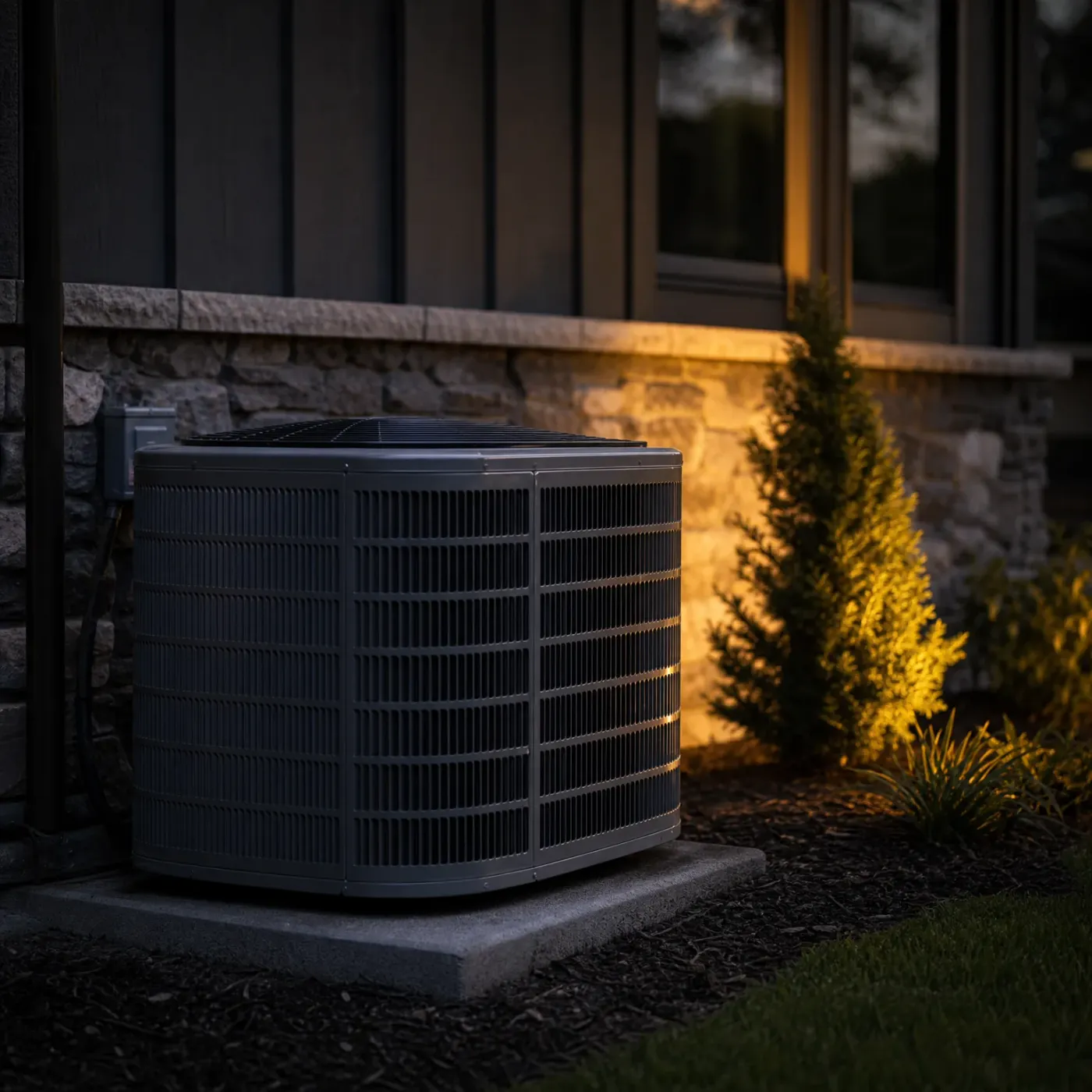
This is what a condenser needs to look like to move heat out of your house. Air passes through the fins and the wire cage without resistance, so the system shuts off when the thermostat is satisfied instead of straining to get there.
Skip the calls to every shop
A dead AC in the middle of a Kansas summer usually comes down to a handful of things: a tripped breaker, a bad capacitor, a thermostat that lost its mind, or a safety switch that shut the system down on purpose. This page walks through what to check and what it means. Past that, instead of calling around and repeating the problem to every contractor you find, you get matched with one licensed local pro who already knows what tends to fail on these systems.
Skip the callsWhen your AC won't turn on, start with the thermostat and the breaker before you assume the worst. If the screen is blank, check the breaker panel first. Summers in Kansas push air conditioners hard for months straight, and that kind of running time wears out the parts that start the compressor: the capacitor weakens, a contactor sticks, or a safety switch trips to protect the system from something more serious, like a clogged drain line or a dirty coil. A thermostat that's lost power or lost its settings can also look exactly like a dead system when nothing is actually broken. If the breaker won't stay reset, or the outdoor unit hums but never kicks on, that points to an electrical part failing rather than something you can fix by flipping a switch. At that point the system needs someone to open it up and test it, because running it further on a failing part risks the compressor itself.


Your thermostat doesn't talk straight to the compressor. It sends a low voltage signal to a contactor out at the condenser, and that switch is what actually closes the circuit. If the contactor is stuck or burned, the signal has nowhere to go. Assuming it gets through, the fan and the compressor are supposed to start together. If you walk outside and hear the fan spinning but nothing else, the run capacitor is usually the reason. There are also a few parts whose whole job is to stop the system on purpose. A pressure switch will cut power if refrigerant or airflow falls outside the range the unit needs. A float switch in the drain pan does the same thing if the condensate line backs up, which is common enough on units installed since the mid 2000s. A blown control board fuse can do it too, often from nothing more than a power flicker. If your AC starts, runs a minute, then shuts off again, that's usually one of these switches working as designed, not a part that failed.




This is what a condenser needs to look like to move heat out of your house. Air passes through the fins and the wire cage without resistance, so the system shuts off when the thermostat is satisfied instead of straining to get there.

Dirt and grime packed into the fins block airflow the same way a clogged filter does. The compressor can trip a safety switch and shut the whole unit down, and on a hot day in Kansas that can look like the AC won't turn on at all.
A hum from the outdoor unit with no startup usually means the compressor or fan motor is trying to run and can't, and that's unsettling to hear, especially when you know the unit has been working through a Kansas summer without a break. You want to know if this is something you caused, something minor, or something that's about to get worse if the unit keeps trying and failing to start.
The capacitor gives the compressor and the fan motor the jolt they need to start spinning. When it weakens, the motor gets power but not enough push, so it hums in place instead of turning over. You'll sometimes see the fan blades sitting still or barely twitching. A capacitor that fails this way usually doesn't come back on its own, and leaving the unit running in that state puts strain on the compressor itself, which costs far more to replace than the capacitor does. After months of summer heat pushing your system to run long hours, a capacitor is one of the parts most likely to wear out first. A contractor can test it in minutes with a meter and know right away if that's the problem.
You set the thermostat below room temperature and wait
The thermostat sends a call for cooling to the control board
The control board energizes the contactor in the outdoor unit
The contactor closes and sends power to the compressor and fan


Your request goes to one pro, not a list of companies.
You're not committing to anything by asking.

Summer air in Kansas carries a dew point around 64°F, averaged across June, July and August by NOAA's monitoring of the area. That's heavy air, the kind that sits on your skin instead of lifting off. Your AC has to pull more moisture out of that air before the house feels dry and cool, which means longer run times even once the thermostat says it's close. The compressor and fan work through more cycles to get there, and a system already carrying a weak capacitor or a clogged condenser has less room to keep up. If your AC won't start at all, that extra load over the summer is often what pushed a marginal part past the point it could still work.
NASA POWER T2MDEW county cells weighted by homes
You walk in and the air feels thick instead of cool. The thermostat screen is dark, or it's lit but nothing kicks on outside when you lower the set point. Maybe you hear a click at the outdoor unit and then nothing, or a hum that never turns into the fan spinning up. Rooms upstairs feel worse than rooms downstairs. The longer it sits off, the more the house holds onto that sticky Kansas air, and humidity indoors climbs along with the temperature. Left alone through a hot stretch, that moisture works into wood floors and trim and gives mold something to grow on, especially in closets and bathrooms that already run damp.


At that rate, a compressor straining to start and tripping its breaker over and over adds up fast on your bill, even before the unit actually cools anything. A system that's working right, with clean coils and a good capacitor, costs less to run every month it sits idle on a tripped switch.
EIA-861 2025 statewide residential average
Your AC not turning on comes down to one of a few things: a tripped breaker, a bad capacitor, a thermostat that lost its settings, or a safety switch doing its job. None of these are a mystery once someone opens the panel and checks them in order. The hard part was never figuring out that something is wrong. You already know that, standing in a warm house in July. The hard part is getting the right person in front of the unit without spending your evening calling around and repeating yourself.
A contractor who works on air conditioners through a Kansas summer has likely heard your exact symptom before, the hum with no start, the blank screen, the breaker that won't hold. They know which of these show up most and what order to check them in. You explain it once, to one licensed local contractor, and they come out knowing the kind of summer your system has been through and what that tends to break first.
Once the actual part gets found and replaced, whether that's a capacitor, a switch, or something in the thermostat, the system goes back to starting the way it's supposed to: one call from the thermostat, one response from the outdoor unit, no straining and no repeated trips to the breaker panel. That's the difference between a system working right and one limping through August.

Describe it once