







A snow-covered small-town street at dusk, lined with illuminated two-story houses and a grain elevator on the horizon.

AC Installation in Atchison, KS

Tell us about the job

Takes about a minute. No obligation.

New system or replacementCentral ACAtchison County, KS
Step 1 of 2

What ZIP code is the job in?

Most homes in Atchison County heat with gas, 57.8% of them. That doesn't change what AC install looks like here, since central air runs on electricity no matter what fuel heats the house. What it does mean is your AC most likely pairs with a gas furnace, sharing the same ducts and the same thermostat. If that's your setup, a new AC unit needs to match the furnace's blower and coil, not just the house. About one in five homes here heat with electricity instead, usually through a heat pump or electric furnace, and that system gets swapped or sized differently.

4 months
June through September, your air conditioner is on duty
86°F
the average summer afternoon it cools against
24 hail events
in ten years, and hail bends the fins on outdoor coils
13.4 SEER2
the federal minimum any new unit must meet
Isometric cutaway illustration of a single-story house showing interior ductwork and an air handler connected by lines to an outdoor condenser unit on a pad beside the building.
Your air conditioner works hardest from June through August.

NOAA nClimDiv, 1991–2020 normals

Half the homes in Atchison County were built in 1968 or earlier.

A new AC system has to match the house it's going into, not the other way around.

Atchison doesn't call for anything oversized or special

Power costs 14.15 cents a kWh statewide
Climate zone 4A
Cooling runs June through September
Cooling runs June through September hereMay is the month to get it done, before June's heat does.

Atchison County is zone 4A, a mixed climate that asks real work from both heating and cooling. That's why any split-system air conditioner installed here has to meet at least 13.4 SEER2, if it was built after the start of 2023. That's a federal floor, not a local one, so it applies whether the house is new or a century old. A contractor sizing your system will work within that minimum and size the unit to your house, not the other way around. It's worth asking what federal credit applies to the equipment you're considering, since efficiency above the minimum can qualify.

A standard system, sized right, is what this county needs

Summers here run June through September, with afternoon highs averaging 86 in July. That's enough to size a system for, nothing more. A standard efficiency unit sized to your house will handle it. Hail shows up in this county more years than not, so the outdoor unit is worth asking about when you're comparing equipment.

Find a contractor
A man in a dark jacket and tan work pants, seen from behind, carries a canvas duffel bag up wooden porch steps toward a red front door, beside a large terracotta pot holding a shrub.
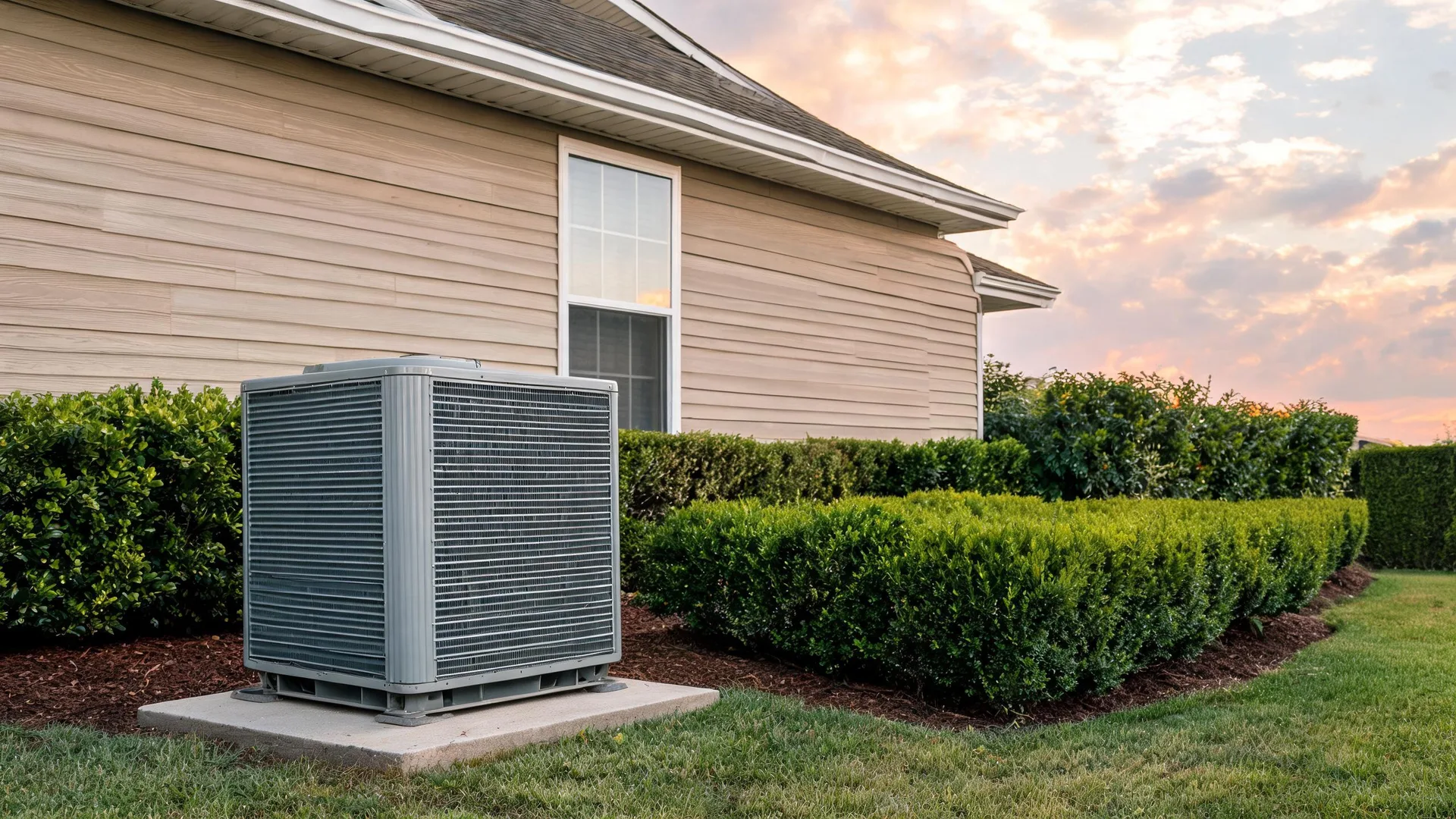
A gray residential air conditioning condenser unit mounted on a concrete pad outdoors, surrounded by green grass under a partly cloudy blue sky.

Size it to the house, not the catalog

Ask for a load calculation before anyone quotes equipment. It measures what your house needs room by room, not just the square footage. In a house built in 1968 or earlier, that's what catches the gap between what your ducts can actually handle and whatever unit happens to be on the truck. Have the contractor walk you through the numbers before they name a size.

Ask what the warranty actually covers

Equipment warranties usually cover the compressor and major parts, but labor is often a separate, shorter warranty from the installer, not the manufacturer. Some manufacturer warranties also require registration after install, or they default to a shorter term if no one files the paperwork. Ask who pays for labor if a part fails down the road, not just whether the part is covered.

Ask how they're handling the refrigerant lines

If the existing line set is being reused, ask whether it was flushed and pressure tested, not just reconnected to the new unit. Old lines can carry contaminants or residual oil that doesn't match the new system, and a leak at a fitting doesn't show up on install day. It shows up as lost cooling later, once the charge has slowly bled out.

Aerial view of a gray central air conditioning condenser unit on a concrete pad next to a house with vinyl siding.

A higher-efficiency unit would save about $30 a year to run in Atchison County compared with a new unit at the federal minimum.

  • A higher-efficiency unit$260 a year
  • A new unit at the federal minimum, 13.4 SEER2$290 a year

Estimates for a typical Atchison County home, from EIA household energy data, Kansas fuel prices and NOAA climate normals. Your home will differ.

Install day starts with the old equipment coming out, not the new unit going in. The outdoor condenser gets disconnected and hauled off. The old coil comes out of the plenum above or beside the furnace, and the line set gets inspected to see what can be reused. Once the new coil is set and the condenser is placed on its pad, the work moves to the connections. That means brazing the refrigerant lines, pulling a vacuum to clear out moisture and air, then weighing in the refrigerant charge to the exact amount the system calls for. A contractor will also check the ductwork at this point, since a new system can expose a return that was always a little undersized. Last comes the startup. The system runs through a full cycle while the contractor checks the temperature split at the vents, confirming it's cooling the way it should before anyone leaves.