







Overhead view of a gray residential air conditioning condenser unit mounted on a concrete pad beside a house with asphalt shingle roofing.

AC Installation in Coffeyville, KS

Tell us about the job

Takes about a minute. No obligation.

New system or replacementCentral ACMontgomery County, KS
Step 1 of 2

What ZIP code is the job in?

Half the homes in Montgomery County were built in 1958 or earlier. A house that age was almost never designed around central air. The ductwork, if it's there at all, may have been added later and sized for a smaller system, or for no system. A new AC has to move a specific amount of air through what's already in the walls and the attic, and an old duct run can choke a unit that's sized right on paper. Whoever installs it should be looking at the house you actually have, not just the square footage.

5 months
May through September, your air conditioner is on duty
89°F
the average summer afternoon it cools against
67 hail events
in ten years, and hail bends the fins on outdoor coils
13.4 SEER2
the federal minimum any new unit must meet
Isometric line illustration of a cutaway single-story house showing interior rooms, ceiling ductwork and an air handler, connected to an outdoor condenser unit on a pad beside the building.
Your air conditioner works hardest from June through August.

NOAA nClimDiv, 1991–2020 normals

The size of the unit is not the only number that sets the price.

Ductwork, the condenser pad, the line set run and the electrical hookup all factor into the install itself.

Most of Coffeyville heats with gas, which keeps the AC install a separate, simpler decision

64.2% of homes heat with gas
Cooling runs May through September
Summer afternoons average 89°F
Coffeyville summers put in the hoursCooling runs May through September, with afternoon highs averaging 89°F in June, July and August.

Cooling here runs May through September, so April is the month to get a new system in. Replace it before that first stretch of warm weather and you pick the unit and the install date yourself. Wait for the old one to fail mid-season and you're taking whatever unit is in stock and whatever install date the contractor has open. Five months of steady run time is a lot to ask of a system on its first week in the ground. Going in during April gives it a quieter start before the real load hits.

A new system here has to clear a higher bar

Montgomery County sits in climate zone 4A, which asks real work of both heating and cooling. Any new split-system air conditioner under 45,000 Btu/h has to meet 13.4 SEER2 at minimum, if it was manufactured from 2023 on. That rules out older, less efficient units being sold as new. A federal tax credit is available on qualifying equipment, which is worth asking about when you're comparing systems.

Find a contractor
A man in a cap, dark jacket and tan work pants carries a worn duffel bag as he steps up onto a porch toward a red front door, with a potted shrub beside the entry.
A gray metal air conditioning condenser unit mounted on a concrete pad in a flat grassy field under a partly cloudy sky.

Let the house set the size, not the other way around

If your house is on the older side for this county, ask the contractor to walk the attic and look at the ducts before they quote a unit. A load calculation on an older house takes more than a square footage number. The duct run, the insulation, and how many return vents the house has all change what size condenser actually fits. A unit sized off square footage alone can end up too big, which means it short-cycles, or too small, which means it runs flat out all summer and still falls behind on the hottest days.

The rating is a seasonal average, not a hot-day score

SEER2 measures how much cooling a system delivers over a full season for the electricity it uses. It does not describe how the unit performs on the single worst afternoon of the year. A system with a strong rating is built to use power well across the whole stretch of warm months, not just to survive the peak.

The number only holds if the install backs it up

A high SEER2 rating assumes the refrigerant charge is correct and the airflow across the coil is what the equipment was built for. Ductwork that is too small or restrictive can pull real-world performance well below the number on the label. The rating describes the equipment tested on its own, not the equipment sitting in a particular house.

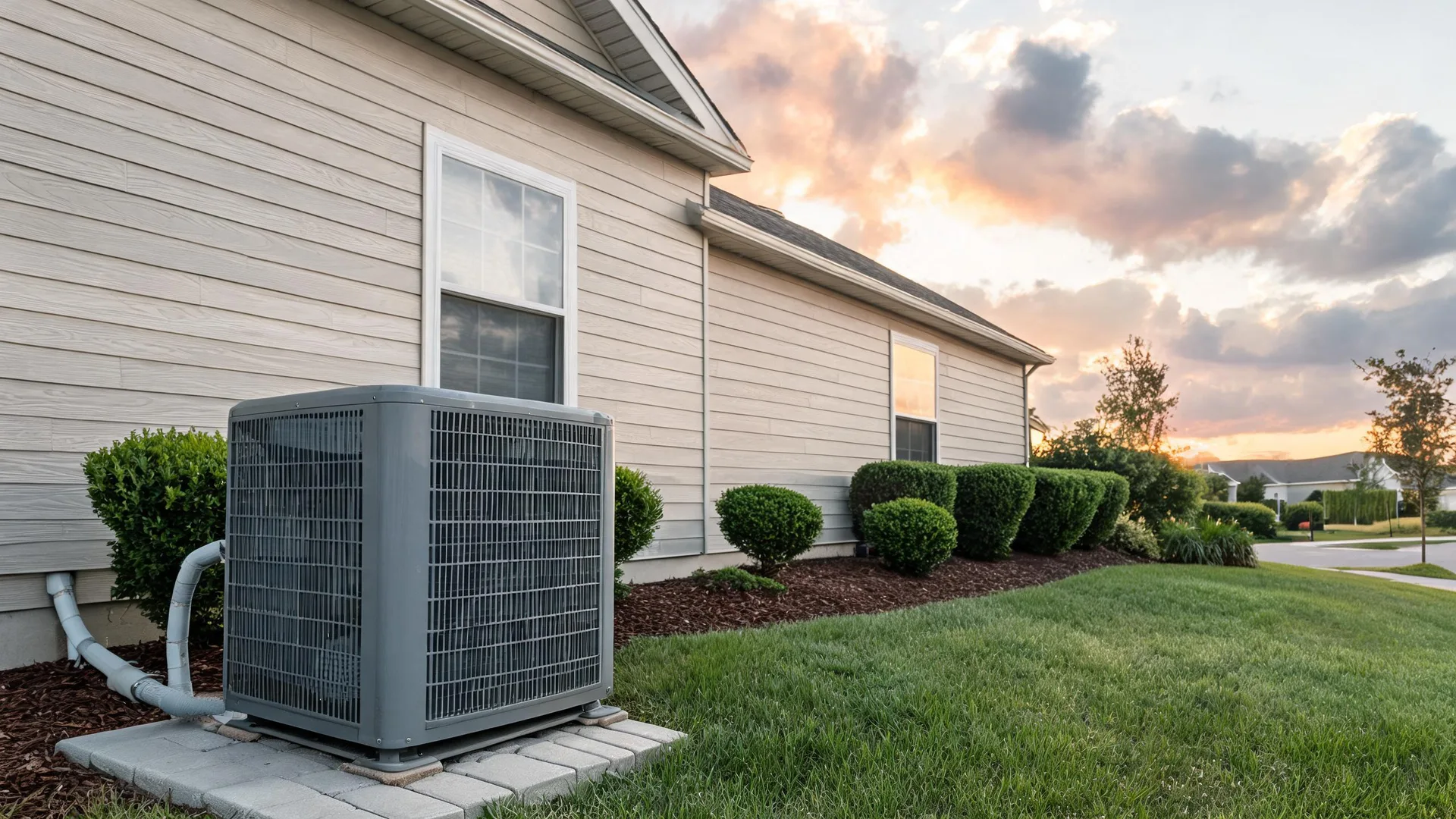
Overhead view of a gray outdoor AC condenser unit on a concrete pad beside a mulched garden bed and a house with vinyl siding.

A higher-efficiency unit would save about $40 a year to run in Montgomery County compared with a new unit at the federal minimum.

  • A higher-efficiency unit$340 a year
  • A new unit at the federal minimum, 13.4 SEER2$380 a year

Estimates for a typical Montgomery County home, from EIA household energy data, Kansas fuel prices and NOAA climate normals. Your home will differ.

Install day starts outside, with the old condenser disconnected and pulled off the pad. If the pad is cracked or has shifted, it gets reset or replaced before the new unit sits down on it. Inside, the coil gets swapped to match the new system, since an old coil paired with a new condenser is a mismatch. The line set gets checked too. Reusing it is sometimes fine, but if it's the wrong diameter for the new equipment, it has to be replaced rather than forced to work. Once everything is connected, the system gets charged with refrigerant to the exact weight the manufacturer specifies, then run through a check of airflow and pressures before anyone calls it done. Skipping that last check is how a new system ends up running worse than the one it replaced.