







A snow-covered residential street at twilight with illuminated houses, bare trees, and an orange horizon glow beneath a deep blue sky.

AC Repair in Arkansas City, KS

Tell us about the job

Takes about a minute. No obligation.

RepairCentral ACCowley County, KS
Step 1 of 2

What ZIP code is the job in?

Your AC runs about five months straight here, May through September, with afternoon highs averaging 89°F across the peak of summer. That kind of stretch doesn't let a system coast. The compressor and the fan motor are working near their limit most afternoons, not just on the hot days. Add in the wind and hail this area sees regularly, and outdoor units take a beating beyond normal wear. If yours is short cycling, blowing warm, or making noise it didn't used to, that's the kind of load talking. A proper diagnosis will tell you whether it's a straightforward repair or a sign the unit is closer to the end.

5 months
May through September, your air conditioner is on duty
89°F
the average summer afternoon it cools against
125 hail events
in ten years, and hail bends the fins on outdoor coils
123 wind events
in ten years, and wind drives debris into outdoor units
Isometric cutaway illustration of a house interior showing ducted HVAC piping, an indoor air handler unit, and an outdoor condenser with fan connected by a line, rendered in grey tones on a white background.
Your air conditioner works hardest from June through August.

NOAA nClimDiv, 1991–2020 normals

Half the homes in Cowley County were built in 1961 or earlier.

An AC that came with a house that old is likely old itself, and worth asking about before you pay for a repair.

Cowley County sees this kind of weather most years, and outdoor units take the hit

275 severe weather events from 2015 to 2024
19% of homes statewide lost power a day or more in 2024
123 damaging wind events from 2015 to 2024
Running costs add up hereKansas electricity ran 14.15 cents per kilowatthour in 2024, and a struggling AC burns more of it

A system that's struggling doesn't fix itself by staying on. If the charge is low, the compressor still runs, just harder, and it carries heat that should be going into the coil. A failing capacitor works the same way. The motor keeps trying to start against it, drawing more current each time, until it trips the breaker or burns out for good. A dirty coil makes the compressor push against higher pressure on every cycle, not just the hot ones. None of these get better with time on. They get worse, and they tend to take other parts down with them.

Find out what's actually wrong before you pay to fix it

Get the diagnosis before you decide anything. With this much summer load behind it, a repair that looks small on one visit can be a symptom of a part close to giving out. A technician can tell you which one you're dealing with.

Find a contractor
A man in a gray long-sleeve shirt, olive pants, cap and boots walks up porch steps toward a red front door, carrying a canvas tool bag beside a potted plant in a terracotta pot.
An outdoor air conditioning condenser unit mounted on a concrete pad surrounded by gravel, photographed against a partly cloudy blue sky.

Ask how old the unit is, not just what's wrong with it

If your AC came with the house, and the house goes back to 1961 or earlier, ask the technician how old the unit itself is when they come out. A unit that's been running that long has already been through years of Arkansas City summers. Get the age and the diagnosis together before you decide whether to repair it.

What you can check yourself

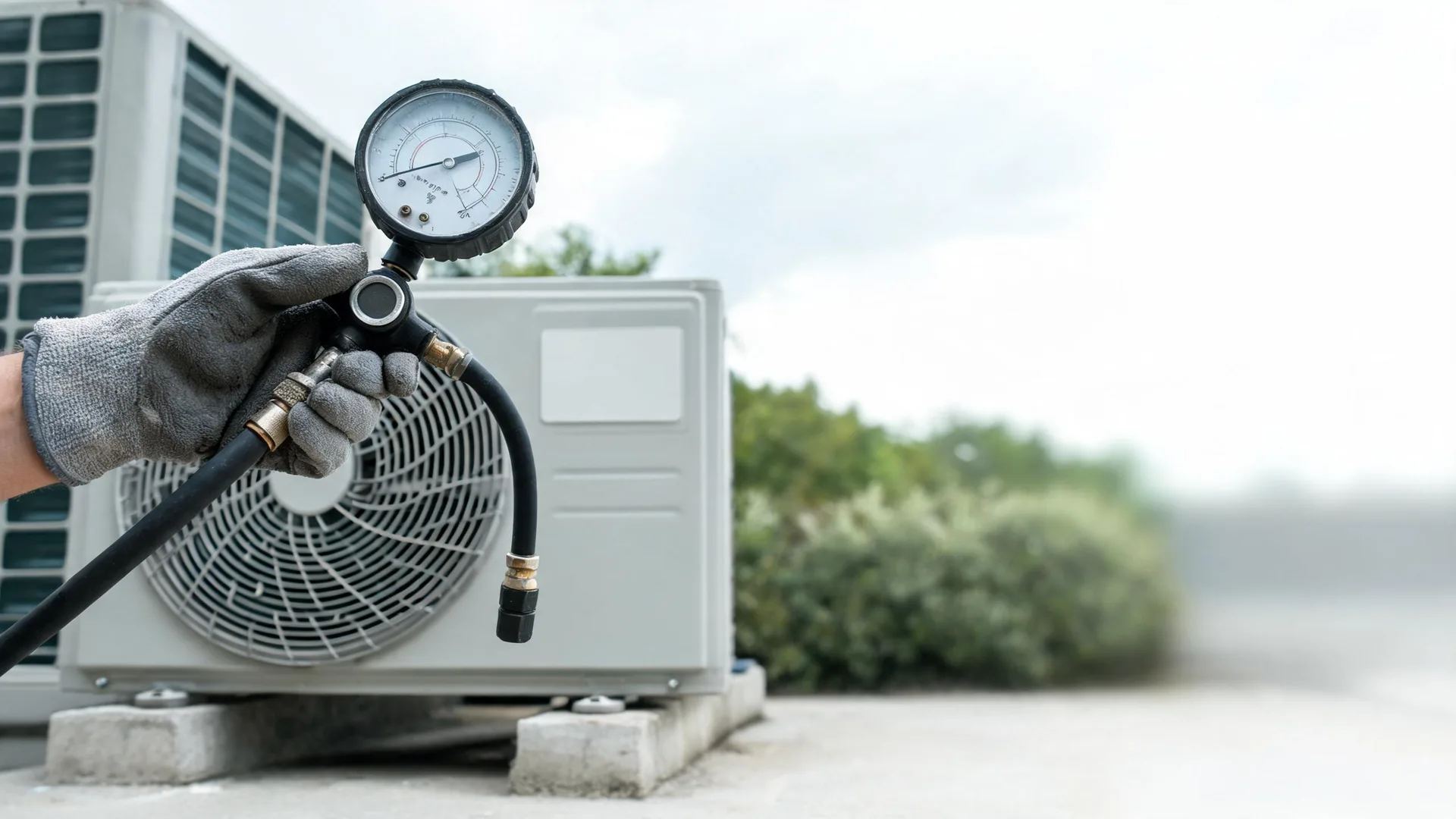
Look at the outdoor unit. If the fan isn't spinning but you hear a hum, that's usually the capacitor or the motor, not something to force or poke at. Check the air filter. A filter clogged with dust chokes airflow across the coil and can ice it up. Check the thermostat batteries and make sure it's set to cool, below room temperature. Look at the breaker panel for anything tripped. Outside, clear leaves or grass clippings away from the unit so air can move through the coil.

What to leave alone

Don't open the electrical panel on the condenser or touch anything inside it. The capacitor in there holds a charge even with the power off. If you see ice on the coil or lines, turn the system off and let it thaw instead of chipping at it. Running a unit that's icing up or tripping the breaker over and over just adds strain to parts that are already failing. Once you've checked the simple things, what's left is a job for someone with gauges and meters.

Overhead view of an outdoor AC condenser unit on a concrete pad next to a house with a dark shingle roof.

A new air conditioner would cut about $30 a year off cooling for a typical Cowley County home.

  • A new one at the federal minimum, 13.4 SEER2$370 a year
  • An older air conditioner$400 a year

Estimates for a typical Cowley County home, compared with an older unit built to the previous federal minimum, from EIA household energy data, Kansas fuel prices and NOAA climate normals. Your home will differ.

Repair makes sense when a part like a capacitor or contactor has failed.

Replacement makes sense when the compressor has failed or the system uses R-22 refrigerant, which is no longer made.

A repair makes sense when the rest of the system is sound and the failure is one part doing what parts eventually do. A capacitor weakens over years of starting the compressor and fan, and replacing it brings the unit back to normal. Replacement starts to make more sense when the compressor itself is the problem, since that's the most expensive part to replace and the one most likely to make a technician recommend a new unit instead. It also matters how many things are going wrong at once. One failed part is a repair. A unit that keeps needing something different every year is telling you it's wearing out everywhere at the same time, not just in the one spot that happened to fail first. Age and refrigerant type matter too, since an older system built for a phased-out refrigerant gets more expensive to keep running every time it needs a recharge.