









Profile view of a bearded man wearing a dark baseball cap and a navy blue t-shirt against a plain light gray background.

Repair or replace an aging AC unit in Kansas

New system or replacementCentral ACKansas
Step 1 of 2

What ZIP code is the job in?

Whether to repair or replace an aging AC unit comes down to its age and what the repair costs against a new system. Past ten to twelve years, a central air conditioner is working harder than it should to keep up with a Kansas summer, and parts failures start stacking up instead of showing up one at a time. A compressor or a coil going out on a unit that old usually costs enough to repair that putting the money toward a new system makes more sense, since the old one is still going to be twelve years old afterward. A unit still under ten years with one failed part is a different case, and a repair is usually the right call there. If your system is cycling more than it used to, running up your power bill, or struggling to keep the house comfortable on the hot, sticky days, that is the wear showing. Replacing it now, before a breakdown forces the decision in the middle of a heat wave, means you pick the time.

A woman in a cream knit sweater sits with eyes closed in a light upholstered armchair beside a window showing autumn foliage, with a ceramic mug on a side table and a lit lamp and shelves in the background.
An older man with gray hair and a beard, wearing a dark blue fleece zip jacket, leans back in an upholstered chair with his eyes closed in sunlight near large windows, with a potted green plant and bare trees behind him.

Your central air conditioner runs as a pair, a compressor outside and an evaporator coil inside, built to work together. When the unit is old and one side quits, the other side's match may not exist anymore, since manufacturers move on to new parts. That is one reason age changes the math on a repair. Refrigerant adds another wrinkle. R-22 is phased out, so a leak in an older system can turn into a refrigerant bill bigger than the part that failed. None of this means every repair is a lost cause. A bad capacitor or contactor is cheap and quick to replace, and that fix buys time no matter how old the unit is. It is the bigger failures, a dead compressor or a cracked coil, that usually bring a tech to suggest replacing the system instead of chasing the repair. A Kansas summer raises the stakes on all of this. When a system struggles, it runs longer trying to wring the humidity out of the air, and that extra runtime wears down parts that were already on their way out.

How an aging AC actually fails

  • A central air conditioner has a compressor outside and an evaporator coil inside, and those two parts are matched to work together.
  • When one side of that pair fails on an older unit, the manufacturer often no longer makes a match for the part still working.
  • R-22 refrigerant has been phased out, so a leak in an older system can mean a repair bill for refrigerant that costs more than the part itself.
  • A capacitor or a contactor is a cheap, quick fix no matter the age of the unit, and replacing one buys more time.
  • A compressor or a coil failure on a unit past ten years is the point where a tech usually brings up replacement instead.
  • Humidity in a Kansas summer means a struggling system runs longer to pull moisture out of the air, which adds wear on top of the heat.
An outdoor air conditioner condenser unit on a concrete pad beside a house with light horizontal lap siding, with an electrical disconnect box and conduit on the wall behind it.
Before you get your air conditioner installation
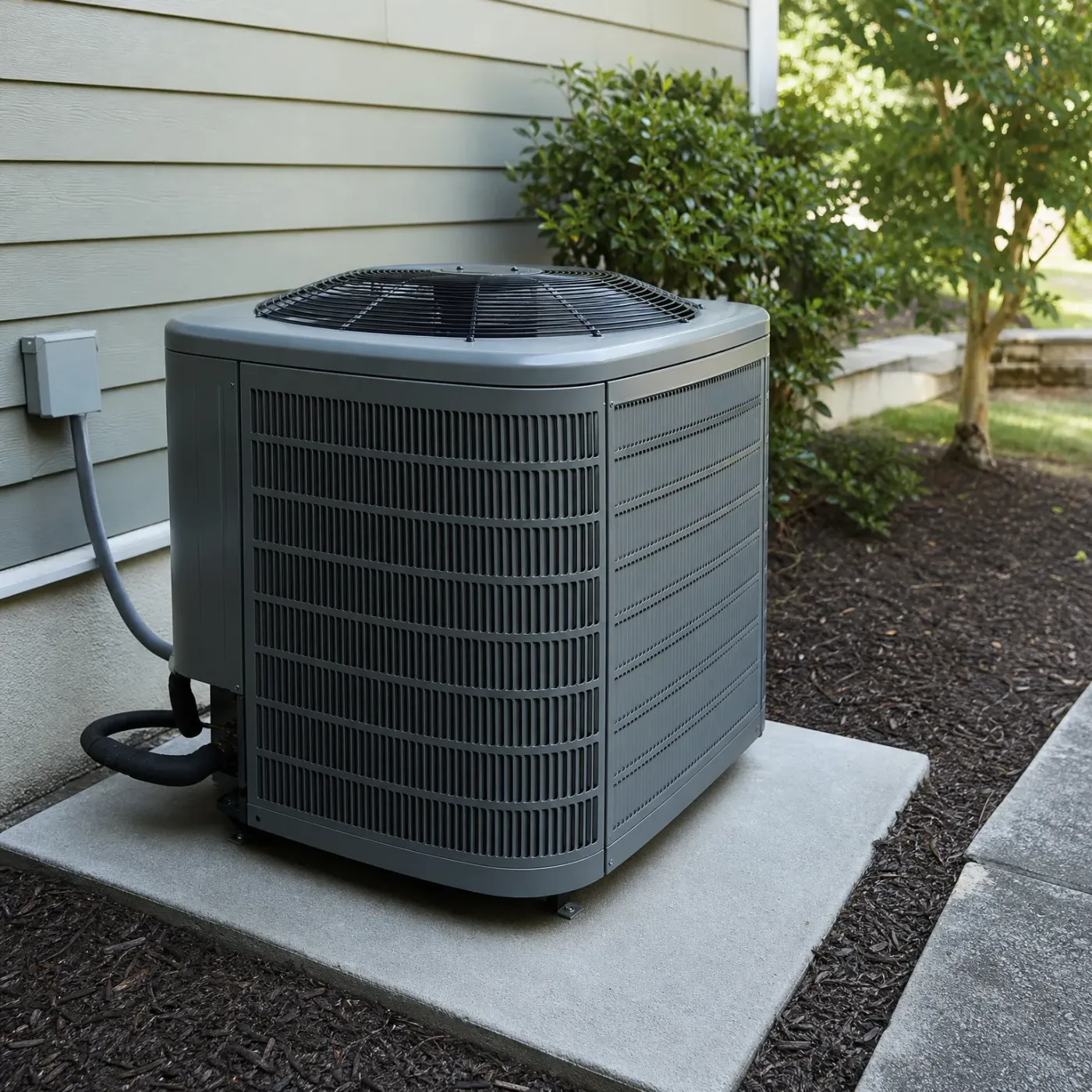
An outdoor air conditioning condenser unit on a concrete pad beside a house with white horizontal lap siding, with an electrical disconnect box and insulated refrigerant line on the wall and a shrub over mulch to the right.
After you get your air conditioner installation

What a SEER2 upgrade changes

A central air conditioner installed today carries a SEER2 rating well above what a unit from ten or twelve years ago was built to. SEER2 measures how efficiently the system turns electricity into cooling, not how much cooling it can produce. A higher-rated system does the same job in your house on less power, which matters most in July and August when the compressor is running for hours at a stretch. Power in Kansas isn't unusually cheap or expensive, so the difference shows up the same way it would anywhere: a lower number on the bill in the months the system works hardest, not a change in how cold the house gets.

Why refrigerant type matters now

Older air conditioners were built to run on a refrigerant that is being phased out, and it costs more each year as supply drops. If your outdoor unit still uses it, a refrigerant leak on an aging system can turn into an expensive repair just from the refrigerant itself, on top of the labor to find and fix the leak. A new installation runs on the current refrigerant, which doesn't carry that same shortage. That's a separate question from whether the compressor and coil still match each other, but it points the same direction: the older the unit, the more a routine repair can cost for reasons that have nothing to do with the broken part.

Power costs 14.44 cents per kilowatt-hour statewide

At 14.44 cents a kilowatt-hour, every inefficient hour your old unit runs shows up on the bill. A compressor that's lost its matched coil pulls more power to hold the same temperature, and in a Kansas summer that's months of paying extra for less cooling.

EIA-861 2025 statewide residential average

What an aging unit costs you at home

  • A compressor running on borrowed refrigerant parts can trip its own safety switch on a 95 degree afternoon and shut the house down.
  • An AC that cycles longer to hold 75 degrees pulls more humidity out of the air only when it's running, so a weak unit leaves the house feeling damp.
  • A breakdown in late July means days on a waitlist behind every other failed system in the same heat wave.
  • Replacing before the old unit fails lets you pick the install date instead of scrambling for emergency service.
  • A unit that short-cycles or struggles to cool every room evenly is already costing you comfort, not just money.
  • Once a compressor or coil fails outright, you lose air conditioning entirely until a new system goes in.

A unit held together with mismatched parts doesn't fail quietly. It fails on the afternoon it's working hardest, which in Kansas means the stickiest, hottest stretch of July or August, when a compressor straining against the wrong coil trips its own safety switch and shuts the whole system down. Until then, it's already showing you smaller signs. Long run times that still leave rooms uneven, one side of the house cooler than the other. A house that feels damp even with the thermostat holding steady, because a struggling unit only pulls moisture out of the air while it's actually running, and a weak compressor runs less effectively than it used to. None of that shows up as a single bad day. It shows up as a summer that never quite feels comfortable, and a bill that climbs while comfort drops.

The timing of a full failure matters as much as the failure itself. When a compressor or coil goes out completely during a heat wave, every other homeowner with a failed system that week is calling the same contractors, and a repair that would normally take a day or two can mean days without air conditioning while you wait in line. Replacing ahead of that, while the old system is still running, means you choose when the work happens instead of being forced into it on the worst possible week. That's the real difference between planning a season ahead and reacting to one.

A woman with long gray hair in a dark green sweater sits on a cushioned window seat with textured pillows and a knit blanket, looking out a window toward trees with yellow and orange foliage.
A gray-haired woman in a cream sweater sits under a blanket in a living room, looking out a window toward sunlit yellow foliage, with a lamp, framed landscape painting, bookshelf and potted plant behind her.
A gray-haired woman in a gray knit sweater sits in an armchair by a window with autumn foliage outside, in a room with a wooden dresser, framed picture, and a potted plant.
A gray-haired woman in a cream turtleneck sweater sits in an armchair by a window, looking out toward yellow and orange autumn foliage, with a lamp, bookshelf and side table in the dim room behind her.

A pro who works on air conditioners

One installer gets your project, so there's no bidding war over it.

There's no charge for the request.

A gray outdoor air conditioner condenser unit on a concrete pad beside a house with white horizontal siding and a brick foundation, with a wall-mounted disconnect box and conduit, and a green shrub with mulch at left.

Working the way it should

This unit sits clean on its pad, lines and conduit running straight to the disconnect. Nothing is caked on the grille, nothing is straining. A compressor in this shape holds its charge and cycles the way it was designed to on a 95 degree day.


An outdoor air conditioning condenser unit on a concrete pad beside a house with white horizontal vinyl siding, with a gray electrical disconnect box and refrigerant lines on the wall behind it.

Grime is a symptom, not just dirt

Dirt built up like this on the cover and grille means the condenser has been starving for airflow for a while. The compressor behind that grille works harder to push heat out through a coil that's half-blocked, and that strain adds up over a Kansas summer.

How do I know if my AC's compressor is actually failing?

You hear the outside unit humming but the air coming out of your vents isn't as cold as it should be, or the compressor clicks and shuts off after a few minutes instead of running a full cycle. You want to know if that's the compressor itself before you pay for a repair visit, since replacing one on an older unit often isn't worth it anyway.

Hard starts, short cycling, and warm air from a running unit point to the compressor

A failing compressor usually shows itself in how the unit starts and runs, not in one obvious breakdown. It may hum for a few seconds without kicking on, trip its breaker repeatedly, or shut itself off partway through a cycle because it's drawing more current than it should. Air coming from the vents stays warm even though the outdoor fan is spinning, because the compressor isn't moving refrigerant the way it needs to. On a 95 degree Kansas afternoon, a struggling compressor often can't keep the house below the low 80s no matter how long it runs. A contractor can confirm it with a gauge reading, but these are the signs that tell you something is wrong before that visit.

A two-story house with light horizontal siding, a gabled roof and a white front door, set on a grassy lawn between two leafy trees, with a wet street and sidewalk in the foreground under low sunlight.

A summer dew point of 64°F is what makes Kansas air feel heavy even when the thermometer doesn't look that bad. That's a lot of moisture for your air conditioner to pull out of the house on top of cooling it. An aging compressor that's already struggling to hold its charge has to run longer cycles to get that moisture out, and if it can't keep up, you'll feel it as a clammy house even when the temperature on the thermostat looks fine. A unit working the way it should handles both jobs without stretching the cycle out. (Source: regional climate normals)

NASA POWER T2MDEW county cells weighted by homes

Fix It Now or Replace It

Repair

  • A repair makes sense when the unit is under ten years old and the failed part still has a manufacturer match to work with.
  • You pay once for the fix and the system runs the rest of this summer without the cost of a full installation.
  • A single failed capacitor or contactor is a straightforward swap that doesn't touch the compressor or the coil.
  • If the compressor and coil are still the original matched pair, a repair restores the system to the efficiency it had before.
  • Repair buys you time if you'd rather plan a replacement for next spring than face it in the middle of a 95 degree week.

Replace

  • Past ten to twelve years, the part that failed may no longer have a match made for it, which turns a repair into a workaround.
  • A new system carries a SEER2 rating built for how Kansas summers run today, not for the grid or the house as it was a decade ago.
  • Replacement stops the cycle of paying for a patched compressor that still pulls more power than it should on a humid afternoon.
  • You get one appointment instead of a string of repair calls as more original parts wear out together.
  • A new coil and compressor installed as a matched pair hold their charge and cycle the way the system was designed to.
A gray outdoor air conditioner condenser unit on a concrete pad beside a house with horizontal siding and a stucco foundation, with a disconnect box and conduit on the wall, decorative gravel, mulch, and a shrub nearby.

Running clean

This condenser sits on its pad with clear gravel around it, lines running straight to the disconnect box. Nothing blocks the coil, so it pulls air through freely and sheds the heat it needs to. A unit kept this way holds its charge and cycles the way it's built to, even on a 95 degree day.

An outdoor air conditioning condenser unit on a concrete pad beside a house with horizontal lap siding, with an electrical disconnect box and conduit on the wall, mulch and a green shrub to the right, and a concrete walkway in the foreground.

Choked with debris

Dirt and grass clippings have packed into this coil grille, and the fins underneath can't shed heat like they should. The compressor behind that buildup works harder to hit the same temperature, pulling more power to do less cooling. Left alone through a Kansas summer, that strain is what pushes an aging compressor toward failure.

A man in a blue sweatshirt and cap carries a red and black tool bag up a paved walkway toward a house entrance where another man in a tan sweater stands in the open doorway, with stone-clad columns, wall lights, and potted mums nearby.

Repair it or replace it, you now know which one fits

If your unit is under ten years old and the part that failed still has a match, fixing it is the right call. If it's past that and the compressor or coil is the problem, you're looking at replacement, and planning that now means you're not stuck making the decision on a 95 degree day with no air in the house. Either way, the next step is the same: getting someone who works on these systems to look at yours and tell you straight what it needs.

A contractor licensed to work in Kansas and familiar with what fails on units your AC's age can look at your specific situation and give you a real answer instead of a guess. You'll be matched with one contractor, not a handful calling you at once, and that contractor reaches out to you directly. Whether that call ends in a repair this week or a plan for a new system before next summer, you'll know where you stand instead of waiting to find out the hard way.

A living room corner with a beige sofa and cushion, a round wooden coffee table holding a pale ceramic vase of eucalyptus stems and a wooden bowl, and a curtained window with a potted plant above a latticed radiator cover in the background.
A gray outdoor air conditioner condenser unit on a concrete pad beside a house with horizontal lap siding, with refrigerant lines, an electrical disconnect box on the wall, shrubs and mulch nearby.

Get your air conditioner to the right pro

Find a licensed air conditioner pro

Your request stays with one local pro.

You only hire the pro if you want to.