Five months of real work
AC in Chanute runs from May through September. Afternoon highs average 88 degrees in June, July and August. That's a normal summer for a Chanute air conditioner, not an extreme one.
Takes about a minute. No obligation.
AC in Chanute runs from May through September. Afternoon highs average 88 degrees in June, July and August. That's a normal summer for a Chanute air conditioner, not an extreme one.
A system that breaks down after a summer like that is usually failing for a reason a contractor has seen many times before. A weak capacitor. A dirty coil. A low charge. Finding which one it is gets the unit fixed instead of just patched.
NOAA nClimDiv, 1991–2020 normals
Chanute AC starts its work in May.
A capacitor that barely got through last September is the first thing to give out when May puts a full load on it again.




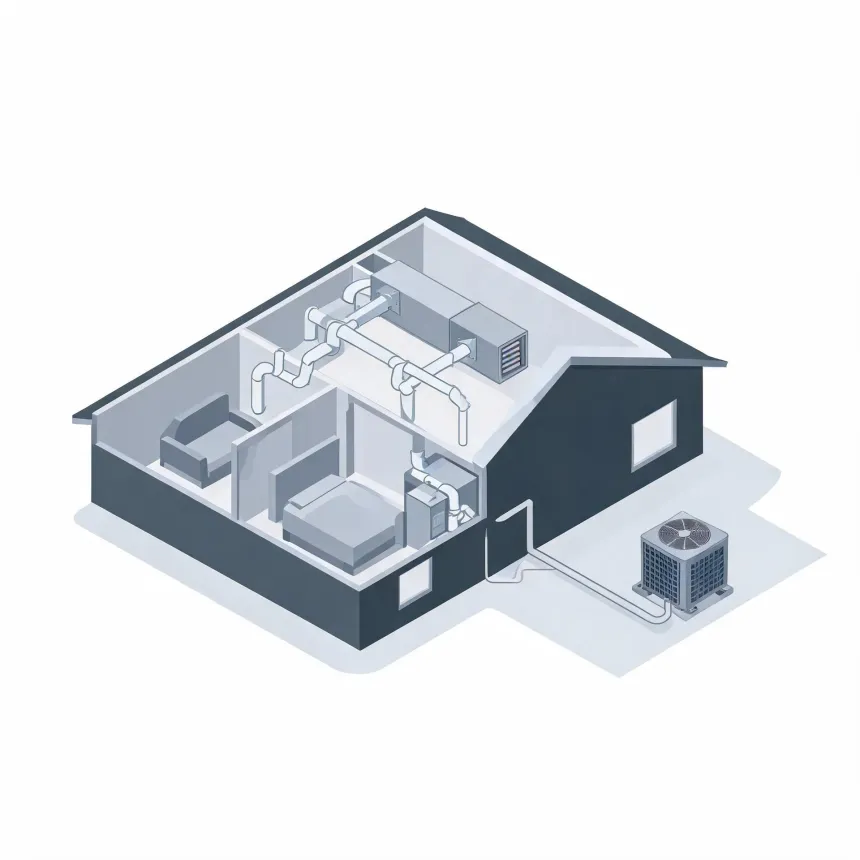
Half the homes in Neosho County were built in 1963 or earlier. If your AC came with a house that old, the unit itself may be getting up there too, even though it doesn't have to match the house's age. An older air conditioner has had more summers to wear down the same parts that cause the usual problems. Before you commit to a repair, it's worth asking how much life the unit has left in it.
A repair is only worth it if the unit has enough life left to be worth repairing. Ask the contractor straight out, before any work starts, how many years they'd expect to get out of this one.
Find a contractorA failing capacitor doesn't just stop working one day. It struggles for a while first, and every hour the compressor runs on a weak start, the motor windings take more heat than they're built for. A coil caked with dirt makes the whole system work harder to move the same amount of heat out of the house, so the compressor runs longer and hotter than it should. Run it long enough in that state and you're not looking at the same repair anymore. A capacitor job turns into a compressor job. That's why a strange noise or a unit that runs constantly without catching up is worth a call before the next hot stretch, not after.
The air from the vents feels wrong before anything shuts off. It runs warm, or weak, or the unit cycles on and off faster than it used to. Sometimes the sound changes first. A hum when the compressor tries to start and can't. A hiss that wasn't there last week. None of these mean the system is finished. They mean one specific part is failing, and it's worth naming before it takes something else down with it.
Warm air with the fan still running usually points to the refrigerant side, a low charge or a compressor losing its ability to keep up. Short cycling often traces back to a capacitor that can't hold the start long enough. Ice on the line or the indoor coil means airflow is restricted somewhere, often the filter or a blower that's lost its strength. Each of these is a different repair. What you notice at the vent tells a contractor where to look first.
Estimates for a typical Neosho County home, compared with an older unit built to the previous federal minimum, from EIA household energy data, Kansas fuel prices and NOAA climate normals. Your home will differ.
Repair makes sense when a part like a capacitor or contactor has failed.
Replacement makes sense when the compressor has failed or the system uses R-22 refrigerant, which is no longer made.
Repair or replace comes down to what's actually wrong and what else is close behind it. A capacitor or a contactor is a small, contained fix, the kind of part that fails on its own without taking the rest of the system down with it. A compressor is a different conversation, because the compressor is most of what the unit is worth, and a failing one often means the refrigerant system around it has been under strain for a while. Age matters less than what's already been replaced. A unit that's needed a string of unrelated repairs over a couple of years is telling you something a single breakdown doesn't. If a contractor finds one worn part in an otherwise sound system, fixing it is usually the right call. If they're finding the second or third thing wrong this year, that's worth weighing against putting the money into a new system instead.