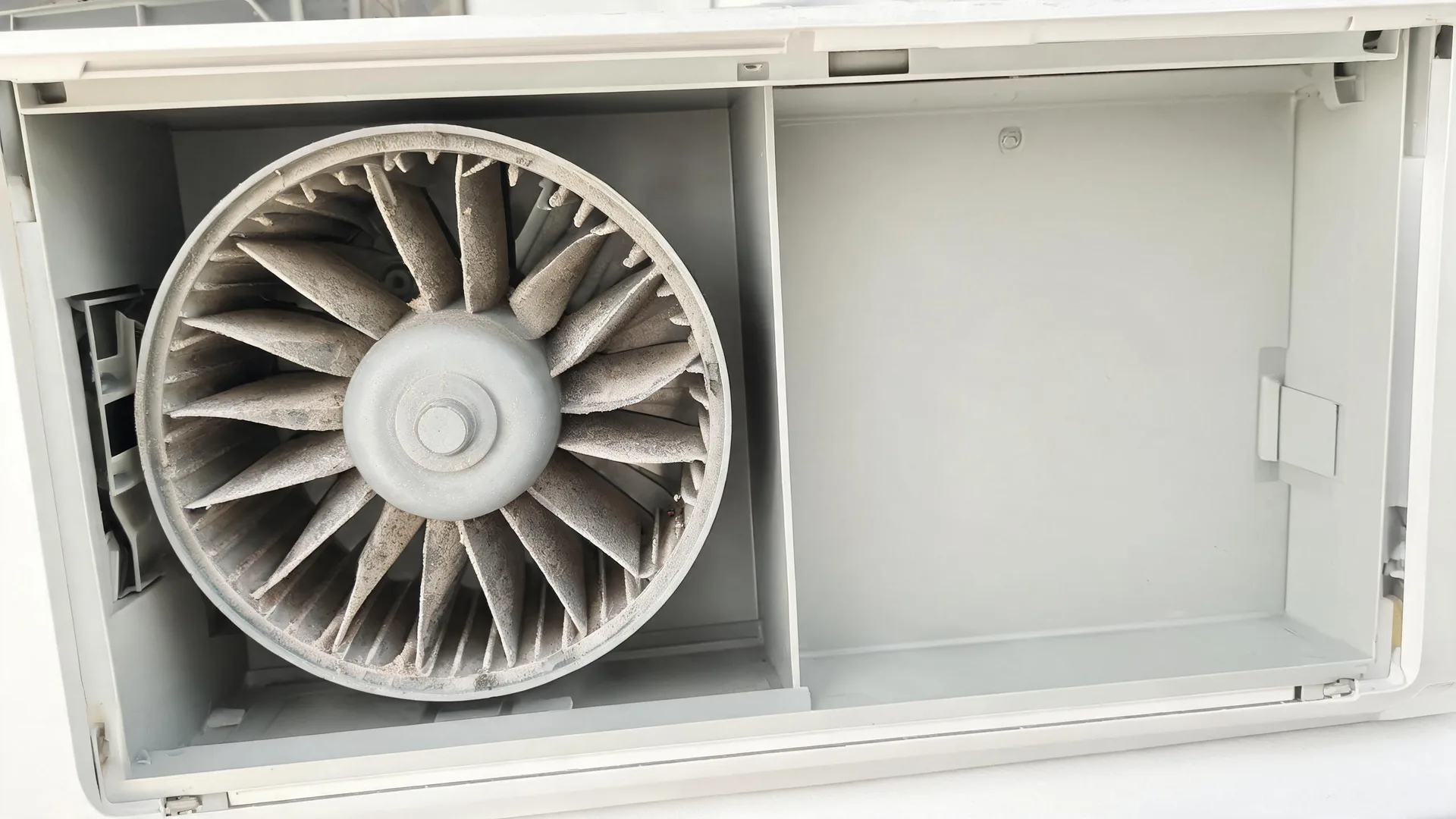
Hail and wind are common here
Cloud County recorded 75 damaging wind events and 53 hail events between 2015 and 2024, along with 6 tornadoes. An outdoor AC unit sits outside through all of it, exposed to whatever comes through.
Takes about a minute. No obligation.
Cloud County recorded 75 damaging wind events and 53 hail events between 2015 and 2024, along with 6 tornadoes. An outdoor AC unit sits outside through all of it, exposed to whatever comes through.
Bent fins or a cracked fan blade do not always stop the system right away. A unit that still cools after a storm can be running on damage that gets worse with time.

NOAA nClimDiv, 1991–2020 normals
Half the homes in Cloud County were built in 1953 or earlier.
An AC repair on a system that old is worth checking against how much life the unit has left.



Before any repair gets started, ask the contractor for the unit's age. The data plate inside the cabinet will show it, and a tech who's already in there can read it in a minute. If the system is old, ask what's left in it rather than just what the repair costs today. A compressor or coil near the end of its life can end up costing more in patches than a replacement would. That's worth knowing before the work starts, not after the bill comes.
If a storm has come through recently, get the outdoor unit looked at even if it's still cooling the house fine. A tech can check the fins, the fan blade and the coil for damage that won't show up as a problem until it gets worse.
Find a contractor
A system that short cycles, turning on and off every few minutes instead of running a full cooling cycle, wears out its compressor faster than one left to run normally. Short cycling also means the air inside never gets down to the temperature on the thermostat, so the house stays muggy even while the unit keeps kicking on. A warm air coming from the vents points at a few different things: a refrigerant leak, a failing compressor, or a condenser coil so caked with dirt it can't dump heat outside. None of those get better by waiting. Ice on the indoor coil is another one people wait out, thinking it'll melt and solve itself. It usually means airflow is restricted, often from a dirty filter, and running the system iced over just adds strain on top of the original problem. A unit that's noisy in a new way, grinding, squealing, a hard clank on startup, is telling you a motor bearing or a fan blade is on its way out. The sound almost always shows up before the failure does, which is the point where a repair is still a repair and not a replacement.
A dirty filter is the most common reason a system struggles, and it's the easiest thing to rule out. Pull it and hold it up to a light. If you can't see through it, air can't get through it either, and the system will run long and cool poorly no matter what else is right with it. A clean filter costs nothing to check and rules out the simplest cause before anyone comes out.
Before assuming the unit has failed, check that the outdoor disconnect is pushed in and the breaker hasn't tripped. Check that the thermostat has working batteries and is actually set to cool, below room temperature. These sound obvious, but a system that looks dead sometimes just lost power or got bumped to the wrong setting, and there's nothing to repair once that's fixed.
Estimates for a typical Cloud County home, compared with an older unit built to the previous federal minimum, from EIA household energy data, Kansas fuel prices and NOAA climate normals. Your home will differ.
Repair makes sense when a part like a capacitor or contactor has failed.
Replacement makes sense when the compressor has failed or the system uses R-22 refrigerant, which is no longer made.
A diagnostic starts outside at the condenser, checking the refrigerant pressure on both the high and low side and watching how the compressor and fan respond when the system calls for cooling. From there a tech checks the capacitor and contactor, since a weak capacitor can let the compressor struggle to start even when everything else is fine. Inside, they'll check the evaporator coil and the airflow across it, because low airflow shows up on the gauges and can look like a refrigerant problem even when it isn't. They'll also check the condensate drain, since a clogged line can trip a safety switch and shut the whole system down with no other symptom. Most of this gets done with the power on and the system running, so the tech can see the fault as it's actually happening rather than guess at it afterward.