An outdoor air conditioning condenser unit positioned on a concrete pad next to a blue-sided house, surrounded by green shrubs and flowering hydrangeas at sunset.

AC Repair in Garden City, KS

Tell us about the job

Takes about a minute. No obligation.

RepairCentral ACFinney County, KS
Step 1 of 2

What ZIP code is the job in?

Finney County sees its share of storms

Between 2015 and 2024, Finney County recorded 363 severe weather events. That includes 252 damaging wind events, 75 hail events, 15 tornadoes and 21 winter storms. Hail and wind are hard on an outdoor AC unit sitting out in the open.


Power doesn't always come right back

In 2024, 19% of Kansas households went at least a day without power at some point. An air conditioner can't do anything for a house during an outage like that, and a unit already weakened by storm damage is in worse shape to handle the next one.

4 months
June through September, your air conditioner is on duty
91°F
the average summer afternoon it cools against
75 hail events
in ten years, and hail bends the fins on outdoor coils
252 wind events
in ten years, and wind drives debris into outdoor units
Isometric grayscale illustration of a cutaway house showing interior rooms, ductwork, an indoor air handler, and an outdoor condenser unit on a pad connected by lines.
Your air conditioner works hardest from June through August.

NOAA nClimDiv, 1991–2020 normals

Four months of 91 degree afternoons ask a lot of an outdoor unit in Finney County.

When yours is struggling through that stretch, the cause is usually plain to find and worth fixing right.

June is when a weak system finally gives out

Cooling runs June through September
Summer afternoons average 91°F
252 damaging wind events from 2015 to 2024

An outdoor unit here takes a beating most of the country never sees. Wind has hit Finney County 252 times between 2015 and 2024, and hail another 75 times, and the unit sits outside through all of it with no cover but its own housing. A bent fin or a cracked line from an event like that doesn't always show up right away. It shows up weeks later as a system that runs long and cools poorly, and by then it looks like ordinary wear. Someone who knows what storm damage looks like from the inside can tell the two apart, and tell you whether the fix is simple or the unit is done.

Had storm damage this year? Get it checked before it fails

If your unit sat through hail or a bad wind this year, have it looked at even if it still cools fine. Damage like that doesn't always show up right away, and a unit already weakened is in worse shape for the next storm or the next outage.

Find a contractor
A man in a cap, dark shirt and tan cargo pants, seen from behind, climbs porch steps toward a red front door while carrying a worn canvas duffel bag, with a potted shrub in a red planter beside him.
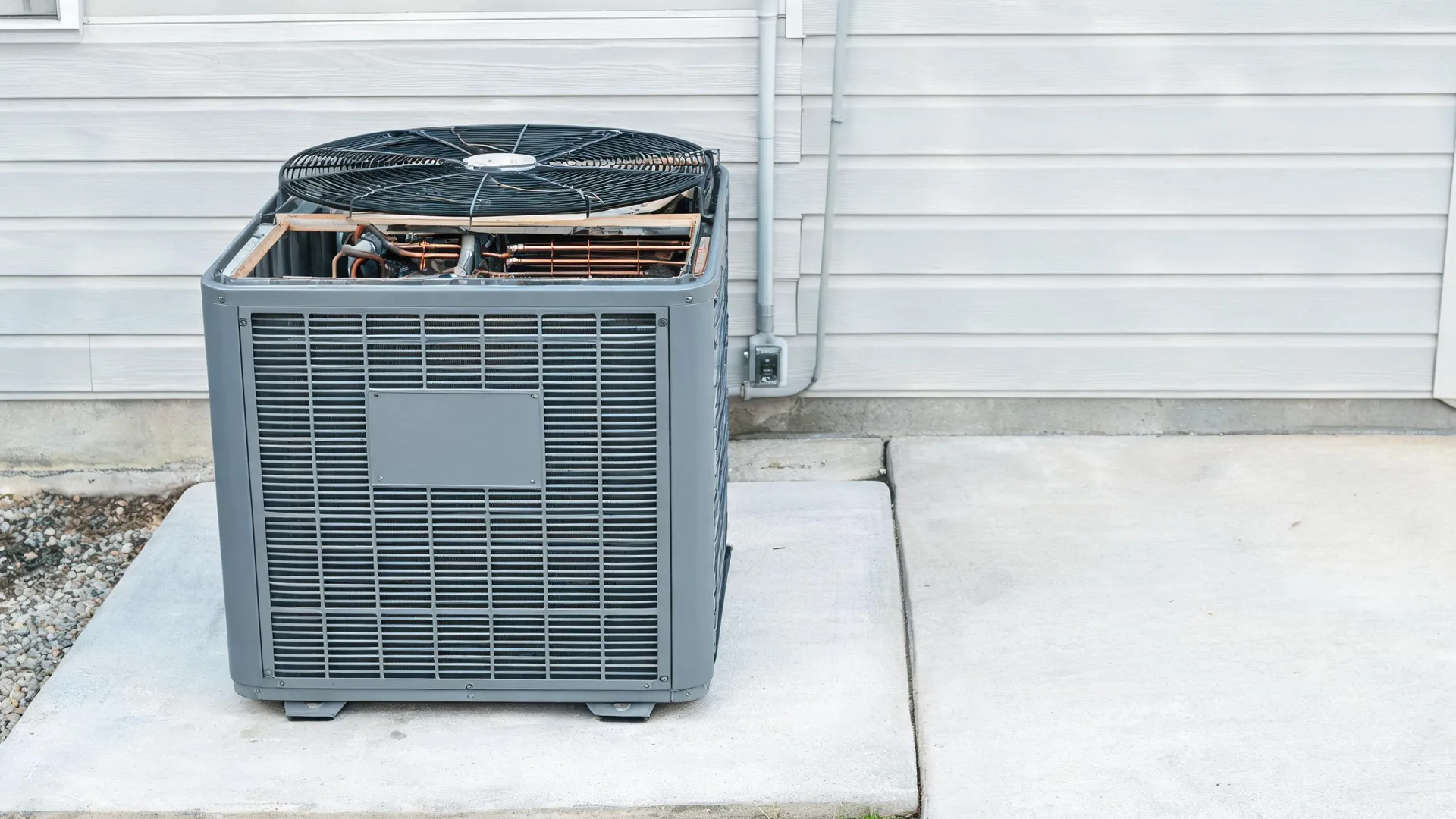
A gray cylindrical air conditioning condenser unit mounted on a concrete pad next to a light-colored vinyl-sided house exterior.

What the unit tells you before it fails

An air conditioner gives warning before it quits outright. It starts short cycling, running a few minutes and shutting off before the house cools down, because something is tripping the system early. Or it runs and runs without getting the house to temperature, which usually means the refrigerant charge is low or the airflow across the coil is blocked. Listen for it too. A hard clunk at startup can mean a failing capacitor. A squeal points to the blower motor or a belt. Warm air out of the vents with the system calling for cool means the compressor outside isn't doing its job, or isn't getting power to do it. Water pooling near the indoor unit means the condensate line is clogged and backing up. None of these mean the unit is finished. Most of them are a single part failing while the rest of the system is fine. The ones worth acting on fast are the ones that can spread: a refrigerant leak keeps starving the compressor until that fails too, and a motor straining on a bad bearing eventually seizes. Catching the sign early is usually what keeps the repair small.

A struggling compressor keeps drawing full power

When refrigerant is low or airflow across the coil is blocked, the compressor works harder to do the same job. It still pulls the same current while putting out less cooling. That strain heats the motor windings, and heat is what ends a compressor early.

A small electrical fault can take out a bigger part

A failing capacitor makes the compressor or fan motor start hard instead of smoothly. Run it that way long enough and the motor windings take the damage meant for the capacitor. What started as one cheap part becomes a motor replacement if it keeps running unfixed.

Overhead view of a gray residential air conditioning condenser unit mounted on a concrete pad beside a house with asphalt shingle roofing.

A new air conditioner would save little on running costs in Finney County, so the repair decision comes down to the unit's condition.

  • A new one at the federal minimum, 13.4 SEER2$310 a year
  • An older air conditioner$330 a year

Estimates for a typical Finney County home, compared with an older unit built to the previous federal minimum, from EIA household energy data, Kansas fuel prices and NOAA climate normals. Your home will differ.

Repair makes sense when a part like a capacitor or contactor has failed.

Replacement makes sense when the compressor has failed or the system uses R-22 refrigerant, which is no longer made.

Most of the time, repair is the right call. A capacitor, a contactor, a fan motor, these are single parts doing one job, and swapping a failed one brings the system back to full strength. What changes the answer is the compressor. It sits at the center of the system, and when it's failing, usually from years of strain or a refrigerant leak that went unfixed, there's no small part to replace. The compressor itself has to be swapped, and that cost gets close to a new system fast. So the real question isn't the repair in front of you, it's what else in the unit has been taking damage alongside it. A unit with a failed capacitor and nothing else wrong is worth fixing without a second thought. A unit on its second compressor, or one where the coil is corroded along with whatever just broke, is telling you the whole system is wearing out at once, not just the one part that happened to go first.