A black-painted two-story house with a steep gabled roof stands behind a wire fence and shrubs, framed by deciduous trees under an overcast sky, with a blurred green grass field in the foreground.

AC Repair in Hays, KS

Tell us about the job

Takes about a minute. No obligation.

RepairCentral ACEllis County, KS
Step 1 of 2

What ZIP code is the job in?

Hail and wind find the outdoor unit

Ellis County logged 141 hail events and 136 damaging wind events between 2015 and 2024, with 315 severe weather events total. That outdoor unit sits outside through all of it, with the coil and fan exposed to whatever comes down.


A unit that still runs can still be hurt

Bent fins or a dented cabinet from hail don't always stop an air conditioner from turning on. Damage like that can sit there working against the system for a long time before it causes a breakdown.

4 months
June through September, your air conditioner is on duty
90°F
the average summer afternoon it cools against
141 hail events
in ten years, and hail bends the fins on outdoor coils
136 wind events
in ten years, and wind drives debris into outdoor units
Isometric line illustration of a cutaway single-story house showing interior rooms, ducted air handler, ceiling ductwork, and an outdoor condenser unit connected by refrigerant lines.
Your air conditioner works hardest from June through August.

NOAA nClimDiv, 1991–2020 normals

Afternoon highs average 90°F through June, July and August in Ellis County.

Four months of that kind of heat wears down parts faster than a mild summer ever would.

June is when a weak part gives out

Cooling runs June through September
Summer afternoons average 90°F
136 damaging wind events from 2015 to 2024

Half the homes in Ellis County were built in 1973 or earlier. If your house is one of them, the air conditioner out there now may not be the original, but it has likely outlasted at least one owner. An old system doesn't always announce itself. It runs fine until a weak part finally gives out, usually the one that was already struggling before the heat set in. Before paying for a repair, ask the contractor how much life the system has left. A failed capacitor on a system near the end of its run is a different conversation than the same part failing on one that still has years ahead of it.

Have the outdoor unit checked, not just the problem you called about

If hail or wind came through before this unit started acting up, that's worth mentioning to the contractor. A dent in the cabinet or bent fins on the coil won't always stop a system from running, but they can be part of what's going wrong now. Have the outdoor unit looked over along with whatever repair it needs.

Find a contractor
An outdoor air conditioning condenser unit mounted on a concrete pad beside a house, with electrical conduit running to a wall-mounted disconnect box.

Every hour on this clip is an hour already on the meter

This clip runs a long stretch of hours to show one machine working through heat and dark alike. Hours like that add up differently depending on what's already been asked of the system. If the house came with it, ask the contractor for its age along with the diagnosis. That number, next to what the repair costs, is what tells you whether to fix it or start planning to replace it.

What you can check before you call

Make sure the thermostat is set to cool and the setting is actually below room temperature. Check the breaker box for a tripped breaker on both the indoor and outdoor unit circuits. Look at the outdoor unit and clear away any leaves, grass clippings or debris blocking the fins. Pull the air filter and hold it up to a light. If you can't see light through it, replace it. Check any drain pan or drain line you can see for standing water, since a clogged line can shut the system down on its own.

What to leave alone

Don't open the electrical panel on the outdoor unit or touch the wiring inside it. The capacitor in there holds a charge even after the power is off. Don't add refrigerant yourself or try to find a leak. Handling refrigerant without the right equipment is against the law for anyone who isn't licensed. If the outdoor fan isn't spinning or the unit is making a grinding or screeching noise, shut it off at the thermostat and the breaker and leave it alone until someone can look at it.

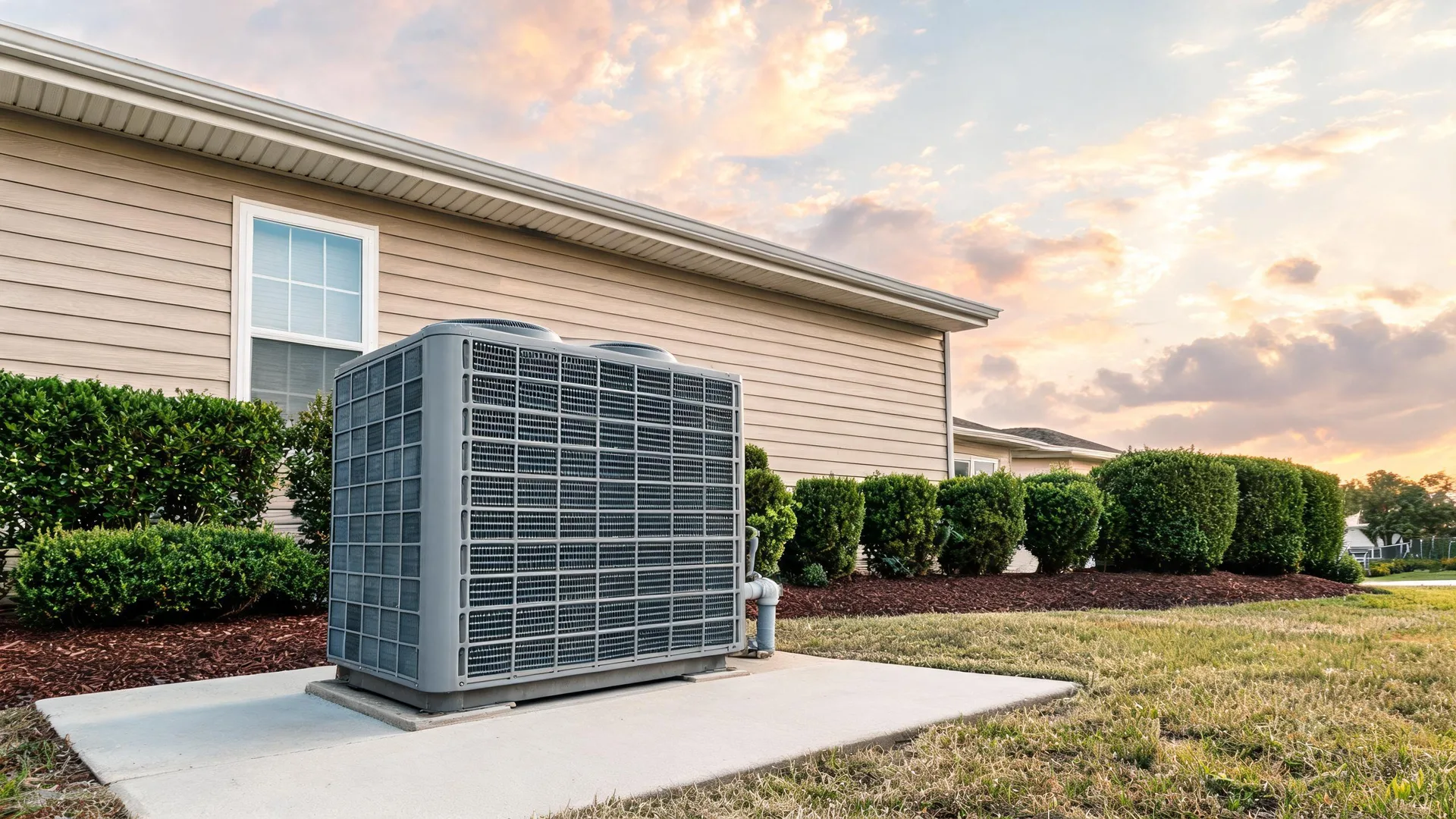
An outdoor air conditioning condenser unit installed beside the exterior wall of a blue vinyl-sided house at sunset.

A new air conditioner would cut about $30 a year off cooling for a typical Ellis County home.

  • A new one at the federal minimum, 13.4 SEER2$320 a year
  • An older air conditioner$350 a year

Estimates for a typical Ellis County home, compared with an older unit built to the previous federal minimum, from EIA household energy data, Kansas fuel prices and NOAA climate normals. Your home will differ.

Repair makes sense when a part like a capacitor or contactor has failed.

Replacement makes sense when the compressor has failed or the system uses R-22 refrigerant, which is no longer made.

A diagnostic visit starts before any panel comes off. The contractor asks what the system was doing, when it started, and what the thermostat shows now. Then they check pressures on the refrigerant lines, test the capacitor and contactor, and look at amp draw on the compressor and fan motor. They'll check the temperature of the air coming off the coil against the air going into it, since that spread says a lot about whether the system is actually cooling. Electrical connections get checked for corrosion or heat damage, since a loose connection can cause problems that look like something else entirely. By the end, the contractor should be able to point to the part that failed and explain why, not just that something is wrong.