






A two-story black-clad house with a covered porch stands in front of a dense line of deciduous trees, behind a wire fence, with a wide mown lawn in the foreground.

AC Repair in McPherson, KS

Tell us about the job

Takes about a minute. No obligation.

RepairCentral ACMcPherson County, KS
Step 1 of 2

What ZIP code is the job in?

McPherson County saw 221 severe weather events between 2015 and 2024. Most of that was wind and hail. Damaging wind hit 115 times, hail came through 90 times, and the county took one tornado in that stretch. An outdoor AC unit sits outside through all of it, with nothing but a thin metal case around the coil and fan. Hail dents the housing and bends the fins. Wind-blown debris does the same, or worse, if it gets into the fan blade. A unit can take a hit like that and still run, at least for a while, so it's worth having someone look it over after a bad storm even if the air coming out still feels cold.

5 months
May through September, your air conditioner is on duty
90°F
the average summer afternoon it cools against
90 hail events
in ten years, and hail bends the fins on outdoor coils
115 wind events
in ten years, and wind drives debris into outdoor units
Isometric grey illustration of a cutaway single-story house showing interior rooms, ceiling ductwork connected to an indoor air handler, and an outdoor condenser unit linked by lines outside the wall.
Your air conditioner works hardest from June through August.

NOAA nClimDiv, 1991–2020 normals

Summers here run from May through September, with afternoon highs averaging 90°F.

An AC unit put through five months like that every year wears parts down sooner than people expect.

Cooling starts in May, and that's when weak parts give out

Cooling runs May through September
Summer afternoons average 90°F
115 damaging wind events from 2015 to 2024

If a storm already dented the housing or put something into the fan, get it looked at before it fails outright. A technician can check the coil, the fan blade and the electrical connections for damage that isn't obvious from the yard. Catching a bent fin or a loose connection now costs less than waiting for the compressor to take the strain and quit in July. That's the month the call list gets long, so an inspection now also means a faster fix later if something does go wrong.

Had a storm come through? Get it checked before it quits.

If your unit has been through a storm, don't wait for it to stop working. Have the coil, fan blade and wiring checked now, while it's a quick visit instead of an emergency one.

Find a contractor
A man in a dark beanie, navy long-sleeve shirt and tan work pants climbs porch steps toward a red front door, carrying a waxed canvas tool bag in his right hand.
A gray residential air conditioner condenser unit mounted on a concrete pad in an open grass field.

A small problem left running becomes a big one

A failing part rarely stays the same size of problem if the unit keeps running. A capacitor that's gone weak makes the compressor pull harder to start each cycle, and that extra strain is what finishes it off. A refrigerant leak lets the system run low, and running low lets the compressor overheat, which is a far bigger repair than patching the leak would have been. A dirty coil makes the whole system work harder to move the same heat, and that extra load falls on the compressor every single cycle until something gives. Even a simple clogged filter chokes airflow across the coil, and the coil can ice over, and ice is what turns a filter change into a coil repair. The pattern is the same each time. A cheap part protects an expensive one, and once the cheap part is struggling, the expensive one is already absorbing the difference.

Check the filter first

Pull the filter and hold it up to a light. If you can't see light through it, it's choking airflow across the coil, and that alone can make the system blow warm or freeze the coil over. A clean filter is free to check and takes a minute.

Look before you call

Check the outdoor unit for anything blocking the fan or pressed against the coil fins, leaves, a fallen branch, a toy. Check the thermostat has fresh batteries if it uses them, and make sure the breaker for the outdoor unit hasn't tripped. None of this fixes a bad capacitor or a refrigerant leak, but it rules out the simple stuff before someone drives out for it.

Aerial view of a gray outdoor air conditioning condenser unit mounted on a concrete pad next to a house with vinyl siding.

A new air conditioner would save little on running costs in McPherson County, so the repair decision comes down to the unit's condition.

  • A new one at the federal minimum, 13.4 SEER2$360 a year
  • An older air conditioner$380 a year

Estimates for a typical McPherson County home, compared with an older unit built to the previous federal minimum, from EIA household energy data, Kansas fuel prices and NOAA climate normals. Your home will differ.

Repair makes sense when a part like a capacitor or contactor has failed.

Replacement makes sense when the compressor has failed or the system uses R-22 refrigerant, which is no longer made.

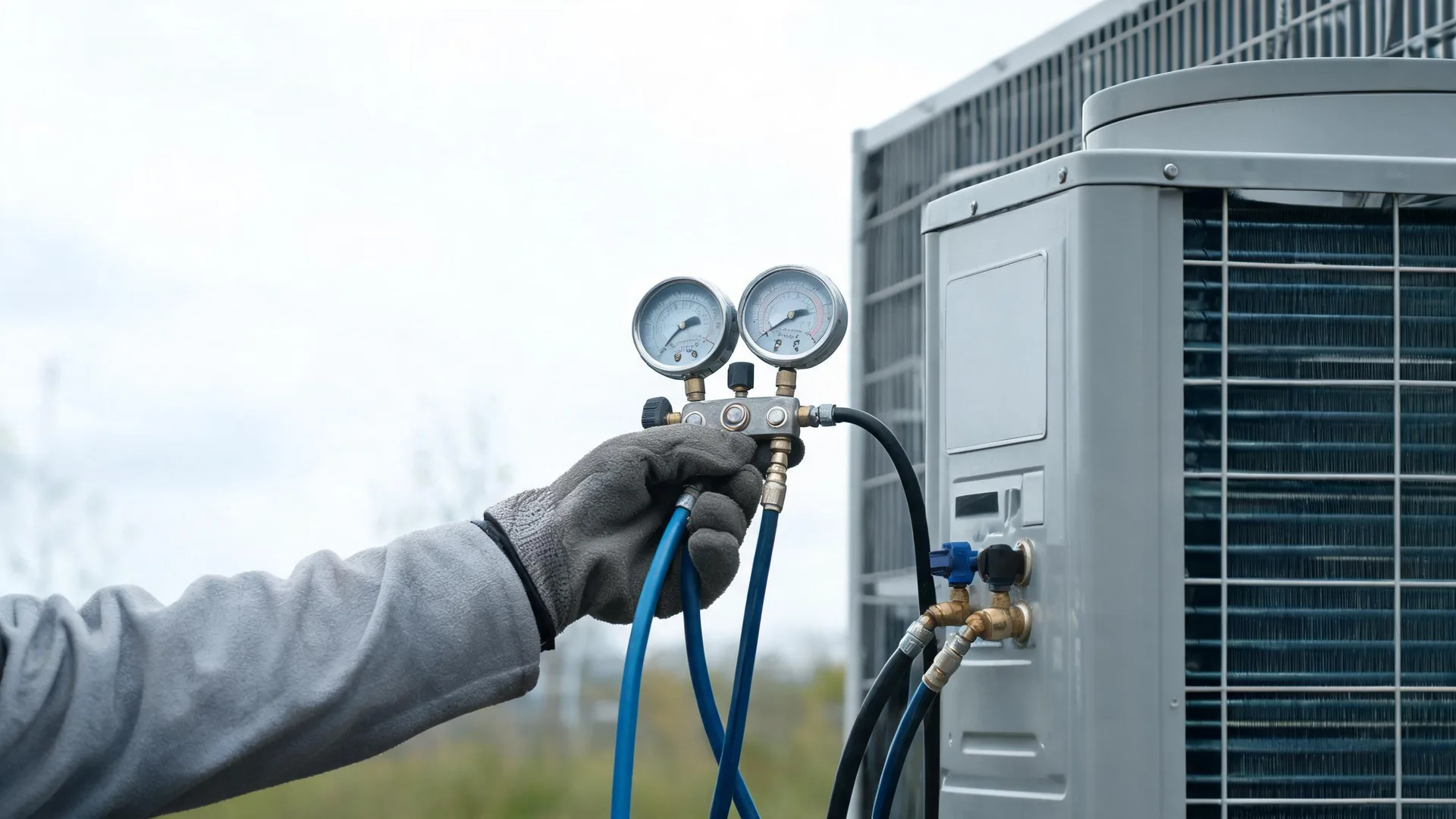
A diagnostic visit starts outside at the condenser, not inside at the thermostat. The technician checks the capacitor and contactor first, because those fail often and show clear signs when they do. Refrigerant pressure gets checked at the service ports, since too little means a leak and too much points to a different problem entirely. Inside, they pull the panel off the air handler and look at the coil for ice or heavy dirt, and check amp draw on the blower motor while it runs. They'll check the temperature of the air going in against the air coming out, because that split tells you whether the system is actually moving heat the way it should. Each check rules something out, so by the end they know which part is causing the problem instead of guessing at it.