






An outdoor central air conditioning unit mounted on a concrete pad beside a blue-sided house at sunset.

AC Repair in Newton, KS

Tell us about the job

Takes about a minute. No obligation.

RepairCentral ACHarvey County, KS
Step 1 of 2

What ZIP code is the job in?

Cooling runs May through September here, five months of the system cycling on most days. Afternoon highs average 90 degrees across June, July and August, and that's the stretch where it has to run for hours at a time, not just cycle on and off. That kind of steady demand wears on a system faster than people expect. A capacitor or contactor that might hold up for years somewhere cooler can give out sooner under that load. When something starts acting up, it's worth having a contractor look at the actual cause rather than guessing.

5 months
May through September, your air conditioner is on duty
90°F
the average summer afternoon it cools against
59 hail events
in ten years, and hail bends the fins on outdoor coils
91 wind events
in ten years, and wind drives debris into outdoor units
Isometric line illustration of a cutaway house showing interior rooms with ductwork, an indoor air handler, and an outdoor condenser unit connected by lines, on a white background.
Your air conditioner works hardest from June through August.

NOAA nClimDiv, 1991–2020 normals

Electricity in Kansas ran 14.15 cents per kilowatthour in 2024.

A struggling AC burns through more of it every month it's not fixed.

April is when a weak part gets found, not May

Cooling runs May through September
Summer afternoons average 90°F
91 damaging wind events from 2015 to 2024
A machine running badly costs you every month it waitsKansas electricity ran 14.15 cents per kilowatthour in 2024, and a bad capacitor or low charge makes your AC use more of it.

Half the homes in Harvey County were built in 1970 or earlier. If your AC came with a house that age, it may be the original system, or close to it. Nothing about an older home tells a contractor the unit is on its last leg, but age on the house is a reason to ask the question rather than assume the answer. A repair on a unit that old is worth doing if it gets you another season. It's worth less if the same part is about to go again, or something else behind it is already weak. Before paying for a big repair, ask how much life the system has left.

Have it looked at before the heat finds the next weak part

A system that runs five months straight through 90 degree afternoons wears parts faster than one that barely gets used. If something's already acting up, get the actual cause checked before it takes anything else with it.

Find a contractor
An outdoor air conditioning condenser unit mounted on a concrete pad surrounded by gravel, photographed against a partly cloudy blue sky.

Ask what the repair is buying you

If your AC is original to a house built that long ago, a repair is only worth it if it buys you real time. Ask the contractor straight out how many years they'd expect from this unit before you sign off on a fix, especially if the part failing is the compressor rather than something smaller like a capacitor.

A refrigerant leak gets worse while the compressor keeps running

A system low on charge has to run longer to cool the same space, and the compressor is doing that extra work with less refrigerant to carry the heat. That's what burns up a compressor that would have lasted years if the leak had been found early.

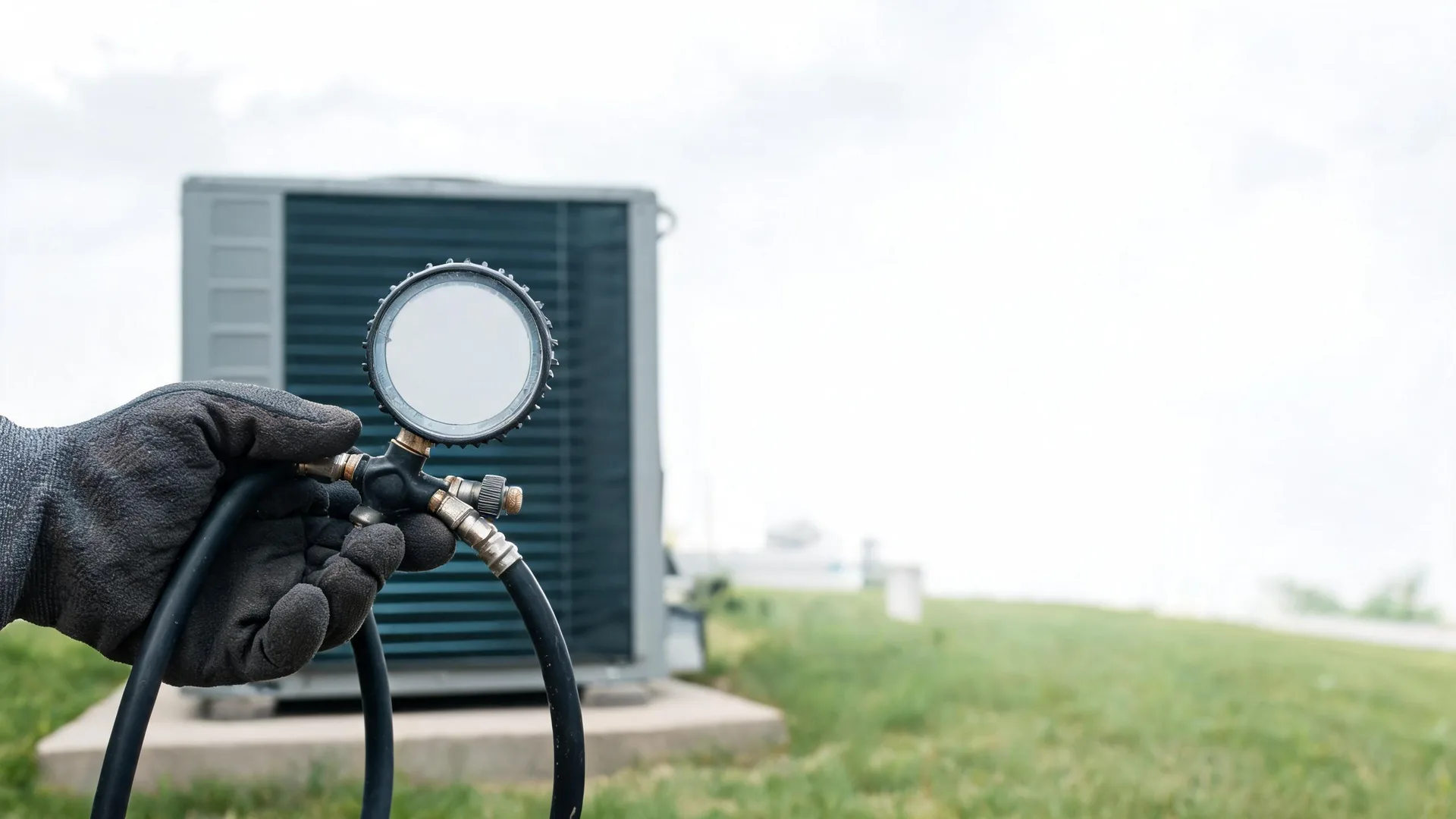
A dirty coil makes the whole system fight itself

A coil caked with dirt can't shed heat the way it should, so the system runs longer to reach the same temperature. Run it long enough that way and the compressor is working against a problem that started somewhere else entirely.

An outdoor air conditioning condenser unit positioned beside a blue-sided house at sunset.

A new air conditioner would cut about $30 a year off cooling for a typical Harvey County home.

  • A new one at the federal minimum, 13.4 SEER2$360 a year
  • An older air conditioner$390 a year

Estimates for a typical Harvey County home, compared with an older unit built to the previous federal minimum, from EIA household energy data, Kansas fuel prices and NOAA climate normals. Your home will differ.

Repair makes sense when a part like a capacitor or contactor has failed.

Replacement makes sense when the compressor has failed or the system uses R-22 refrigerant, which is no longer made.

A repair makes sense when the part failing is small and the rest of the system is sound. A capacitor, a contactor, a fan motor, these wear out on their own without saying anything about the compressor behind them. Replace the one part and the unit runs like it did before. It's a different question when the compressor itself is the problem, or when the same repair is the second one this year. A system that keeps finding new ways to fail is telling you something about what's left in it, not just the one part in front of you. A straight answer about which kind of repair this is matters more than the repair itself.