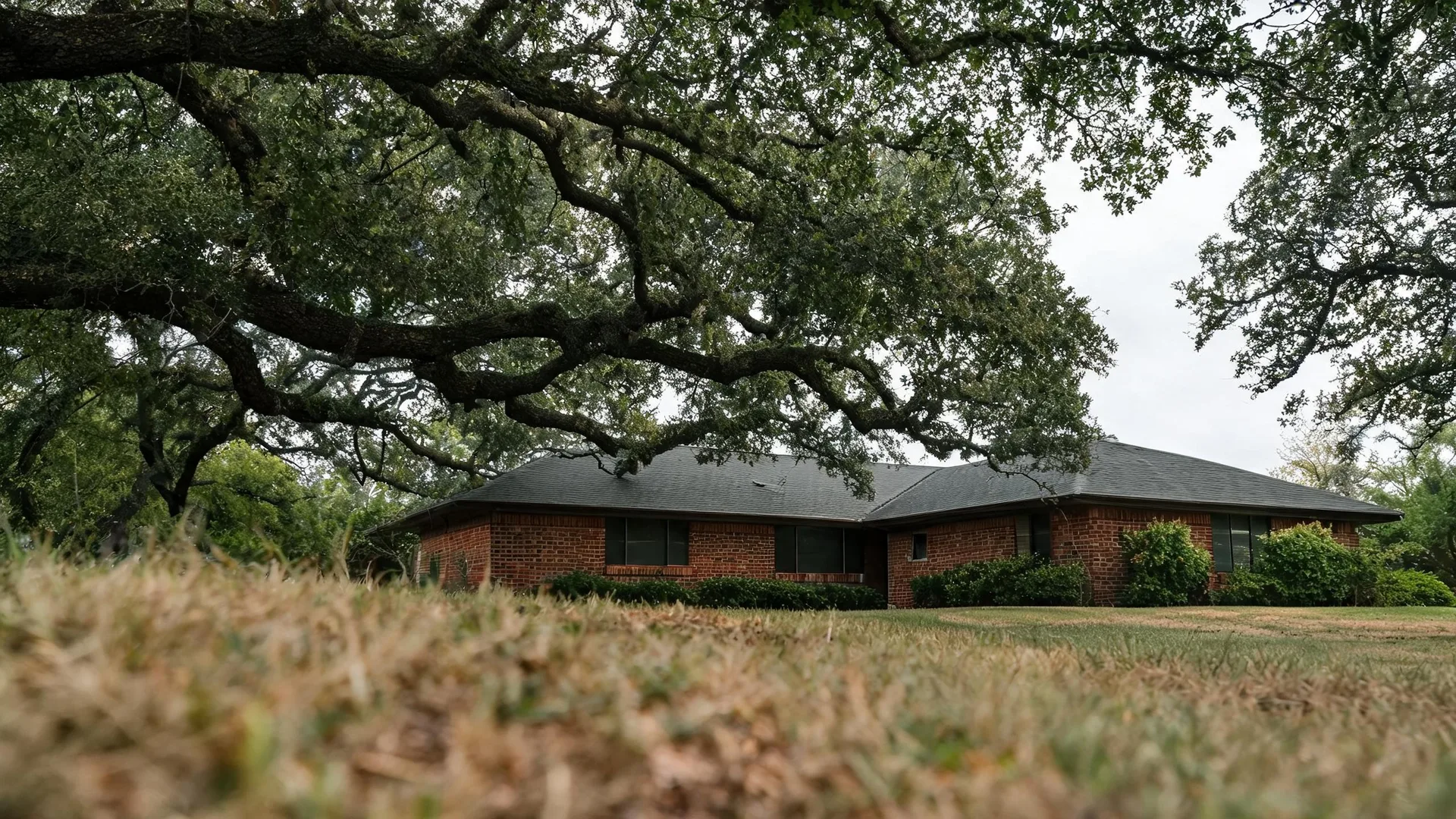
A single-story brick house with a dark shingled roof seen from a low angle across a lawn, framed by the spreading branches of a large oak tree under an overcast sky.

AC Repair in Parsons, KS

Tell us about the job

Takes about a minute. No obligation.

RepairCentral ACLabette County, KS
Step 1 of 2

What ZIP code is the job in?

Five months of real heat

Air conditioners in Labette County run from May through September, and June through August the afternoon high averages 89°F with a dew point around 67°F. That is heavy air to push through a coil, and it means the system runs long hours at its hardest setting for most of the summer.


That strain is usually the cause

A compressor or capacitor giving out in July is rarely bad luck. It is the normal result of a machine running flat out for months at a time. Whatever is going wrong with your AC right now, start with that in mind, and have it diagnosed with that cause in view rather than guessed at.

5 months
May through September, your air conditioner is on duty
89°F
the average summer afternoon it cools against
43 hail events
in ten years, and hail bends the fins on outdoor coils
50 wind events
in ten years, and wind drives debris into outdoor units
Isometric cutaway illustration of a single-story house showing interior rooms, ductwork and an air handler in the attic space, and an outdoor condenser unit connected by lines at the exterior wall.
Your air conditioner works hardest from June through August.

NOAA nClimDiv, 1991–2020 normals

Half the homes in Labette County were built in 1958 or earlier.

An air conditioner that old, or even one in a house that old, is working on borrowed time.

A system under strain here costs you every month it runs

Power here costs 14.78 cents per kilowatt-hour
Cooling runs May through September
Summer afternoons average 89°F

A system that has to run long and hard doesn't get cheaper to operate while it waits for a repair call. A weak capacitor or a dirty coil makes the unit run longer to hit the same temperature, and every one of those extra hours lands on the power bill. Waiting a few weeks doesn't save money, it just spreads the cost out. Get it looked at now instead of letting it run that way through the rest of summer.

Find out how much life is left before you pay for a repair

If your AC came with a house built decades ago, repair is still worth checking first. A contractor can tell you whether the unit is original to the house, and if so, how much is left in it. That answer is worth more than a guess before you put money into a repair.

Find a contractor
A gray cylindrical air conditioning condenser unit mounted on a concrete pad next to a light-colored vinyl-sided house exterior.

Five months of running, plus whatever the weather throws at it

Hail is part of the picture too. Labette County saw 43 hail events between 2015 and 2024, and a coil or fan blade that takes a hit doesn't always show it right away. A unit already running long hours all summer has less room to absorb that kind of damage before something gives out. If yours is acting up now, get it looked at and let a contractor check the coil and cabinet while they're at it, not just the part that failed.

What shows up first

Warm air from the vents when the thermostat is set low is usually the first thing anyone notices. After that it's the system cycling on and off more than it used to, or running without ever quite reaching the set temperature. Sometimes it's a smell when it kicks on, or water pooling near the indoor unit where the drain line has backed up. None of these fix themselves. Each one points to a specific part giving out, not the system wearing down all at once.

What the sound is telling you

A healthy air conditioner runs quiet. A grinding or screeching sound usually means a motor bearing is going. A clicking that repeats without the unit starting points to a failing capacitor or relay. A hissing or bubbling sound near the lines can mean refrigerant escaping, which is never something to wait on. If the outdoor unit is making a noise you haven't heard before, that noise is the diagnosis starting itself. A contractor can confirm it, but the sound already told you something is wrong.

An outdoor air conditioning condenser unit positioned on a concrete pad next to a blue-sided house, surrounded by green shrubs and flowering hydrangeas at sunset.

A new air conditioner would cut about $30 a year off cooling for a typical Labette County home.

  • A new one at the federal minimum, 13.4 SEER2$370 a year
  • An older air conditioner$400 a year

Estimates for a typical Labette County home, compared with an older unit built to the previous federal minimum, from EIA household energy data, Kansas fuel prices and NOAA climate normals. Your home will differ.

Repair makes sense when a part like a capacitor or contactor has failed.

Replacement makes sense when the compressor has failed or the system uses R-22 refrigerant, which is no longer made.

A diagnostic visit starts outside at the condenser, checking that the fan spins freely and the compressor is drawing power the way it should. The technician checks refrigerant pressure on the lines, because too little points to a leak and too much points to a different problem entirely. Inside, they pull the panel off the air handler and test the capacitor, since a weak one is one of the most common reasons a unit struggles to start or runs longer than it should. They check the coil for dirt or ice, because either one blocks the airflow the system needs to cool properly. They look at the drain line too, since a clog there is what causes water to back up near the indoor unit. By the end, the contractor should be able to point to the specific part that's failing and explain what it does, not just tell you something is wrong.