






Aerial view of a gray central air conditioning condenser unit on a concrete pad next to a house with vinyl siding.

AC Repair in Pittsburg, KS

Tell us about the job

Takes about a minute. No obligation.

RepairCentral ACCrawford County, KS
Step 1 of 2

What ZIP code is the job in?

Your air conditioner here runs from May through September, working against an afternoon high around 88 degrees for most of that stretch. That's long run times for five months straight, not just a few hot weeks. The condenser outside and the compressor inside both log more hours than they would in a milder place, and the parts that wear, the capacitor, the contactor, the fan motor, wear sooner because of it. The outdoor unit also takes a beating from the weather itself, wind and hail both hit this county often enough to bend fins or put debris in the coil. When something starts acting up, that combination is usually why. Get the actual cause diagnosed instead of guessing, so whatever gets fixed actually holds.

5 months
May through September, your air conditioner is on duty
88°F
the average summer afternoon it cools against
49 hail events
in ten years, and hail bends the fins on outdoor coils
84 wind events
in ten years, and wind drives debris into outdoor units
Isometric cutaway illustration of a single-story house showing interior ductwork and an air handler connected by lines to an outdoor condenser unit on a pad beside the building.
Your air conditioner works hardest from June through August.

NOAA nClimDiv, 1991–2020 normals

Half the homes in Crawford County were built in 1972 or earlier.

If your AC is that old too, it's likely near the end of its life, so ask how much life it has left before paying for a big repair.

Crawford County sees 142 severe weather events a decade. That's hard on an outdoor unit.

142 severe weather events from 2015 to 2024
19% of homes statewide lost power a day or more in 2024
84 damaging wind events from 2015 to 2024

April is worth paying attention to here. Cooling runs May through September, and the first hot week is when a weak part finally gives out. A capacitor that held on fine all last year can fail the moment it has to run every day. Getting the system looked at in April, before that starts, means whatever is wearing out gets caught on a slow afternoon instead of in the middle of a hot stretch. It also beats the rush once summer gets going, when a contractor's schedule is harder to get on.

A struggling AC costs more to run here than most places

Kansas electricity runs 14.15 cents per kilowatthour, on the high side. A struggling AC draws more of it just to keep up. A bad capacitor or a dirty coil makes the compressor work harder for the same cooling, and that extra draw shows up on the bill every month the system runs this way. Get it diagnosed instead of letting it run like this through the summer.

Find a contractor
A man in a dark jacket and tan work pants, seen from behind, carries a canvas duffel bag up wooden porch steps toward a red front door, beside a large terracotta pot holding a shrub.
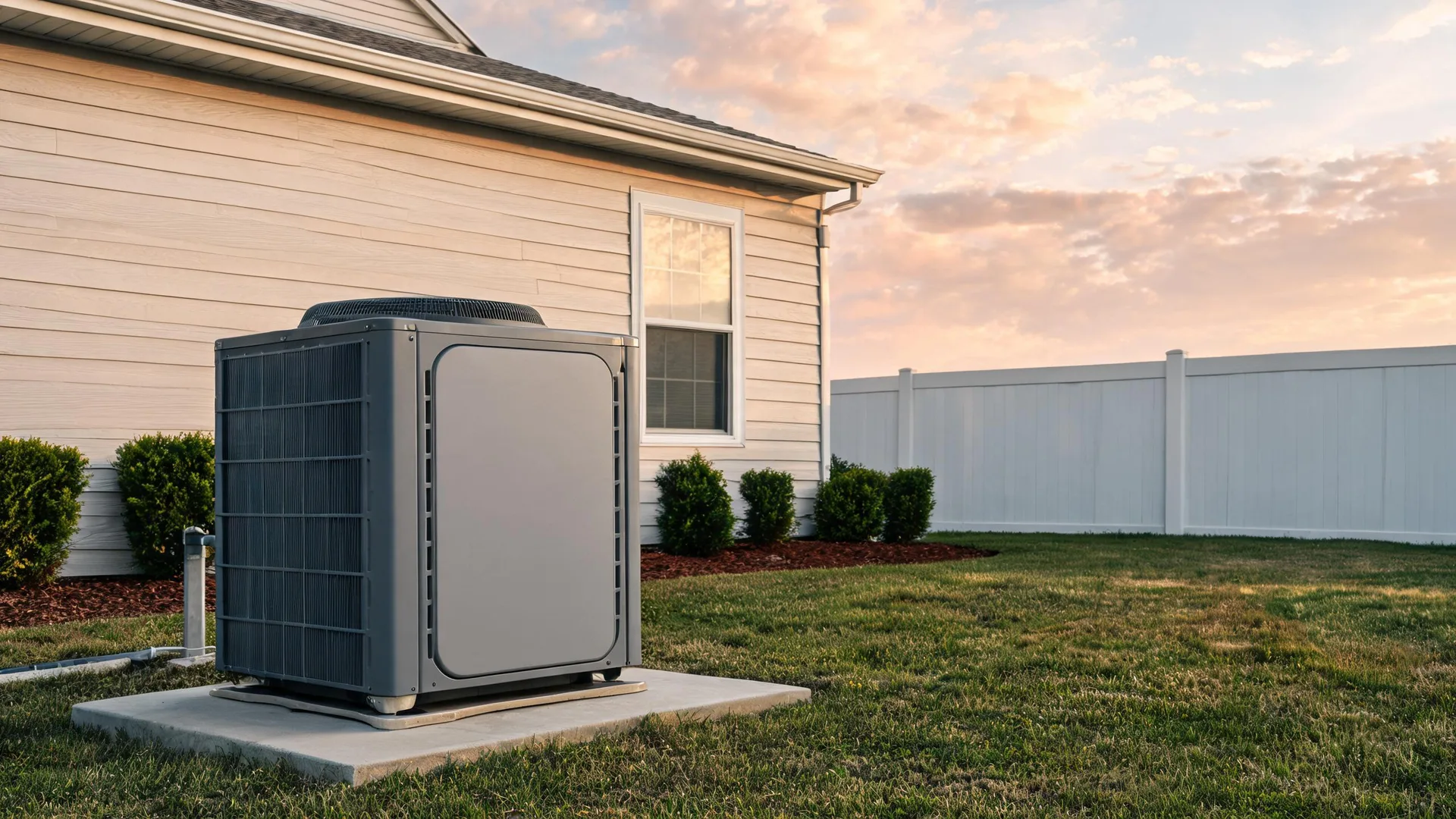
A gray residential air conditioning condenser unit mounted on a concrete pad outdoors, surrounded by green grass under a partly cloudy blue sky.

Five months of hard running adds up

The clip beside this runs May through September because that's the stretch this unit doesn't get a break. By the time something acts up, it's usually logged months of long days already, not a bad week. That history is exactly why a proper diagnosis matters here. It finds the actual part at fault, whether that's the capacitor, the contactor, or coil damage from wind or hail, instead of swapping parts and hoping one of them was it.

The capacitor is usually first

The capacitor gives the compressor and fan motor the jolt they need to start, and it weakens a little every time they cycle on. A weak one shows up as a unit that hums but won't start, or a fan that spins slow. The compressor can suffer real damage if it keeps trying to start without enough charge behind it.

Low refrigerant means a leak, not just a refill

An AC doesn't burn through refrigerant the way a car burns gas. If the charge is low, it's because it's leaking out somewhere in the coil or the lines. Topping it off without finding that leak just means doing it again later, so it's worth asking whoever looks at it to find the leak, not just the pressure.

An overhead view of a residential air conditioning condenser unit mounted on a concrete pad next to a house with vinyl siding.

A new air conditioner would save little on running costs in Crawford County, so the repair decision comes down to the unit's condition.

  • A new one at the federal minimum, 13.4 SEER2$360 a year
  • An older air conditioner$380 a year

Estimates for a typical Crawford County home, compared with an older unit built to the previous federal minimum, from EIA household energy data, Kansas fuel prices and NOAA climate normals. Your home will differ.

Repair makes sense when a part like a capacitor or contactor has failed.

Replacement makes sense when the compressor has failed or the system uses R-22 refrigerant, which is no longer made.

A repair is worth it when the part that failed is cheap next to the system around it, a capacitor or a contactor, and the rest of the unit is keeping up fine otherwise. Replacement starts making more sense once the compressor itself is the problem, since that's the most expensive part in the unit and the labor to swap it isn't far off from a new system anyway. Age matters too, but less than how the thing has been running. A unit that needs a repair every season is telling you something a single breakdown doesn't. Ask whoever diagnoses it what actually failed. Then ask whether that failure is a one-time thing or a sign the rest is wearing out alongside it.