







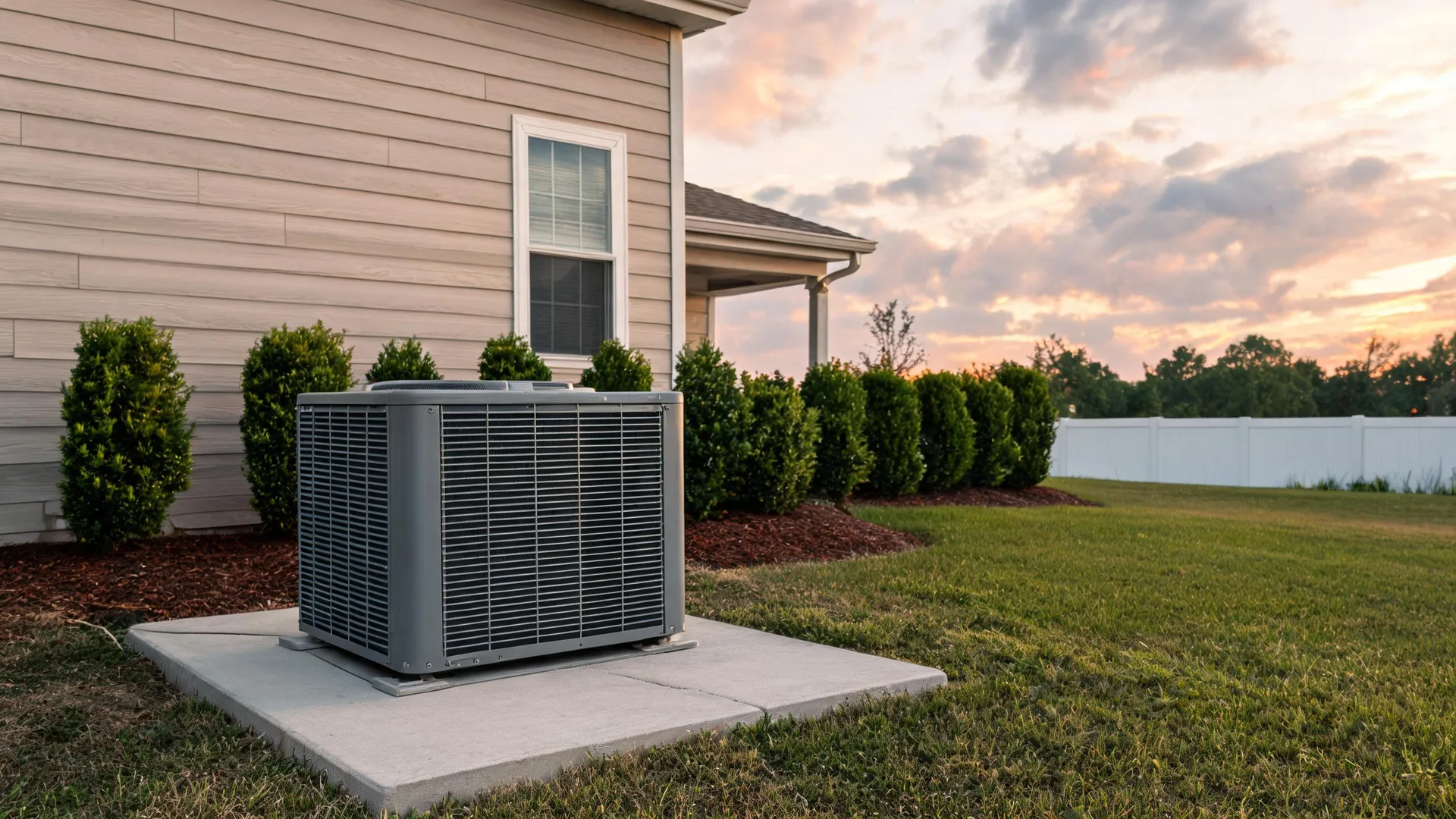
An outdoor air conditioning condenser unit on a concrete pad next to the gray vinyl siding of a residential home.

AC Repair in Topeka, KS

Tell us about the job

Takes about a minute. No obligation.

RepairCentral ACShawnee County, KS
Step 1 of 2

What ZIP code is the job in?

Shawnee County recorded 351 severe weather events between 2015 and 2024, most of it wind and hail: 224 damaging wind events and 108 hail events. Hail dents coil fins and bends them shut, and wind throws branches and grit into the condenser. A unit can take a hit like that and keep running for a while, with the coil working harder to do the same job. The county also saw 7 tornadoes and 12 winter storms with heavy snow and ice in that span. If your outdoor unit has been through weather like that, it is worth having someone check the coil and the fan blades even if the air still comes out cold.

5 months
May through September, your air conditioner is on duty
88°F
the average summer afternoon it cools against
108 hail events
in ten years, and hail bends the fins on outdoor coils
224 wind events
in ten years, and wind drives debris into outdoor units
Isometric cutaway illustration of a single-story house showing interior rooms, ductwork and an air handler in the attic space, and an outdoor condenser unit connected by lines at the exterior wall.
Your air conditioner works hardest from June through August.

NOAA nClimDiv, 1991–2020 normals

Half the homes in Shawnee County were built in 1972 or earlier.

If your AC came with a house that old, repair cost matters less than how much life the unit has left in it.

At 14.90 cents a kilowatt-hour, a struggling AC runs up your bill for months before it quits

Power here costs 14.90 cents per kilowatt-hour
Cooling runs May through September
Summer afternoons average 88°F
May is when a weak AC gives outCooling in Shawnee County starts in May and runs through September, and the first hot stretch finds whatever was already wrong

Your AC here runs about five months straight, May through September, and it isn't idling through that stretch. Afternoon highs average 88°F across June, July and August, and the dew point sits around 65°F, which is the heavy, hard-to-breathe air that makes the unit run longer to pull moisture out as well as heat. That kind of steady load wears on the parts that cycle the most: the compressor, the fan motor, the capacitor that gets it started. A system asked to run this hard for five months doesn't fail all at once. It shows small signs first, like longer run times or weaker airflow, before something gives out.

If your AC has been through a storm, have it checked before summer finds the damage

If your outdoor unit took a hit from hail or wind and kept running, get the coil and fan blades looked at now, before the first hot stretch finds the weak spot.

Find a contractor
A man in a dark jacket, cap and tan work pants climbs wooden porch steps toward a red door, carrying a canvas tool bag beside a potted shrub in a red planter.
A gray residential air conditioner condenser unit mounted on a concrete pad in an open grass field.

Five months of running will find whatever's weak

Five months of steady running is enough to turn a small problem into a bigger one before you notice it. A weak capacitor still starts the compressor most mornings, right up until the day it doesn't. A coil that's a little dirty just runs a little longer, until a hot afternoon asks more of it than it has left to give. Whatever's making your AC act up now was probably manageable back in May. Getting it looked at properly, instead of just topped off or reset, is what makes the fix hold for the rest of the summer.

What you can check yourself

Look at the outdoor unit first. Clear away leaves, grass clippings or anything blocking the fins, and make sure nothing is sitting close enough to choke off airflow. Check the air filter inside and swap it if it's gray and clogged, since a blocked filter starves the whole system and can freeze the coil. Check that the thermostat is set to cool and actually set below room temperature. Look at the breaker box too. A tripped breaker or a blown fuse will shut the whole unit down, and resetting it once is a reasonable thing to try.

What to leave alone

If the breaker trips again after you reset it, stop and leave it off. That's the system telling you something electrical is wrong, and forcing it back on can damage the compressor. The same goes for ice on the coil or lines. Don't chip it off or run the system to try to melt it. Switch to fan only and let it thaw on its own. Anything behind the outdoor unit's panel, the capacitor, the contactor, the wiring, holds a charge even with the power off and isn't something to open up yourself.

Overhead view of an air conditioning condenser unit on a concrete pad next to a house with asphalt shingle roofing and vinyl siding.

A new air conditioner would cut about $30 a year off cooling for a typical Shawnee County home.

  • A new one at the federal minimum, 13.4 SEER2$320 a year
  • An older air conditioner$350 a year

Estimates for a typical Shawnee County home, compared with an older unit built to the previous federal minimum, from EIA household energy data, Kansas fuel prices and NOAA climate normals. Your home will differ.

Repair makes sense when a part like a capacitor or contactor has failed.

Replacement makes sense when the compressor has failed or the system uses R-22 refrigerant, which is no longer made.

A repair fixes what failed. It doesn't tell you what's about to fail next, and that's the real question once a unit has some years on it. The compressor is the part that settles the question on its own. It's the most expensive part in the system, and losing it usually means losing the refrigerant charge along with it, so a compressor failure is usually a replacement conversation whether or not anything else is wrong. A failed capacitor or a bad fan motor is a different story. Those are wear parts. They fail on their own schedule, and swapping one doesn't say anything about the condition of the rest of the unit. The question worth asking isn't just what this repair costs, it's whether it's the first of several or whether the rest of the system is sound enough that fixing this one part actually settles things.