






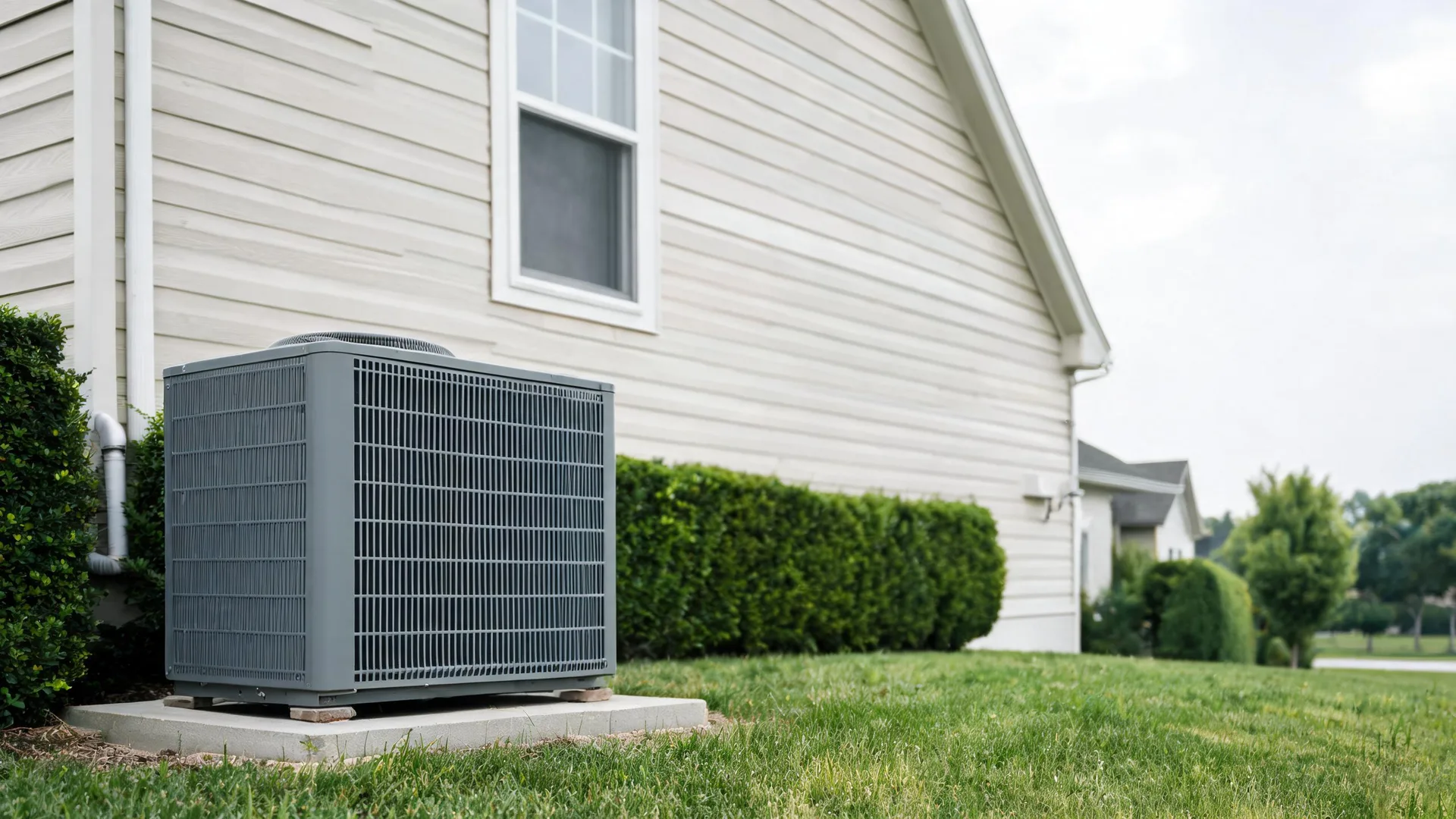
An outdoor HVAC condensing unit on a concrete pad next to a beige single-story house with a dark shingle roof.

Heat Pump Repair in Chanute, KS

Tell us about the job

Takes about a minute. No obligation.

RepairHeat PumpNeosho County, KS
Step 1 of 2

What ZIP code is the job in?

April is when most Chanute heat pumps switch over to cooling, and that first run is when a weak part finally gives out. A capacitor that limped through the winter on the heating side often can't start the compressor once it has to cool instead. September does the same thing in reverse, when the system switches back to heat after running cooling from May through September. If your heat pump is struggling in one of those changeover weeks, that timing is probably not a coincidence.

7 months
October through April, your system heats
5 months
May through September, it cools
26°F
the average winter night it heats against
88°F
the average summer afternoon it cools against
Isometric line illustration of a cutaway house showing interior rooms with furniture, ceiling ductwork under a dark shingled roof, and an outdoor condenser unit connected by lines on the right.
Your system heats October through April and cools May through September.

NOAA nClimDiv, 1991–2020 normals

A heat pump that won't switch modes usually comes down to a stuck reversing valve.

The reversing valve moves every time the system changes between heat and cool, so it wears out faster than almost any other part.

Half the homes in Chanute are older than their heat pump's first replacement

Half the homes here were built by 1963
Power costs 14.15 cents a kWh statewide
Climate zone 4A
Nothing unusual here, just a heat pump that needs the right fixKansas homes paid 14.15 cents per kilowatthour for electricity in 2024

Before paying for a reversing valve or compressor job, it's worth finding out how old the heat pump actually is. If it came with the house and nobody's touched it since, ask the contractor for a straight answer on how much life is left in it before the repair starts. A unit that old may be near the end regardless of what fails next. If the heat pump is newer than the house, that's a different conversation, and fixing what's broken is probably the right call.

Get it looked at early

Problems tend to show up in the first weeks of the season, when the load hits a part that was already weak.

Find a contractor
A white mini-split heat pump outdoor unit mounted on a concrete pad beside a gray-sided house, surrounded by gravel and green shrubs.

What to check before you pick up the phone

Check the thermostat first. Set it a few degrees past the current room temperature, in whichever direction you need, and listen for the system to kick on within a minute or so. Next look at the outdoor unit. If the coil is caked in leaves, grass clippings or ice, that airflow problem can look like a much bigger failure than it is. Clearing debris by hand is safe. Chipping away ice is not, since it's usually a sign of a problem inside the system, not outside it. Inside, pull the air filter and hold it up to a light. If you can't see light through it, that's restricting airflow enough to cause real problems at the coil. Walk the vents in each room and make sure none are closed or blocked by furniture. Last, check the breaker panel for anything tripped. If the outdoor unit is dead quiet and the breaker looks fine, that points to something electrical that isn't a homeowner fix.

Short cycling wears out the compressor fast

A heat pump that kicks on, runs a couple minutes, then shuts off again isn't resting, it's struggling. Every restart puts a hard load on the compressor, and a compressor that keeps getting hit with that load tends to fail sooner than it should.
Warm air from the vents in heat mode means check it now

If the vents are blowing air that feels barely warm, or even cool, while the system is set to heat, something is already failing. It might be low refrigerant, a failing reversing valve, or a defrost cycle that's stuck. None of those get better by waiting.

A heat pump that's struggling doesn't fail all at once. It fails a little more every hour it keeps running. A compressor low on refrigerant still tries to build pressure with every cycle, and that extra strain is what turns a slow leak into a burned-out compressor. A reversing valve that's partly stuck still gets pushed to shift every time the thermostat calls for it, and that's what turns a sticky valve into one that won't move at all. Even something as simple as a dirty coil gets worse under load, since the system keeps pulling the same amount of power to move air that can't get through as easily as it used to. None of these get better with time. The part that's already weak is the part doing the extra work, and it's the first one to go.

A compressor is usually the most expensive part in a heat pump, and it's also the reason age matters more than the symptom. A cracked heat exchanger or a failed compressor often costs close to a full system, so a contractor will usually walk through both numbers before touching either one. A weak capacitor or a bad fan motor is a different story. Those are parts that get swapped on their own all the time, and fixing one doesn't say anything about what else is about to fail. The question worth asking isn't just what broke, it's whether this is a part that fails by itself or one that tends to take the rest of the system down with it.