







A snow-covered residential street at twilight with illuminated houses, bare trees, and an orange horizon glow beneath a deep blue sky.

Heat Pump Repair in Dodge City, KS

Tell us about the job

Takes about a minute. No obligation.

RepairHeat PumpFord County, KS
Step 1 of 2

What ZIP code is the job in?

Ford County saw 484 severe weather events between 2015 and 2024. Damaging wind was behind 251 of those, hail hit 163 times, and 33 tornadoes touched down in that same stretch. An outdoor heat pump unit sits outside through all of it, exposed to whatever the wind throws at it or whatever the hail does to the coil and fan. A unit can take a hit and keep running for a while before the damage shows up as a real problem. Power matters too. Nearly one in five Kansas households went at least 24 hours without power in 2024, and a heat pump that loses power loses heat along with it.

7 months
October through April, your system heats
4 months
June through September, it cools
21°F
the average winter night it heats against
90°F
the average summer afternoon it cools against
Isometric cutaway illustration of a small house showing interior ductwork and an air handler connected by lines to an outdoor condenser unit on a pad beside the building.
Your system heats October through April and cools June through September.

NOAA nClimDiv, 1991–2020 normals

Heat pumps start working hard in October here, and again in June.

A part that was already weak often fails in the first cold snap or the first hot stretch, not before.

Half the homes here were built by 1972

Half the homes here were built by 1972
251 damaging wind events from 2015 to 2024
163 hail events from 2015 to 2024
This county works a heat pump harder than mostWind hit Ford County 251 times between 2015 and 2024. Hail hit it 163 times.

If your heat pump came with a house built in 1972 or earlier, ask the contractor one question before paying for the repair: how much life is left in this unit. A compressor or reversing valve job is not cheap, and on an old system it can end up as money spent ahead of a replacement you were going to need anyway. The data plate on the unit tells a tech its age in about a minute. That's worth asking for before you commit to the repair, not after.

Had storm damage or acting strange since the last one? Get it checked now.

A heat pump outside through 163 hail events and 251 wind events doesn't always show the damage right away. If yours is still running but you know it took a hit this year, or it's been acting up since the last storm came through, get it looked at now instead of waiting for it to quit on a cold night.

Find a contractor
A man in a cap, dark shirt and brown work pants walks up porch steps toward a red door, carrying a worn canvas tool bag, with a potted shrub in a red planter beside him.
A white mini-split heat pump outdoor unit mounted on a concrete pad beside a gray-sided house, surrounded by gravel and green shrubs.

Years of hard weather, one repair call

A heat pump that's been through 251 windstorms and 163 hail events doesn't always fail on the day it gets hit. A bent fin or a loose connection can sit there for months before it turns into a unit that won't hold temperature. When a tech comes out for a repair, the wear that shows up usually traces back to something specific rather than just age. Tell them what the unit has been through, storms included, so the repair addresses what's actually wrong instead of just the symptom you noticed.

What you can check from the thermostat

Before anything else, check the thermostat is set to heat or cool as needed and the temperature is actually set past room temperature. Replace the batteries if it has any. Then check your breaker panel. A heat pump runs off two breakers, one for the outdoor unit and one for the air handler, and either can trip on its own. If a breaker is tripped, reset it once. If it trips again, stop and call someone, because that usually means a short or a failing part, not a fluke.
What to look at outside

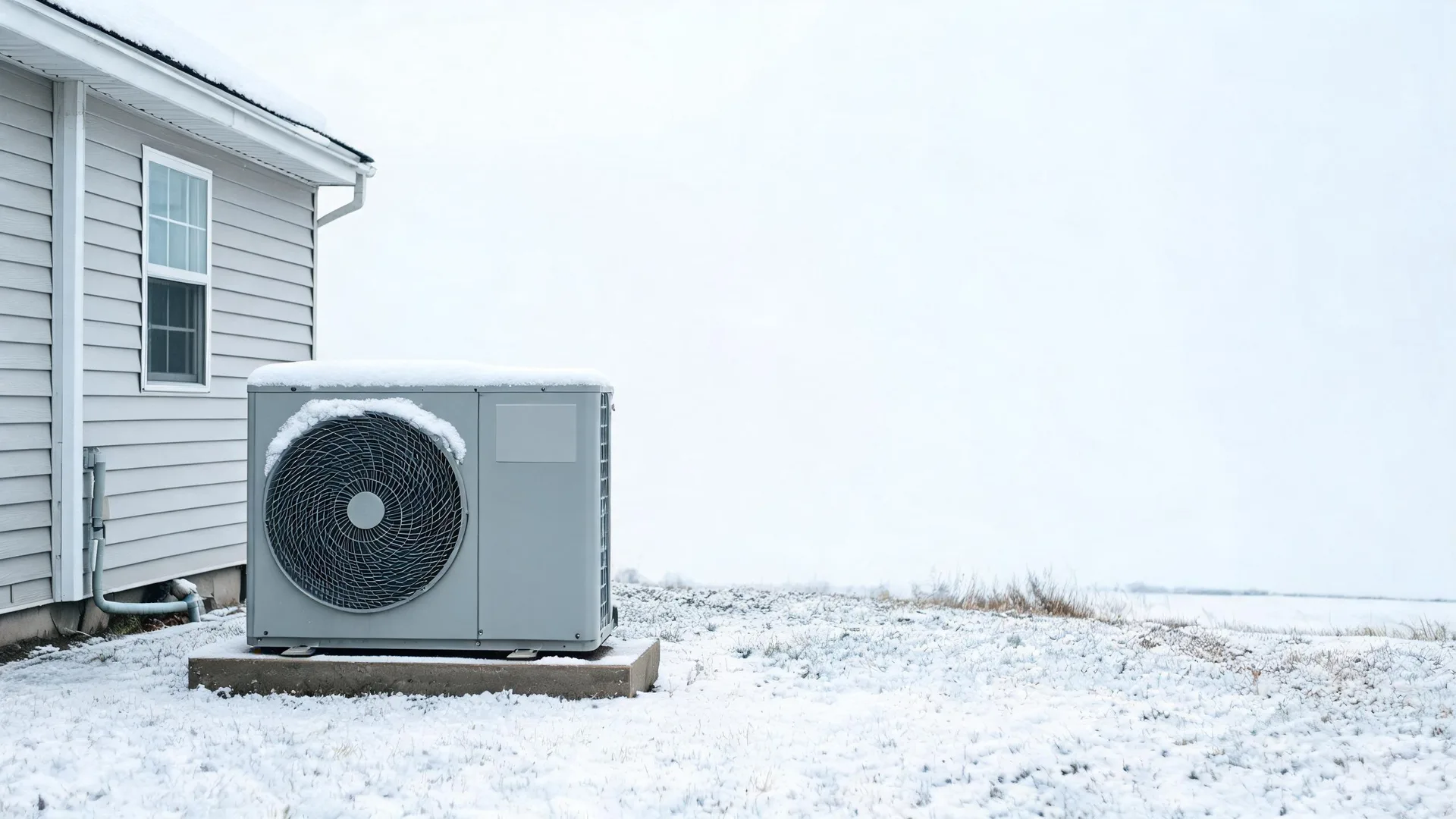
Walk out to the outdoor unit and look at the fan through the top grille. If it's not spinning and the unit is humming, don't keep it running, that's a sign of a bad capacitor or a seized motor and it can burn the compressor out. Check that nothing is pressed up against the sides or sitting on top blocking airflow. Look at the coil fins around the outside for anything packed in tight, like leaves or debris, and clear it by hand if you can. Also check the outdoor unit isn't caked in ice with the system running in heat mode. Some frost is normal, a solid block of ice is not.

Most heat pump failures start with the parts that move or carry a charge. The capacitor that kicks the compressor and fan motors into motion weakens over time, and when it goes, the fan won't spin or the compressor won't start even though the unit is humming. Refrigerant leaks show up at joints and valves, and a system running low won't move heat well in either direction, heating or cooling. The reversing valve is the part that lets a heat pump switch between the two, and when it sticks, the unit blows cold air in winter or warm air in summer even though everything else is working. Outdoor coils pick up corrosion and get their fins bent or packed with debris, and either one cuts down how much heat the unit can pull from the air or push into it. Contactors and relays wear out from the current they switch every time the system cycles, and a worn one can leave the outdoor unit silent while the thermostat still calls for heat or cool.

A diagnostic call starts outside at the unit itself. The tech checks the fan, the coil, the refrigerant lines, and the electrical connections before touching anything inside the house. Readings come next: pressures on the refrigerant lines, voltage and amp draw on the compressor and fan motors, resistance on the capacitor. Those numbers point to whichever part is failing, because a healthy system falls inside a known range and a failing one doesn't. Inside, the tech checks the thermostat's call against what the outdoor unit is actually doing, since a signal that isn't reaching the unit looks like a dead system but isn't one. The visit ends with the tech naming the failed part and what it takes to fix it, not just confirming that something's wrong.