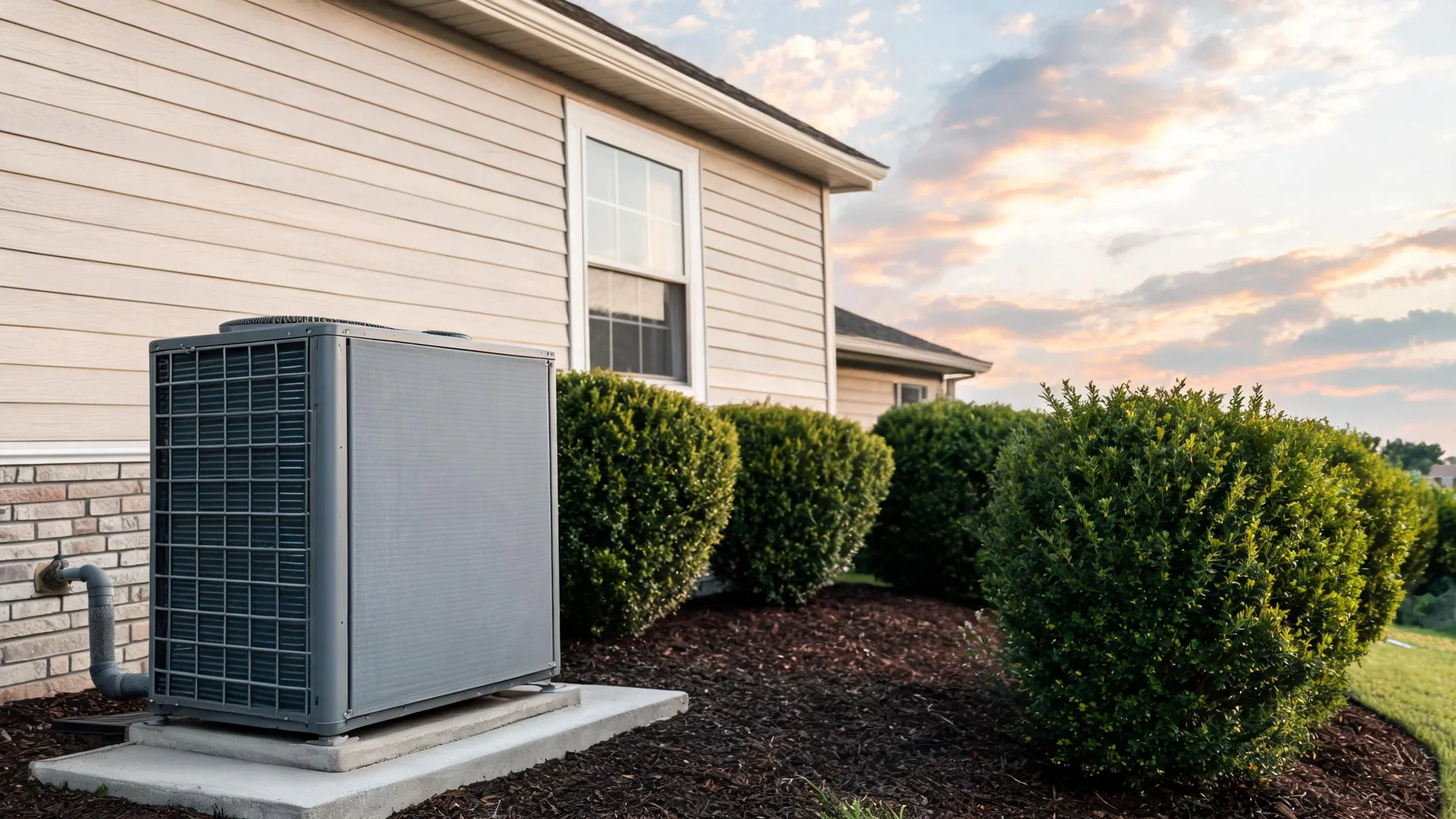
A grey air-source heat pump outdoor unit mounted on a concrete pad next to a modern white-rendered residential house.

Heat Pump Repair in Hutchinson, KS

Tell us about the job

Takes about a minute. No obligation.

RepairHeat PumpReno County, KS
Step 1 of 2

What ZIP code is the job in?

The air here holds a lot of moisture

The dew point in Reno County averages 63°F across June, July and August. Heavy air like that makes a heat pump run longer to pull the same moisture and heat out of a room, and that longer runtime wears on the parts doing the work.


Wind and hail hit this county often

Reno County saw damaging wind 141 times and hail 104 times between 2015 and 2024. The outdoor unit sits outside through all of it, and a bent fin or a loose connection from one of those events can be the real reason it's struggling now.

7 months
October through April, your system heats
5 months
May through September, it cools
23°F
the average winter night it heats against
90°F
the average summer afternoon it cools against
Isometric line illustration of a cutaway single-story house showing interior rooms, ceiling ductwork, an indoor air handler unit, and an outdoor condenser connected by a line set.
Your system heats October through April and cools May through September.

NOAA nClimDiv, 1991–2020 normals

Half the homes in Reno County were built in 1962 or earlier.

A heat pump installed when a house like that was built has already outlived most of its kind.

This county sees more storms than most, and this machine lives outside in them

265 severe weather events from 2015 to 2024
19% of homes statewide lost power a day or more in 2024
141 damaging wind events from 2015 to 2024

October is when heat here switches over, and that first cold snap is when a weak heat pump shows what it can't do anymore. Overnight lows average 23°F through December and January, and a unit that was already struggling to keep up in September has no room left once it's pulling heat out of air that cold. The strain doesn't wait for the hardest part of winter. It shows up in the first week the system has to work for real, when a worn part that was coasting through mild weather suddenly has to carry the load it was built for. If yours is already short cycling or running constantly before the weather has even turned hard, that's not a sign to wait and see.

Before you pay for the repair, ask what it's buying you

If your heat pump went in when your house was built, and your house is one of the older ones in the county, a big repair bill is worth a second thought. Ask the contractor how much life the unit has left before you pay for the part.

Find a contractor
A man in a dark long-sleeve shirt and tan work pants, seen from behind, steps onto a porch toward a red front door while carrying a worn leather tool bag, with a shrub in a red planter beside him.
A gray air-source heat pump mounted on a concrete pad next to a house with gray vinyl siding, surrounded by gravel and flanked by green shrubs and white hydrangea flowers.

Running worse, not running right

Wind and hail already came up, and that's the point. When a storm bends a fin or works a connection loose, the unit doesn't quit right then. It keeps running, just worse, and every muggy day after that asks more of parts that are already compromised. A contractor who checks for storm damage first, before replacing anything, is the one who finds why it's actually struggling. Ask whoever comes out to look at the outdoor unit itself, not just the part that's failing.

A refrigerant leak doesn't hold steady

A heat pump low on refrigerant will keep running, but the compressor works harder to move what's left and starts pulling in heat it can't fully use. Run it long enough in that state and the compressor itself can overheat and fail. A leak that would have been a simple recharge and patch turns into a compressor replacement, which is most of the cost of a new unit anyway.

A failing part rarely fails alone

When a motor or capacitor is struggling, something else usually picks up the slack. A weak capacitor makes the compressor or fan motor strain on every start, and that strain shortens the life of the motor too. Let a small, cheap part limp along and it tends to take a bigger, more expensive part down with it.

A heat pump that needs repair usually tells you before anyone opens a panel. It blows air that isn't warm enough or cool enough to match where the thermostat is set. It cycles on and off in short bursts instead of running a full, steady stretch. It runs constantly and still can't catch up. Ice builds on the outdoor coil when the weather doesn't call for it, or the outdoor fan struggles to spin freely. A hissing or bubbling sound near the lines usually means refrigerant escaping, not just a noisy unit. Any of these on their own is worth a call. More than one at a time usually means something has been wrong for a while.

If your outdoor unit has been through a hail event or a bad windstorm in the last few years, that history matters now that it's acting up. A tech checking it out should look at the coil fins and the fan blade for dents before condemning the compressor or the board. Pull the panel off and look yourself if you can get to it safely. Bent fins restrict airflow across the coil, and a dinged fan blade throws itself out of balance and wears the motor bearing faster than it should. Mention the storm history when you call, even if you don't remember the exact date. It gives the contractor somewhere to start instead of guessing.