







A snow-covered small-town street at dusk, with lit white clapboard houses, bare trees, and a grain elevator silhouetted against an orange and blue twilight sky.

Heat Pump Repair in Junction City, KS

Tell us about the job

Takes about a minute. No obligation.

RepairHeat PumpGeary County, KS
Step 1 of 2

What ZIP code is the job in?

Geary County logged 173 severe weather events between 2015 and 2024. Damaging wind caused most of them, 92 times in that stretch, with 66 hail events and 4 tornadoes mixed in. A heat pump's outdoor unit sits outside through all of it, exposed to wind-driven debris and hail that can bend the fins or crack the fan blade. The unit can keep running after a hit like that and still be worse off for it, losing efficiency or straining the compressor. If a storm has come through, it's worth having the outdoor unit looked at even if the system seems fine.

7 months
October through April, your system heats
5 months
May through September, it cools
21°F
the average winter night it heats against
88°F
the average summer afternoon it cools against
Isometric cutaway illustration of a single-story house showing interior rooms with ductwork, an indoor air handler unit, and an outdoor condenser unit connected by lines along the exterior wall.
Your system heats October through April and cools May through September.

NOAA nClimDiv, 1991–2020 normals

Geary County's outdoor unit takes wind and hail most places don't see.

A heat pump running through that kind of year needs more than a quick look when it starts acting up.

At 15.19 cents a kilowatt-hour, a heat pump that's struggling runs up the bill while it struggles

Power here costs 15.19 cents per kilowatt-hour
Climate zone 4A
Cooling runs May through September
Newer homes here mean newer systemsHalf the homes in Geary County were built in 1987 or later

October is when heat takes over here, and that first cold snap is when a weak part finally gets tested. A heat pump that limped through September cooling without quite keeping up often won't switch over cleanly to heat. Same compressor, same outdoor coil, now asked to do the opposite job as the temperature drops. By December and January, overnight lows here average 21°F, and the unit is running long hours just to hold the house steady. A problem that was minor in September, a sluggish defrost cycle or a part that was already drawing hard, tends to show itself fully once the cold settles in and stays.

If a storm just came through, have the outdoor unit looked at before it tells you itself

After wind or hail comes through, get the outdoor unit checked even if the heat pump still seems to be working. A bent fin or a cracked fan blade can leave it running worse without shutting it down outright, and with 19% of Kansas households losing power for a day or more last year, it's also worth knowing before an outage whether the unit is already struggling.

Find a contractor
A man in a gray t-shirt and tan work pants, seen from behind, carries a worn canvas tool bag up wooden steps toward a red front door of a gray clapboard house with a potted plant beside it.
A white mini-split heat pump outdoor unit mounted on a concrete pad beside a gray-sided house, surrounded by gravel and green shrubs.

A newer system is worth fixing when it breaks

A system running day into night, year after year, still has a lifespan behind that clock. If your heat pump came with the house, and the house is one of the newer ones here, it's probably not close to the end of that lifespan yet. That's worth knowing when something on it fails. A compressor or a control board acting up on a system with years of work still ahead is usually worth repairing. It gets the unit back to doing the job it still has left to do, not keeping something near the end limping along.

The reversing valve is usually where it starts

A heat pump has one part a furnace or straight air conditioner doesn't: the reversing valve that switches it between heating and cooling. That valve wears from being asked to shift back and forth, and when it sticks, the system can get stuck in one mode or blow air that's neither warm nor cold. It's one of the more common reasons a heat pump stops doing its job while the rest of the system still runs.
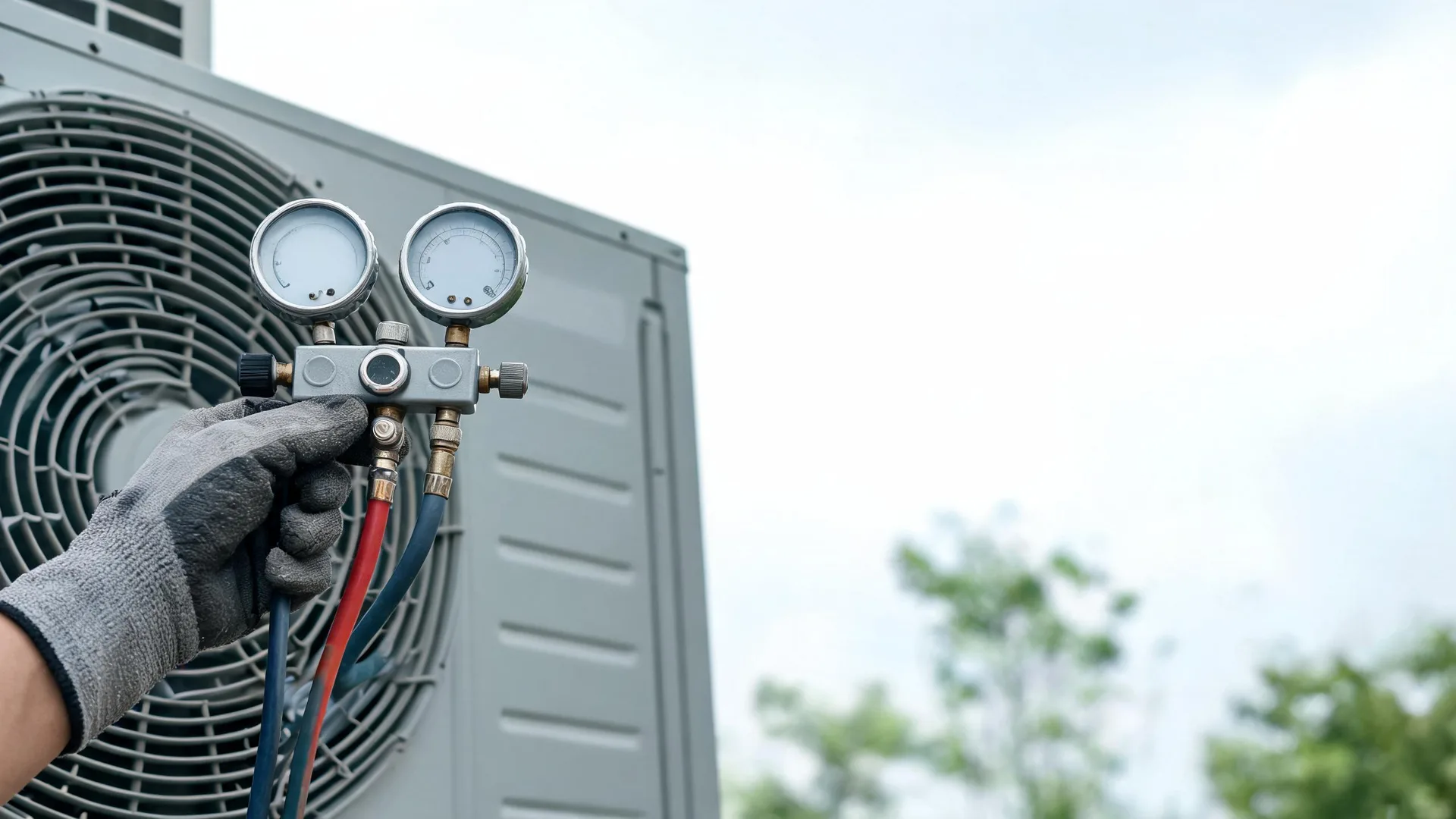
A failing part rarely shuts the system off right away

A weak capacitor, a dirty outdoor coil, a low refrigerant charge, these tend to show up as the system working harder for a worse result, not quitting outright. The compressor strains, the unit runs longer to hit the same temperature, and efficiency drops before anything actually fails. Catching it at that stage is usually a smaller repair than waiting for the part to give out completely.

A few things are worth checking before calling anyone out. Look at the thermostat first, make sure it's set to the right mode and the batteries aren't dead, since a heat pump stuck in the wrong mode can look like a bigger problem than it is. Check the outdoor unit for anything blocking airflow around it, leaves, ice, debris packed against the coil. Look at the air filter and swap it if it's gray or clogged, since restricted airflow makes the whole system work harder and can trip it off. Check your breaker panel for a tripped breaker before assuming the unit itself has failed. If the outdoor unit is covered in ice beyond what normal defrost cycles clear, or if you smell something burning, that's past what a homeowner should handle and it's time to call someone.

Wind and hail aren't a one-time event here, they're a pattern the outdoor unit has already lived through. That matters when something's wrong with the heat pump now, because the cause might not be new at all. A fin bent last spring or a fan blade nicked by hail months back can go unnoticed until the unit finally struggles to keep up. A proper diagnosis means someone actually opening up the outdoor unit and checking the coil, the fan, the refrigerant charge, not just listening to it run and guessing. That's the difference between a repair that holds and one that puts you back in the same spot next season.