






A snow-covered residential street at twilight with illuminated houses, bare trees, and an orange horizon glow beneath a deep blue sky.

Heat Pump Repair in Salina, KS

Tell us about the job

Takes about a minute. No obligation.

RepairHeat PumpSaline County, KS
Step 1 of 2

What ZIP code is the job in?

A heat pump works year round, so it earns out its cost differently than a furnace that only runs part of the year. If the compressor is still good and the problem is a failed capacitor, a bad contactor, or a low charge from a slow leak, repair usually makes sense. Those are contained failures. It's a different story when the compressor itself is going, or when the coil is corroded through and leaking refrigerant from more than one spot. At that point you're paying to patch a system that's already on its way out, and the next failure may be months away, not years. Age matters too, but less than condition. A unit that's been maintained and sheltered can outlast one that's been neglected, even if the neglected one is younger. Ask what's actually failing before you decide what it's worth fixing.

7 months
October through April, your system heats
5 months
May through September, it cools
22°F
the average winter night it heats against
90°F
the average summer afternoon it cools against
Isometric line illustration of a cutaway house showing interior rooms with furniture, a furnace or air handler with overhead ductwork, and an outdoor condenser unit connected by lines outside the wall.
Your system heats October through April and cools May through September.

NOAA nClimDiv, 1991–2020 normals

Half the homes in Saline County were built in 1966 or earlier.

A heat pump that came with a house that old is likely closer to the end of its life than the middle.

Salina heat pumps earn their keep from October to September, with no real break

Cooling runs May through September
Heat runs October through April
86 hail events from 2015 to 2024
Salina sees its share of storms211 severe weather events hit Saline County between 2015 and 2024

Most heat pump calls trace back to a handful of parts. The reversing valve is a common one. It's what switches the system between heating and cooling, and when it sticks, the unit blows cold air when it should be heating, or won't defrost right in cold weather. The defrost control board and its sensor fail too, and when they do, ice builds up on the outdoor coil until airflow stops. Run capacitors wear out from heat cycling, which shows up as a compressor or fan that hums but won't start. Low refrigerant almost always means a leak somewhere in the lines or coil, not a system that just needs a top-off. None of these are tied to one season. A heat pump works the compressor every month of the year, so whatever's going to fail usually fails on its own schedule, not because of a particular stretch of hot or cold.

Ask how much life it has left

If your system came with an older house, it may be near the end of its life. Ask how much life it has left before paying for a big repair.

Find a contractor
A white mini-split heat pump outdoor unit mounted on a concrete pad beside a gray-sided house, surrounded by gravel and green shrubs.

Find out what year you're working with

If you don't know when your heat pump was installed, ask the contractor to check the age off the nameplate before they quote a repair. That number, matched against what's actually failing, tells you whether you're looking at a repair or a countdown.

What you'll actually notice first

Heat pump trouble rarely starts with a system that won't run at all. It starts smaller. Air from the vents that's cooler than it should be on a cold day. A unit that runs long stretches without catching up to the thermostat. Ice on the outdoor unit that doesn't clear on its own between cycles. A clicking or humming sound when the compressor or fan tries to start and fails. Any of these is worth a call before the system stops working outright.
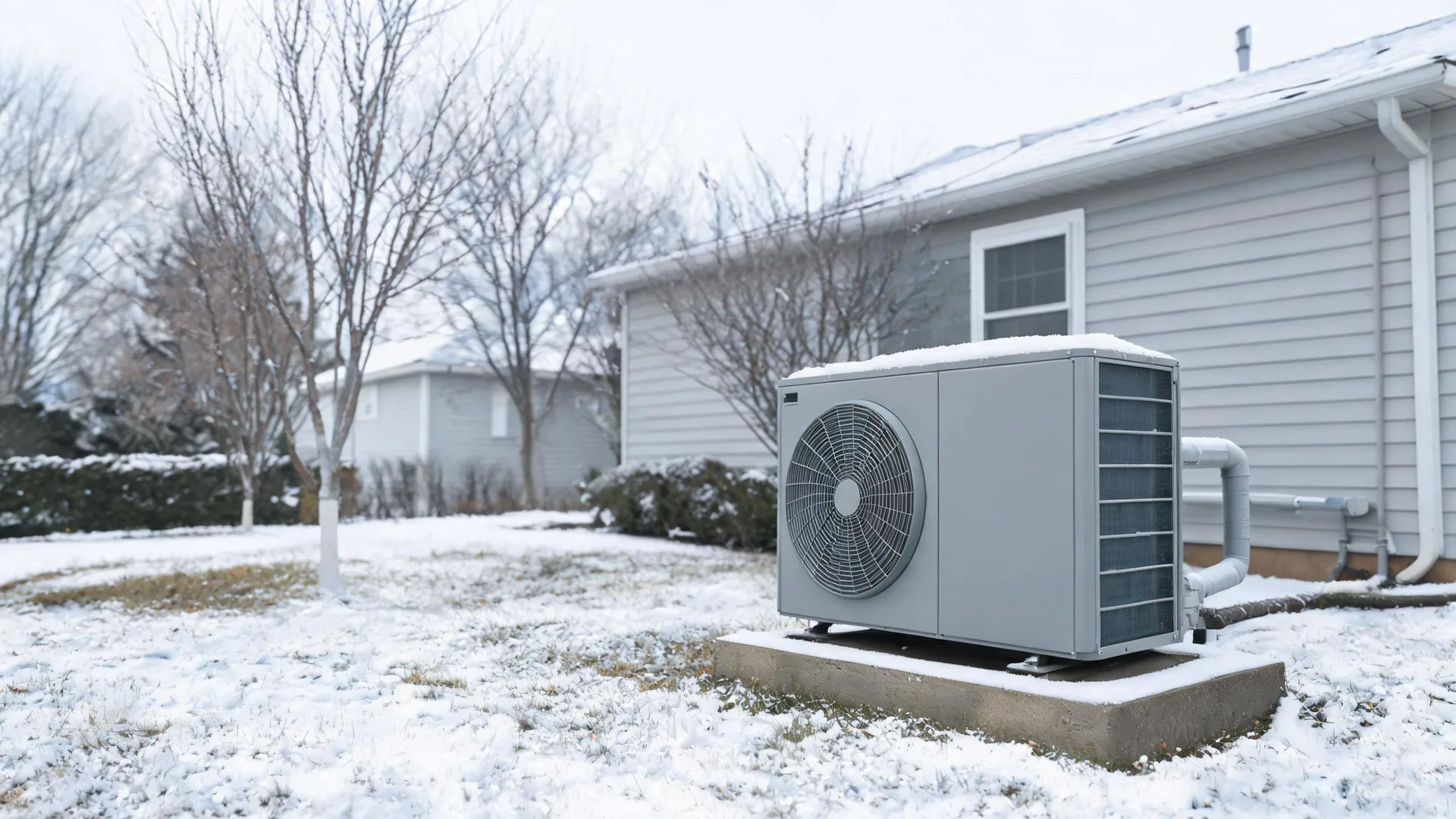
Why the failing part matters more than the symptom

A struggling heat pump doesn't fix itself by running longer. A bad capacitor makes the compressor work harder every time it starts, and a compressor that keeps straining to start is one that wears out early. A refrigerant leak behaves the same way. It doesn't stay the size it started at, and the system runs low longer each week until it can't keep up at all. Whatever part is failing tends to drag down the part next to it, which is why the repair gets bigger the longer it sits.

A compressor that keeps starting against a bad capacitor is building heat it can't shed, and that heat breaks down the motor windings a little more each time. Ice on the outdoor coil blocks airflow, so the system pulls in less heat than it needs, runs longer to compensate, and loads the compressor harder while it's already struggling. A slow refrigerant leak works the same way from a different angle. Less refrigerant means less oil circulating back to the compressor, since the oil travels with the refrigerant, and a compressor running short on oil wears at its bearings even if it keeps starting fine. None of this shows up as a sudden stop. It shows up as a system that runs more and heats less, until the part that was marginal finally gives out and takes the next one with it.

A diagnostic visit starts outside, at the unit itself. A tech checks refrigerant pressures, amp draw on the compressor and fan motor, and the condition of the capacitor and contactor before touching anything else. Readings that don't match what the system should be pulling point toward where the problem actually is, rather than where the symptom showed up. Inside, they'll check the air handler, the coil, and run the system in both heating and cooling to see if the reversing valve switches clean. If there's frost on the outdoor coil, they'll watch a defrost cycle to see whether it clears on its own or whether the control board or sensor is the reason it doesn't. Most of this is done with gauges and a multimeter, not guesswork, and a tech should be able to tell you which part is failing and why before any repair gets quoted.