A snow-covered residential street at twilight with illuminated houses, bare trees, and an orange horizon glow beneath a deep blue sky.

Heat Pump Repair in Wamego, KS

Tell us about the job

Takes about a minute. No obligation.

RepairHeat PumpPottawatomie County, KS
Step 1 of 2

What ZIP code is the job in?

The tech checks both modes

A heat pump has to move heat in and out, so the tech runs it in cooling and in heating to see where it struggles. Refrigerant charge, the reversing valve, the defrost control board and airflow across both coils all get checked, since a problem in one mode can trace back to a part that only shows itself in the other.


The fix depends on what's actually wrong

A refrigerant leak gets found and sealed before anything gets recharged. A reversing valve that's stuck means it gets replaced, not cleaned. A dirty outdoor coil might just need a real cleaning instead of a part swap. Knowing which one it is before any work starts keeps the homeowner from paying for a repair that was never going to fix the problem.

7 months
October through April, your system heats
4 months
June through September, it cools
20°F
the average winter night it heats against
87°F
the average summer afternoon it cools against
Isometric cutaway illustration of a house showing interior ductwork, an indoor air handler unit, and an outdoor condenser unit beside the building.
Your system heats October through April and cools June through September.

NOAA nClimDiv, 1991–2020 normals

Electricity in Pottawatomie County runs 15.36 cents per kilowatt-hour.

A heat pump that's struggling pulls more power to do the same job, and you pay for every bit of it.

This machine switches on in June and October, and that's when a weak part fails

Cooling runs June through September
Heat runs October through April
82 hail events from 2015 to 2024

Half the homes in Pottawatomie County were built in 1987 or later. If yours is one of them, the heat pump itself may still be fairly young, since a system gets replaced on its own schedule, not the house's. A newer system that develops a problem usually has a sound compressor and good coils behind it. That's the kind of situation where fixing the failed part makes more sense than replacing the whole unit.

Stop paying for a struggling machine

Power costs more here, so a machine that's running badly costs you every month. Get it fixed soon.

Find a contractor
A man seen from behind in a dark shirt and tan pants carries a canvas duffel bag up concrete steps toward a red front door, with a potted shrub to the right.
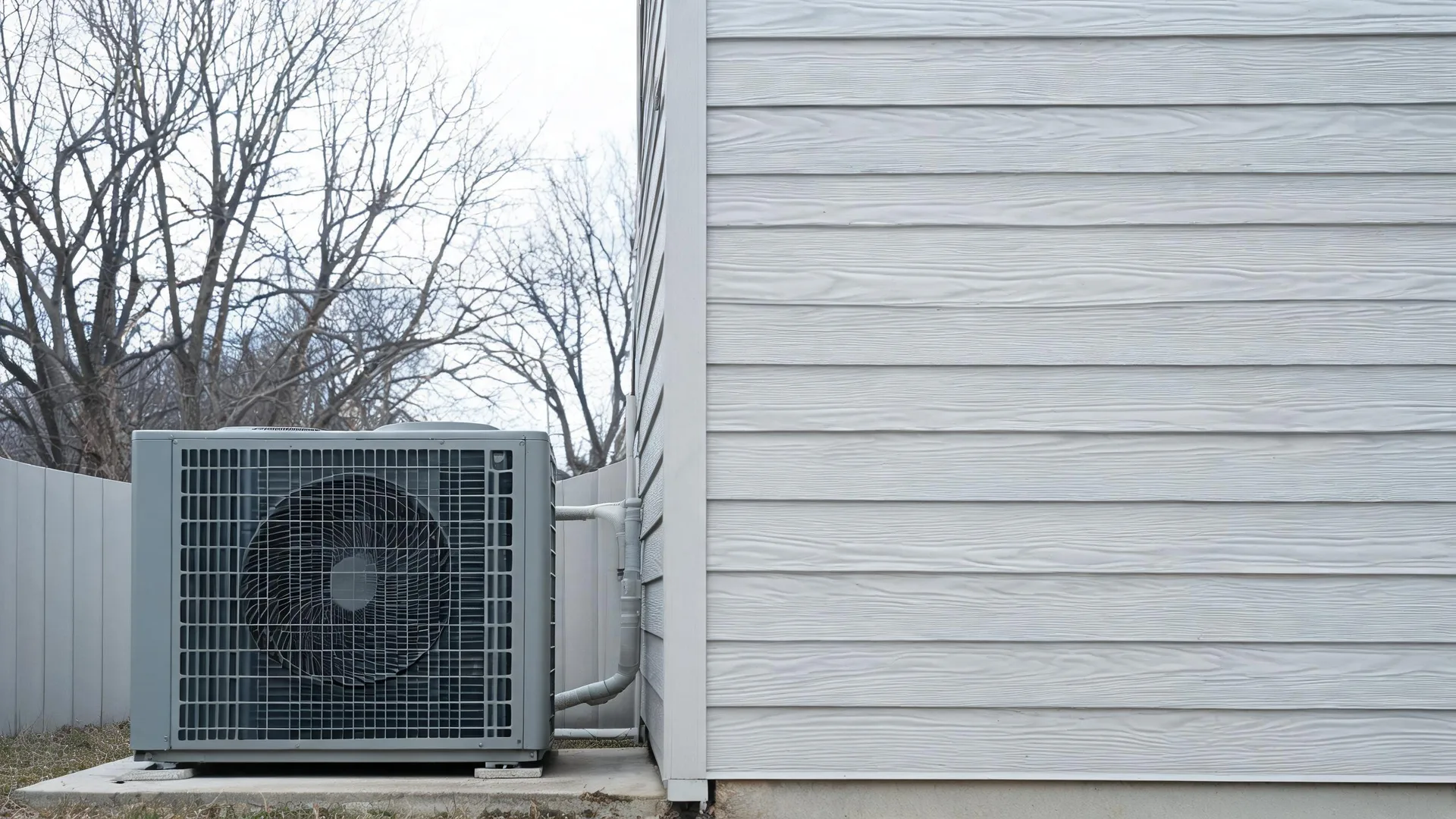
A gray outdoor HVAC unit mounted on a concrete pad beside a house with gray lap siding and a stone foundation.

A system with life left in it is worth fixing

Watch this heat pump across a full day here and you'll see it switch modes, not just cycle on and off. That back and forth is normal. What matters is whether it gets there and back without a fight. A system with good years left in it should shift from heating to cooling without hesitating, without a strange sound, without tripping the breaker. If yours came with a newer build, there's a good chance the compressor and coils are fine and the trouble is one part doing its job wrong.

A small fault turns into a bigger one

A heat pump that's low on refrigerant will keep running, but the compressor ends up working harder to move the same amount of heat. Run it like that long enough and the compressor itself takes the damage, not just the part that failed first. What started as a leak you could seal turns into a compressor you have to replace.

Ice on the coil doesn't fix itself

If the defrost cycle isn't kicking in right, frost builds on the outdoor coil instead of melting off. The system keeps calling for heat or cooling through it anyway, and airflow across that coil keeps dropping. Left alone, the ice gets thicker, the coil can't do its job at all, and the compressor is left straining against a system that can't move air.

A heat pump in trouble doesn't always go quiet about it. Warm air coming out of the vents when it should be cold, or the reverse, usually means it's stuck in one mode or the reversing valve isn't shifting like it should. Short cycling, where it kicks on and off every few minutes instead of running a full cycle, points to a control problem or a system that's low on charge. Ice on the outdoor unit that doesn't melt off during the defrost cycle means that cycle isn't doing its job. A hissing or bubbling sound near the lines usually means refrigerant is escaping somewhere it shouldn't. And if the outdoor fan runs but the compressor stays silent, or the whole unit trips the breaker when it tries to start, that's a sign something electrical or mechanical inside has failed. None of these fix themselves by waiting.

A heat pump that's low on charge or stuck cycling doesn't just perform worse, it pulls more power doing it. The compressor runs longer trying to hit the same temperature, and that extra runtime shows up on the bill before anything else tells you something's wrong. Waiting a few weeks to see if it's really a problem just means a few more weeks of paying for a machine that's struggling. A tech can usually tell within one visit whether it's a quick fix or something bigger. Either way, you stop paying the penalty for not knowing.