







An outdoor heat pump unit mounted on a concrete pad in front of a two-story suburban house.

Heat Pump Repair in Wichita, KS

Tell us about the job

Takes about a minute. No obligation.

RepairHeat PumpSedgwick County, KS
Step 1 of 2

What ZIP code is the job in?

Sedgwick County saw 620 severe weather events between 2015 and 2024. Most of that was wind and hail. Damaging wind hit 332 times in that span, and hail came through 268 times, so the outdoor unit sits outside through a lot of rough weather. A dented cabinet or bent fins on the coil do not always stop a heat pump from running, but they can keep it from working the way it should. Tornadoes touched down 4 times in the same years, and winter storms brought heavy snow and ice 11 times, so wind-blown branches and ice are in play too. If the outdoor unit has taken a hit from a storm, it is worth having someone look at it even if it is still keeping the house comfortable.

7 months
October through April, your system heats
5 months
May through September, it cools
24°F
the average winter night it heats against
90°F
the average summer afternoon it cools against
Isometric cutaway illustration of a single-story house showing interior ductwork, an indoor air handler, and an outdoor condenser unit connected by lines along the exterior wall.
Your system heats October through April and cools May through September.

NOAA nClimDiv, 1991–2020 normals

A heat pump has an outdoor coil exposed to wind, hail, and whatever a storm throws at it.

Bent fins or a dented cabinet can throw off airflow long before the unit quits running altogether.

Wind and hail here are hard on a heat pump, year after year

332 damaging wind events from 2015 to 2024
268 hail events from 2015 to 2024
Power here costs 14.59 cents per kilowatt-hour
Almost no season offCooling runs May through September, heat runs October through April, so a weak part gets found fast

If the outdoor unit has been through a few storms and now something's off, get the cause checked before paying for a fix. A refrigerant leak from a hail-dented coil and a worn-out run capacitor can cause the same weak airflow, and only one of those gets fixed by replacing the part that failed. A contractor can tell you which one you're dealing with. That matters more here than in places where the unit just sits and ages quietly. With 332 wind events and 268 hail events behind it, the damage sitting under a unit that still runs may have built up over more than one storm.

Storm damage on a heat pump does not always show up right away

If the outdoor unit has taken a hit from wind or hail and something seems off now, have it checked before it goes any further. A heat pump that still runs can be working harder than it should.

Find a contractor
A man seen from behind in a dark shirt and tan pants carries a canvas duffel bag up concrete steps toward a red front door, with a potted shrub to the right.
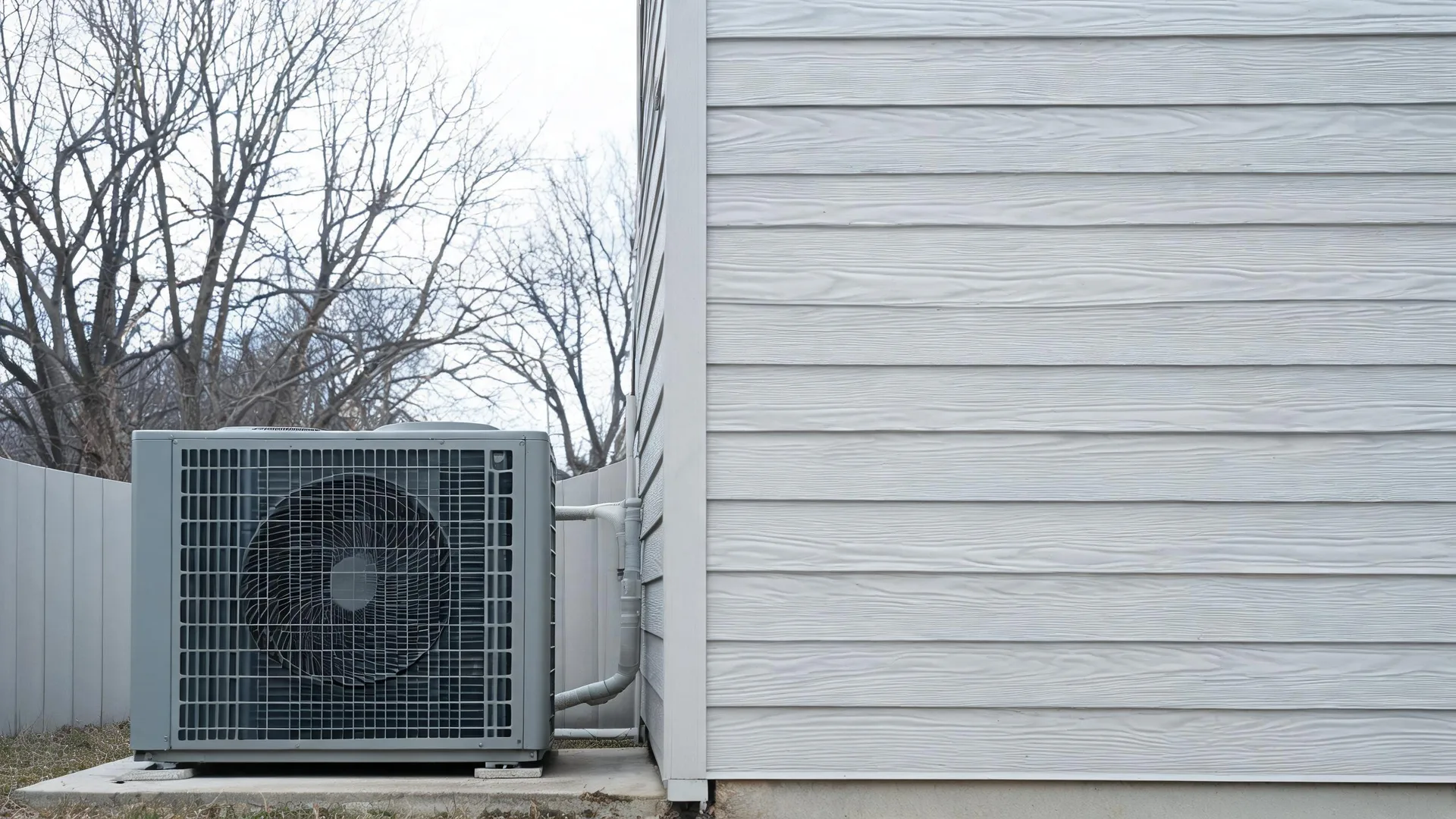
A dark gray heat pump unit mounted on a concrete pad next to a house with gray siding and a stone veneer wall.

It runs nearly year round, so trouble doesn't stay hidden long

A heat pump does not get an off season. It switches between cooling and heating and keeps working the parts that wear: the reversing valve, the contactor, the compressor itself. A furnace that only fires up for half the year gets a rest the rest of the time. A heat pump's compressor doesn't get that. So when something is starting to go, like a contactor with pitted contacts or a capacitor that's weakening, it tends to show up sooner rather than later. Short cycling, a unit that runs constantly without catching up, warm air out of the vents when it should be warm, cold air when it should be cold. None of that is normal, and none of it tends to fix itself. The same goes the other way: a heat pump that's been maintained and kept clear of debris around the outdoor unit will generally hold up better over all that run time than one that's been ignored. Either way, more hours running means wear shows itself faster, for better or worse.

Check the simple things first

Look at the thermostat before anything else. Make sure it is set to the right mode and the temperature actually calls for heating or cooling. Check the breaker for both the indoor air handler and the outdoor unit, since a tripped breaker on either side will stop the system cold. Swap or clean the air filter if it is dirty. A clogged filter chokes airflow and can make a heat pump seem like it is failing when it is just starved for air. Walk outside and look at the unit itself. Clear away leaves, grass clippings, or anything piled against the cabinet, since the outdoor coil needs open air around it to work at all.
Know what to leave alone

Do not open the outdoor unit's cabinet or touch anything inside it. The electrical components in there can hold a charge even with the power off, and refrigerant lines are not something to work on without the right equipment. If you see ice built up on the outdoor coil, do not chip at it. Turn the system off and let it thaw, or switch to fan only if the thermostat allows it. If the air coming from the vents is the wrong temperature, if the unit is making a new noise, or if it is short cycling, that points to something inside the system itself, like the reversing valve or the compressor. Those are jobs for someone with gauges and training, not something to chase down with a screwdriver.

A heat pump that is struggling does not fix itself by staying on. A compressor working against a low refrigerant charge runs hotter than it should, and that heat breaks down the oil that keeps it lubricated. A reversing valve that is starting to stick gets worse with every cycle it is forced through. Even something as simple as ice on the outdoor coil blocks airflow further the longer it sits, which makes the system pull harder to do the same job. The part that is failing does not get a break just because the house is still comfortable. Shutting the system off and calling someone before it fully quits usually costs less than letting it run until it does.

A heat pump nearing the end of its working life tends to ask for repairs more often, not less, and each one is a separate decision. A compressor failure is the one that usually settles the question, since the compressor is the most expensive part in the system and the labor to replace it rivals putting in a new outdoor unit. A refrigerant leak raises the same issue if the system uses an older refrigerant that is being phased out, since locating it or paying for it gets harder every year. A blown capacitor or a bad contactor is a different story. Those are inexpensive parts that fail on their own, in systems of any age, and replacing one does not say anything about the rest of the unit. What matters most is whether the same system keeps coming back with new problems or whether this looks like an isolated failure. A contractor who has opened the cabinet and seen what actually failed is in a better position to answer that than a guess based on how the system sounds or how old it looks from outside.