
Why your AC runs all day in Kansas summers

RepairCentral ACKansas
Step 1 of 2

What ZIP code is the job in?

Why does my AC run all day in the summer?

You keep the house comfortable, and lately the AC hasn't shut off for hours. You're checking vents, listening at the thermostat, wondering if it's broken or if this is just how Kansas summers go. The electric bill crossed your mind too, but mostly you want to know if the unit running nonstop means something is wrong with it.

A system in good shape still runs long hours when it's muggy out

A healthy air conditioner pulls humidity out of the air along with heat, and Kansas summers hand it a lot of both to work through. That alone stretches run times past what you'd see on a dry 90 degree day somewhere else. If the house holds its set temperature and the air coming out of the vents feels properly cold, long runtimes on their own aren't a problem. What is worth a look: short cycling, a system that runs all day but never quite reaches the thermostat setting, or air that isn't as cold as it should be. Those point to something worth a technician checking, not just a hard summer.

A gray outdoor air conditioning condenser unit on a concrete pad beside a house with horizontal siding and a stone veneer base, with a wall-mounted disconnect box and conduit, next to a shrub bed and a concrete patio.

Running long but keeping up

On a sticky Kansas afternoon, a healthy AC can run close to nonstop and still hold the temperature you set. If the house feels cool and the air coming from the vents feels cold, the long runtime is the system doing its job in the heat.


An outdoor air conditioner condenser unit on a concrete pad beside a house with light gray vinyl siding, with a gray electrical disconnect box and conduit on the wall, gravel beds and dried plants nearby, and a concrete sidewalk in the foreground.

Running long and losing ground

This unit sits against the siding, gravel bed around it, weeds growing close enough to crowd the sides. Airflow around an outdoor unit matters, and so does what's inside it. If the house stays warm no matter how long it runs, something is working harder than it should.

A woman with dark hair in a bun wearing a cream knit sweater sits on a gray sofa in a bright living room, looking off to the side.
A woman wrapped in a knit blanket sits on a gray sofa in a living room, looking toward a bright window with houseplants and an armchair in the background.
A woman in a gray cowl-neck sweater sits on a light sofa with cushions, smiling and looking to the side, with a kitchen and window visible behind her.
A woman with dark hair in a bun, wearing a light linen shirt, sits on a sofa and looks to the side, with a window, houseplants and a kitchen with pendant lights blurred behind her.

How your AC actually cools

  • A central AC cools by running a compressor that moves refrigerant between the outdoor coil and the indoor coil, not by switching on and off like a light.
  • A thermostat set at one temperature calls for cooling continuously until the indoor coil pulls enough heat out of the air to reach it, so a long call is normal.
  • Most residential systems run on a single fixed speed, so the only way to put out more cooling is to keep running, not to run harder.
  • The outdoor coil gives up heat to the outside air, and the higher the outdoor temperature, the longer that trade takes to catch up with the house.
  • Humidity adds a second job, since the indoor coil has to condense moisture out of the air at the same time it pulls out heat.
  • A dirty filter or a low refrigerant charge slows both of those jobs down and stretches a normal long runtime into one that never catches up.

A central AC isn't like a space heater clicking on and off. It runs a compressor that pushes refrigerant in a loop, out to the coil outside, back to the coil inside the air handler. That compressor stays on as long as the thermostat is calling for cooling, and on a 95 degree Kansas afternoon, that call can last a long time. Most home systems have one speed. There's no low and high setting, no way to push harder when it's hotter outside. The only lever the system has is time. So when it's hot, it just runs longer to move the same amount of heat out of the house and into the outside air, which is fighting it the whole way. Humidity makes the job bigger. The indoor coil isn't just cooling the air, it's also condensing the moisture out of it, the same way a cold glass sweats on a July evening. Both of those happen on the same pass of air across the same coil. When the outdoor air is heavy and wet, which is most of a Kansas summer, that coil is doing two jobs every time air crosses it, and that takes longer than cooling dry air would. A clogged filter or a refrigerant charge that's run low doesn't cause this. It makes it worse, turning a long but normal runtime into one that falls behind and never quite reaches the set temperature.

A gray outdoor air conditioning condenser unit on a concrete pad beside a house with horizontal lap siding, with a conduit and electrical disconnect box on the wall and a green shrub in mulch to the right.
A clean condenser with clear space around it can move heat outside all day without losing the fight against a 95 degree afternoon.
A weathered outdoor air conditioner condenser unit on a concrete pad beside a house with horizontal vinyl siding, with a conduit and disconnect box on the wall to the right.
Dirt packed into the grille and leaves piled at the base choke airflow, so the unit runs longer and still falls behind.
An older woman with short gray hair in a cream cable-knit turtleneck sweater smiles while looking to the side in a wooden kitchen, with a round loaf of bread on a board in the foreground and a lit candle by a dark window.
A woman with her hair in a bun sits wrapped in a beige knitted blanket on a couch, holding a sleeping child against her chest in a warmly lit room with a lamp and houseplant in the background.

Matched to your air conditioner job

Describe what your air conditioner is doing once, in one form.

You're not committing to anything by asking.

An outdoor air conditioner condenser unit on a concrete pad beside a house with light horizontal siding, with a small electrical disconnect box on the wall, mulch and shrubs at left, and a plain white wall and concrete slab at right.

What a thermostat setting actually does

A thermostat doesn't limit how long the compressor runs. It only tells the system when to stop, once the air at the register matches the set temperature. On a 98 degree day, that point takes longer to reach than on a mild one, so the compressor stays on longer to get there. That's the thermostat working correctly, not struggling.

A dark gray outdoor air conditioner condenser unit on a concrete pad beside a house with horizontal siding and a plain light wall, with mulch and grass in the foreground and a conduit and electrical box on the wall.

The gap between outside and inside

The harder a system works to move heat from indoor air to the outdoor air, the longer each cycle runs. A 20 degree difference between outside and your set temperature asks a lot less of the compressor than a 30 degree difference does. Kansas summers push that gap wide most afternoons, and the equipment answers with a longer runtime, not a shorter life.

A man with a duffel bag walks up a concrete path toward a white board-and-batten house where a woman stands in the open wooden front door, flanked by potted plants and black lanterns.

What a long runtime is doing to your house

A system that runs long but keeps the house cool is working as it should. One that runs long and still leaves rooms warm is losing ground, and that gap tends to show up first in whichever room is farthest from the thermostat. Check it at the end of the day. If that back bedroom is still warmer than the hallway, something is making the system work harder than a Kansas summer alone explains.

The other place it shows up is the bill, since a compressor that never gets to rest is pulling power the whole time it runs. If you've reached the point of wanting someone to look at it, the work most people dread is finding who to call, explaining the symptoms once, then again, then comparing what each one quotes. Answer a few questions about your system and your house, and a contractor who covers your part of Kansas gets in touch with you directly.

A mug and a small round vase sit on a wooden windowsill beside sheer and heavier curtains, with blurred autumn trees seen through the rain-speckled window and a sofa with cushions and a throw in the foreground.
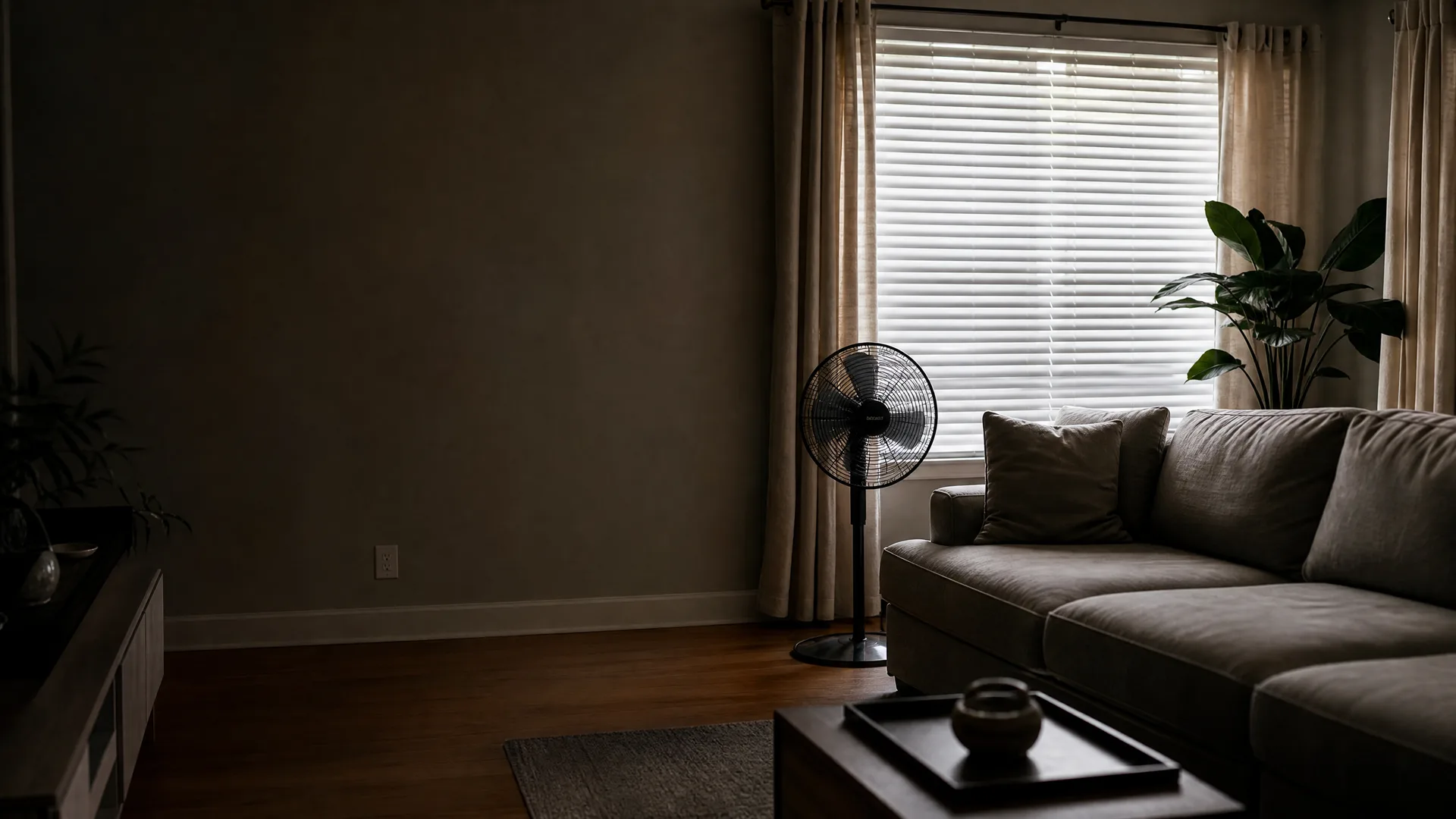
A dimly lit living room with a gray sectional sofa, a standing pedestal fan, a curtained window with blinds, a potted broad-leaved plant, a wooden coffee table with a tray and lidded jar, and a rug on dark wood flooring.

It's a little after two and the blinds are drawn against the sun, the kind of July afternoon where the light outside looks white. You've pulled the floor fan over next to the couch and pointed it at the spot where you're sitting, because the air from the vent above you isn't doing much from here. The AC has been running since before lunch. You can hear it through the wall, that steady low sound that hasn't changed in hours. Your hand on the cushion feels the fan more than the vent. Somewhere behind you a glass sweats a ring onto the side table, and the dog's found the one patch of tile floor and stretched out flat on it.

Power costs 14.44 cents per kilowatt-hour statewide

At that rate, a system running long hours on a July afternoon shows up directly on your bill, since every hour the compressor runs is an hour you're paying for. A repair that gets your AC back to normal runtimes keeps those long hours from becoming a pattern all summer.

EIA-861 2025 statewide residential average

A long runtime on a hot Kansas day doesn't tell you much by itself. A cool house tells you the system is keeping up. A house that stays warm while the AC keeps running tells you something is wrong, and that's worth a repair call rather than another week of watching the thermostat. You don't have to figure out whether it's low refrigerant, a dirty coil, or a failing capacitor before you pick up the phone. That part isn't on you. Once you request a repair here, you're matched with a contractor who takes on the diagnosis, the explaining, the back and forth that usually falls on you when you're the one calling around and repeating the same story to every number you try. You keep the house livable for the people in it. Figuring out which contractor to trust and chasing down quotes shouldn't be the thing standing between your family and a working AC.

Sunlight falls across a beige upholstered sofa with a textured woven cushion and a chunky knit throw, beside a dark wood cabinet holding a ceramic vase with green leafy branches, near a white-framed window.
A sunlit corner of a room with a wooden side table holding a ceramic vase of green foliage and a wooden bowl, beside a light upholstered sofa with a knit throw and rust-colored pillow, with window shadows cast on a beige wall.
A sunlit room corner with beige walls, a white-framed window with sheer cream curtain, wood floor with a light rug, and a woven basket holding a knit blanket.
A beige ceramic vase holding a leafy green branch sits on a wooden cabinet in a corner, with sunlight through a sheer curtain casting leaf shadows on the wall.
A grey upholstered sofa with a rust-orange velvet cushion and a textured throw sits beside a window with linen curtains, next to a wooden side table holding a pale ceramic vase of olive branches.

An air conditioner pro near you

Answer a few questions instead of calling shop after shop.

Match me with a pro

It costs nothing to send, and you don't have to hire anyone.