A local pro who services air conditioners gets in touch about the tune-up.
A hundred degrees outside and your AC is the only thing standing between your family and a miserable week. In Kansas, when summer turns mean, it doesn't ease up for a day or two. It sits on you for stretches at a time, and the unit outside your house runs almost nonstop to keep up.
That kind of run time is hard on a system. A dirty coil can't shed heat the way it should. A low charge makes the compressor work harder than it was built to. A weak capacitor can leave the unit struggling to start at all, right when you need it most. None of these show up all at once. They build during the exact weeks when you can least afford the system to quit.
Maintenance done before or during a heat wave catches what's already going wrong, not what might go wrong someday. A contractor who checks the refrigerant charge, cleans the coil, and tests the electrical parts is looking for the specific thing that's about to fail in your system, not reading off a general checklist.
You don't have to figure out on your own what your unit needs or who's available to look at it this week. Once you send the request, that search is no longer something you're carrying. It gets handed to a contractor who takes on the job of understanding your situation, your system, and when you need it looked at, and reaches out to you directly.
Kansas summers don't leave much room for a system to limp along. The sooner the small problems get found, the less chance they have of taking your AC down on the hottest day of the year. The button below is where that starts.
When a Kansas heat wave sets in, your AC runs almost nonstop for days, and that is what gets it into trouble. The system is sized to cycle on and off, resting between runs so heat can shed off the outdoor coil and the compressor doesn't labor nonstop. Take that rest away and a few things that were minor start to matter. A dirty coil can't shed heat as well, so the unit works harder to hit the same temperature. A low refrigerant charge that was tolerable in June starts making the compressor strain. A weak capacitor that barely started the fan motor before may not start it at all once the unit has been running for hours straight. None of this means the unit is failing. It means small weaknesses that never had to prove themselves now have to, every single day of the heat wave, with no break in between. Keeping it running through the stretch depends on how well it was holding up before the heat hit.
Running steady, cycling off and on like it's built to, coil and fan both doing their job.
Running nonstop and never cycling off, which means it's not keeping up and something needs a look.
Your AC is built to turn off and on, not to run straight through for days. A heat wave takes that rest away. The outdoor coil needs cooler air passing over it to let go of heat, and when the air outside is sitting near 100 degrees, that process just works slower. The compressor feels this the most. It's the part moving refrigerant through the whole system, and hours of nonstop operation push its temperature higher than it would ever reach in a normal cycle. Anything that limits airflow, a dirty coil, a clogged filter, makes the compressor work even longer to move the same heat. Refrigerant is what actually carries heat out of your house, and if the charge is low, every cycle carries less of it, so the system has to run more to keep up. The indoor fan motor is running this whole time too, with no pause. A capacitor already on its way out tends to give up under this kind of sustained load, not during a quick startup.
Why Long Runs Wear Parts Out
The outdoor coil sheds heat into the air, and when the air around it is already near 100 degrees, that transfer slows down.
The compressor is the part doing the most work, and running it nonstop for days raises its temperature well past a normal cycle.
A dirty outdoor coil or a clogged filter cuts airflow, so the system has to run longer to move the same amount of heat.
Refrigerant picks up heat inside the house and releases it outside, and a low charge means less heat gets carried out each cycle.
The fan motor that pulls air across the indoor coil runs the entire time the system runs, with no break to cool down.
A capacitor that's starting to weaken often fails during a long run instead of at startup, because sustained load is harder on it than a short cycle.
Before you get your air conditioner maintenanceAfter you get your air conditioner maintenance
The right pro for this job
Send the form, and lining up the air conditioner tune-up stops being yours to chase.
Say what's going on with your air conditioner, and a pro who works on them reaches out.
You find out the capacitor is weak the day you need the AC most, not before.
Dust and grime on the outdoor coil stay put, so the coil keeps shedding heat worse than it should right when it's hottest outside.
A refrigerant charge that drifted low stays low, so the system works harder without anyone catching it.
If the system fails mid heat wave, you're waiting on a contractor the same week everyone else with the same problem is calling.
Small issues like a dirty filter or a sluggish fan motor keep stacking up against a compressor that's already under strain.
Get it maintained
A contractor checks the capacitor and refrigerant charge before the heat wave puts them to the test, not during it.
A cleaned outdoor coil sheds heat the way it's supposed to, even when the air around it is pushing 100 degrees.
Fan and motor get looked at and lubricated where needed, so they keep pace instead of straining.
Catching a weak part on a mild day means it gets handled before it becomes a no-cooling call in July.
A system that's been gone over runs the way it was built to, cycling off instead of grinding nonstop.
Coil clean, cycling normal
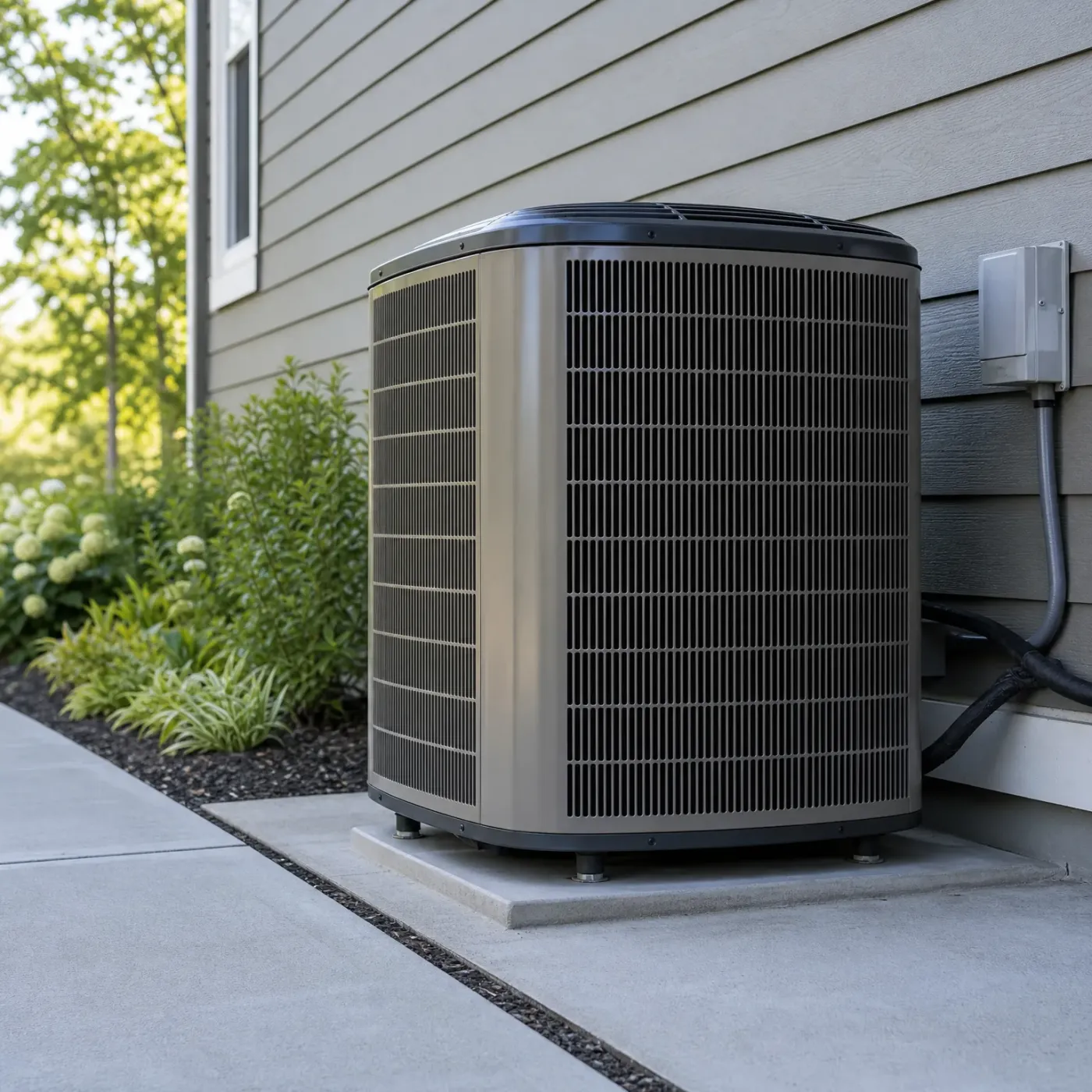
The outdoor unit sits on its pad, disconnect box mounted on the wall beside it, cabinet clear and the fins open to the air. Heat moves off the coil the way it's supposed to, so the compressor gets the breaks it needs even when it's running hard.
Coil caked with dust
That wire mesh is supposed to let air through, not hold onto grime. With dirt built up like this across the cabinet, the coil can't shed heat fast enough, and on a hundred-degree day that's the difference between an AC that keeps up and one that doesn't.
Refrigerant lines under heat stress
Heat makes a refrigerant system work harder to move heat out of the house. A low charge or a restriction shows up fastest during a stretch like this, not on a mild day.
The compressor and fan both rely on the capacitor to start and keep running. A weak one can let the system run partway, then drop out during the hottest part of the day.
You might notice the outdoor unit running longer than usual, or not shutting off at all between early morning and late at night. Inside, air coming from the vents feels less cold than it did a few weeks ago, and the house takes longer to cool back down after the front door opens and closes a few times. Some homeowners hear a hum from the outdoor unit instead of the usual click and whir of the compressor starting. A warm room upstairs that used to even out by evening might stay warm now. Left alone through a stretch of hundred degree days, a system already struggling can stop keeping up with the house entirely, and that's a harder problem to fix than one caught early.
Late May, and the cottonwoods along the yard have already let go. You cut across the side yard to grab the hose and notice the condenser fins gone white, a soft layer of fluff caught across the whole face of the unit. It came down over a few days without you thinking much of it. You crouch down and see the fan still turning fine behind it, but the fluff sits packed into the fins like a filter that was never meant to be there. Summer in Kansas hasn't even turned mean yet, and already the coil underneath that fluff is working through a layer of cotton to get rid of any heat at all.
Power costs 14.44 cents per kilowatt-hour statewide
At 14.44 cents a kilowatt-hour, every extra hour your AC runs through a heat wave shows up on the bill. A unit that's cycling normally costs you less to run than one straining nonstop, so keeping it tuned up matters as much for your wallet as for your comfort.
EIA-861 2025 statewide residential average
Maintained unit, ready for it
This is a system set up to take a heat wave in stride. The pad is clean, the lines run straight into the wall, and the fins are open so air moves through them. Nothing here is working harder than it has to.
Worn unit, falling behind
Rust on the shroud and dirt packed into the fins mean the coil can't shed heat the way it should. An older unit like this is already working at a disadvantage before the heat even hits, and a stretch of hundred-degree days finds that weakness fast.
Summers here carry a dew point around 64°F, by the National Weather Service average for June, July and August. That's the kind of air that doesn't dry out overnight. Your AC isn't just pulling heat out of the house, it's pulling moisture out too, and that second job gets harder when the air outside is already heavy with it. You'll notice it as a house that feels warm even when the thermostat reads where you set it, because sticky air sits on your skin different than dry heat does. The system has to run longer to get the same comfort, which is more hours of work stacked onto a stretch that's already asking a lot of it.
NASA POWER T2MDEW county cells weighted by homes
Your AC's job is to keep up, not to prove itself
A heat wave in Kansas doesn't test your air conditioner once. It tests it for days straight, and a system that's clean and charged right handles that the same way it handles a normal July afternoon. One that's behind on upkeep starts showing it the first long stretch above 100, and by then you're not scheduling maintenance anymore, you're waiting on a repair.
Getting matched with a contractor who services your system means someone looks at the coil, the charge, the capacitor, the things that decide whether your AC cycles like it should or runs itself into the ground. Once you send the form, that part isn't on you anymore. The contractor reaches out, and you're not the one tracking down who's available during the week everyone else is calling too.