Profile view of a bearded man wearing a black baseball cap and a dark gray T-shirt against a plain light background.

Why your AC keeps turning on and off in Kansas

RepairCentral ACKansas
Step 1 of 2

What ZIP code is the job in?

An AC that turns on and off every few minutes, instead of running a steady cycle, is short cycling. The most common reason is a unit that's too big for the house, which cools the air fast without pulling out the humidity, so the thermostat shuts it off before the house actually feels comfortable. A dirty air filter or a low refrigerant charge can cause the same thing, because the system senses it's struggling and stops to protect itself. A failing capacitor or a bad thermostat sensor can also trigger it. In a Kansas summer, with the humidity that sits over the state for months, short cycling means the air never gets properly dried out, so the house feels clammy even when the temperature looks fine on the thermostat. It also means the compressor is starting far more often than it should, which wears on it faster than steady, longer runs. Left alone, this tends to get more frequent, not less.

A smiling woman with dark shoulder-length hair in a cream V-neck sweater sits at a marble counter with a glass of red wine, with a kitchen and softly lit living room behind her.
A woman in a dark green sweater laughs while seated at a marble kitchen island with a glass of red wine, with open shelving, cabinets and a living room visible behind her.
A woman with long dark hair in a cream knit sweater laughs while looking off to the side, seated at a counter with a glass of red wine, in a dimly lit living room with a sofa, lamp, framed pictures and houseplant behind her.
A smiling woman with long dark hair in a beige sweater sits at a marble kitchen counter with a glass of red wine, with a dimly lit living room behind her.
A gray outdoor air conditioner condenser unit on a concrete pad beside a house with horizontal vinyl siding, surrounded by mulch, flowering shrubs, and lawn.

Running a normal cycle

A healthy unit outside runs for a while, then shuts off, then stays off for a stretch before starting again. Through a Kansas summer it might run long and often, but each cycle has time to pull the humidity down, not just the temperature.

A weathered outdoor air conditioning condenser unit on a concrete pad beside a house with light horizontal siding, an electrical disconnect box and conduit on the wall, and mulched soil on either side.

Caked coils, short cycles

Dirt packed into the coil fins blocks airflow, so the unit can't shed heat the way it's built to. It overheats, trips off, cools down, and starts again, over and over. A dirty outdoor unit is one of the things that turns a normal cycle into short cycling.

A smiling bearded man in a navy sweater sits at a candlelit dinner table with a glass of red wine, a bowl of salad, and plates of food in the foreground.
A woman with dark hair in a bun reclines on a sofa with her eyes closed, wrapped in a cream fleece blanket, a closed blue hardcover book resting in front of her, with a lit lamp and a vase of dried flowers in the background.

Faulty Part or Wrong-Sized Unit

Call for repair

  • If the short cycling started suddenly, a part has likely failed, like a bad capacitor or a thermostat sensor reading the wrong temperature.
  • A contractor can check the refrigerant charge, since a unit low on refrigerant will often cool fast in a short burst then shut off.
  • If the outdoor coil or air filter is caked with dirt, the system overheats and cuts off early, which a cleaning or filter change can fix.
  • A contractor can tell you if the thermostat is mounted somewhere it's reading badly, like near a supply vent or in direct sun through a window.
  • If the unit is cycling on and off within the same summer it was installed, something was likely set up wrong and needs correcting, not replacing.
  • A repair visit rules out the simpler causes before anyone talks about the size of the unit itself.

Live with it or replace

  • If the unit has always run this way, every summer since it went in, the sizing itself is probably the issue, not a broken part.
  • An oversized unit will keep short cycling no matter how many parts get replaced, since the problem is how much cooling it dumps into the house at once.
  • Short cycling wears on the compressor, so a unit that keeps doing this for years may fail sooner than one that runs normal cycles.
  • Short cycles that never pull down humidity leave the house feeling clammy even when the thermostat says it hit the set temperature.
  • Replacing with a properly sized unit solves the cycling for good, where a repair on an oversized system only treats one symptom at a time.
  • A contractor can measure the house and the current unit's capacity to tell you if replacement is really the fix, instead of guessing from the symptom alone.
A gray outdoor air conditioner condenser unit on a concrete pad beside a house with horizontal lap siding, with a wall-mounted disconnect box and conduit to its right and shrubs to the left.
A clean coil like this one lets the unit pull heat out of the house without straining, so it can run a full, steady cycle.
An outdoor air conditioning condenser unit on a concrete pad beside a house with horizontal lap siding, with a conduit and electrical disconnect box on the wall at right.
Dirt built up on the coil guard like this makes the unit work harder to shed heat, which can push it into short, repeated cycles.
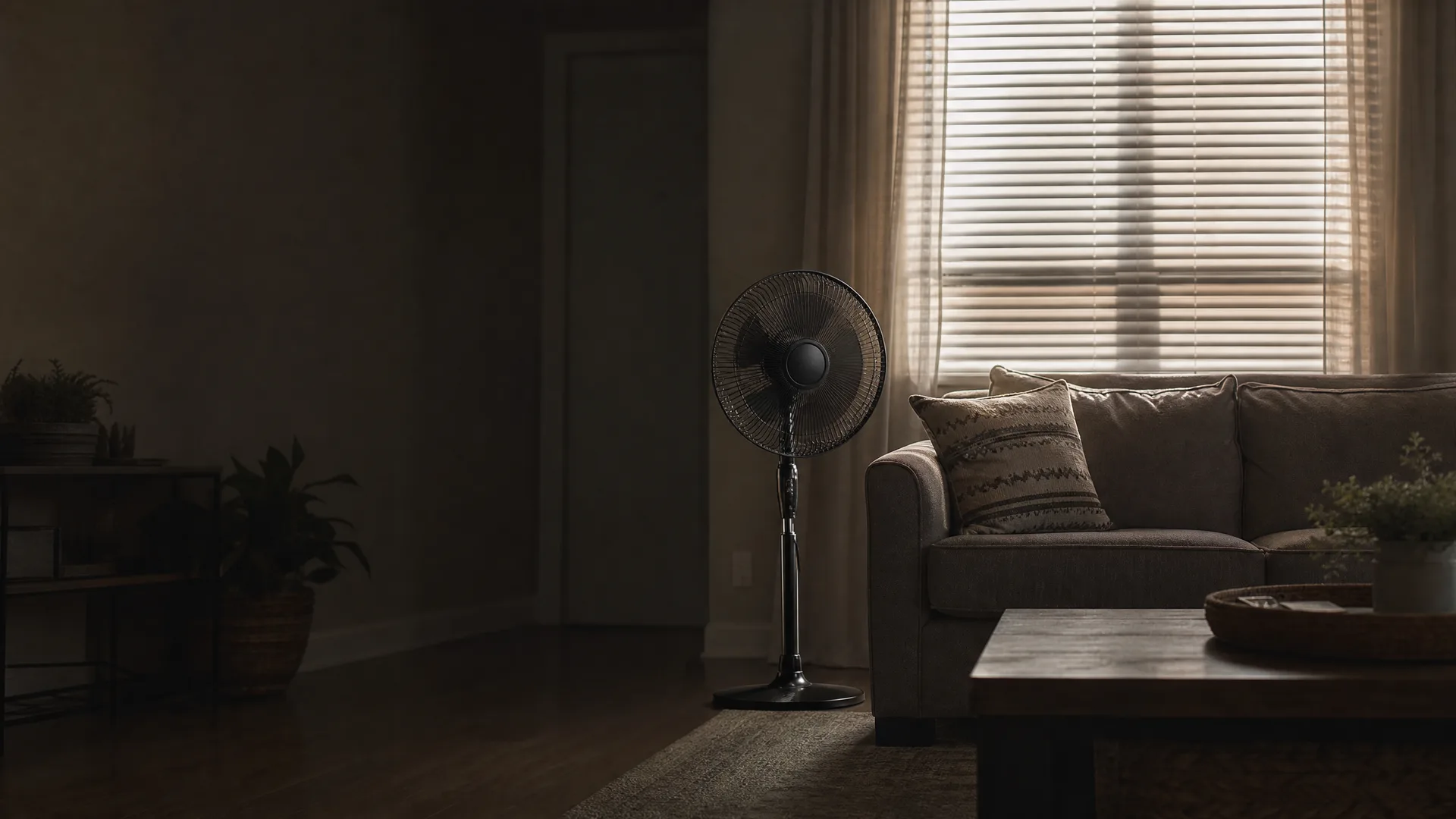
A dimly lit living room with a black pedestal fan on a wood floor beside a gray sofa with a patterned pillow, a wooden coffee table in the foreground, potted plants at left, and a curtained window with blinds behind.

The blinds are shut against the sun, but the room is still bright at the edges. It's past three and the air feels thick even with the fan going beside the couch, blowing across your ankles instead of actually cooling you off. You hear the unit outside kick on, then off again a few minutes later, then on again, that pattern you've noticed all week. The air coming out of the vent is cool enough but the room never quite catches up, and you've stopped expecting it to by this point in the afternoon. You reach for the thermostat, then stop, because you already know turning it down three more degrees won't change what you're hearing outside.


A local pro for your air conditioner repair

A unit that short cycles isn't going to fix itself, and every stop-start cycle in a Kansas summer leaves more moisture hanging in the air of your house. You could start calling around, but then you're explaining the same thing to every company that picks up, waiting on callbacks, and trying to judge who actually knows a short-cycling unit from someone just guessing. A contractor who takes this on can look at the capacitor, the thermostat sensor, the refrigerant charge, or the size of the unit against your house, and work out which one it actually is. That takes someone who's seen it before. Hand off the finding-someone part now, while the afternoons are still sticky and the unit is still kicking on and off every few minutes, and get back to the part where your house just cools down and stays that way.

A gray outdoor air conditioner condenser unit on a concrete pad beside a house with horizontal siding and a light stucco wall, with a disconnect box and refrigerant lines on the wall and a shrub and mulch bed at left.

What short cycling does to the motor

Every time the outside unit starts, the compressor has to work against full pressure before it settles into a steady draw. Starting pulls more current than running does. A unit that starts and stops every few minutes is putting the compressor through that hard start far more often than one that runs a full cycle. Over a Kansas summer, with the unit calling for cooling day after day, that adds up to a lot more starts than a unit cycling normally would ever see.

A gray outdoor air conditioning condenser unit on a concrete pad surrounded by gravel, next to a white horizontal-lap-sided house wall with an electrical box and conduit, against a blank white background on the left.

Why the humidity stays

An air conditioner pulls moisture out of the air mainly in the second half of a cycle, once the coil has been cold for a while and condensation is running off it steadily. A cycle that ends after a few minutes shuts off right around when that would start. The air gets cooled some, but the moisture stays in the house. That's why a room can read at the temperature on the thermostat and still feel damp, with the short cycles never running long enough to do the drying part of the job.

What are you noticing around the house right now

The house doesn't feel cool even though the unit outside keeps running. Rooms feel clammy, and anything left on the counter or the bathroom mirror seems to stay damp longer than it should. You might notice the air coming out of the vents feels cool at first, then warm again a few minutes later, because the cycle keeps cutting short. Some rooms, especially upstairs or ones farthest from the thermostat, stay warmer than the rest no matter how low you set it. Left alone through a Kansas summer, that extra moisture sitting in the house can lead to a musty smell, condensation on windows, and conditions where mold starts in closets or basements.

Single-story house with tan horizontal siding and a dark shingled hip roof, fronted by a patchy green and brown lawn and a concrete walkway leading to the covered entry.

NOAA puts the average summer dew point for Kansas at 64°F, the number that tells you how heavy the air feels rather than just how hot it is. That's thick air for an AC to work against. A short-cycling unit never runs long enough to pull that moisture out, so even when the thermostat says you've hit your set temperature, the air in the house still feels damp. You'll notice it on the skin before you notice it on any gauge, a stickiness that the fan alone can't push away.

NASA POWER T2MDEW county cells weighted by homes

An outdoor air conditioner condenser unit on a concrete pad beside a house with light gray vinyl siding, with a gray electrical disconnect box and conduit on the wall, gravel beds and dried plants nearby, and a concrete sidewalk in the foreground.
Before you get your air conditioner repair
A gray outdoor air conditioning condenser unit on a concrete pad beside a house with horizontal siding and a stone veneer base, with a wall-mounted disconnect box and conduit, next to a shrub bed and a concrete patio.
After you get your air conditioner repair
  1. Thermostat senses indoor temperature and calls for cooling.

  2. Contactor closes and sends power to the compressor and fan.

  3. Compressor pressurizes refrigerant and starts the cooling cycle.

  4. Pressure or sensor fault trips a safety switch early.

Power costs 14.44 cents per kilowatt-hour statewide

At 14.44 cents per kilowatt-hour, every short start of that compressor adds up fast, since starting draws more power than running does. A unit that kicks on and off all afternoon is billing you for the hardest part of the cycle over and over, without ever cooling the house down.

EIA-861 2025 statewide residential average

A man seen from behind raises his hand to wave at a woman standing in the open front doorway of a single-story house with gray shingle siding, white columns and a gabled porch entry.

A unit that runs right doesn't stop every few minutes

A healthy air conditioner starts, runs long enough to pull the heat and the moisture out of your house, and shuts off for a real stretch before it starts again. If yours is cycling every few minutes instead, something in it is already telling you what's wrong, whether that's a sizing problem from the start, a dirty coil making it strain, or a part that failed outright. The fix depends on which one it is, and that takes someone looking at your unit, not guessing from a list of possibilities.

Finding that someone is its own chore. You'd be calling around, describing the same short cycling to every company that answers, waiting on quotes, trying to tell which contractor actually knows what they're looking at. Instead, you can be matched with a contractor who takes on jobs like yours, and they'll reach out to you. One conversation, with someone who already knows what you're dealing with before they walk up to your unit.

A living room corner with a beige upholstered armchair holding navy and striped cushions, a small round wooden side table with a carved bowl and a potted green plant, a framed landscape picture on a pale wall, built-in shelving, and a curtained window.
Elevated view over a flat field with patches of snow, a bare deciduous tree at center, evergreen trees at both sides, and the shingled ridge of a roof in the foreground under a pale sky.

Get the right pro for your air conditioner

Get a local pro

No charge to send it. You decide if you hire them.

A unit that short cycles won't sort itself out over a long Kansas summer. Every week it runs this way is another week of rooms that stay clammy and a bill that charges you for compressor starts instead of actual cooling. Getting it looked at now is what stops that cycle.