
One contractor, not five
A local contractor who services mini splits all summer sees these blink patterns often and knows what to check first before guessing at a fix.

A local pro for your mini split repair
A blinking light on your mini split is its way of pointing to a specific problem, not just a general warning. The pattern of blinks usually tells you whether it's a sensor, a drainage issue, or something electrical. This page breaks down what the blinking means and connects you with a local contractor who works on mini splits in Kansas and can take a look.
Get a local proA blinking light on your mini split is the unit's way of flashing a fault code, and the pattern it makes tells you what kind of problem it's reporting. A steady count of blinks, then a pause, then the same count again, usually points to something specific the control board has caught, like a frozen coil, a clogged condensate line, or a sensor reading that's out of range. In Kansas, where summers run hot and sticky, the drain line is a common culprit since condensation builds up fast when the unit runs for hours at a stretch. The exact number of blinks and how they're spaced depends on the brand, since each manufacturer sets its own codes. What it means for you is that the light isn't random. It's the system telling you where to look, and that's information worth having before anyone opens the unit up.




Inside the indoor unit, a control board watches the sensors and the compressor the whole time the system runs. When something falls outside normal range, the board doesn't just shut down. It converts that specific fault into a number of flashes you can count, then pauses, then repeats the same count so you can confirm what you saw. Three or four repeats is common before it starts over.
Where the fault lives changes what the count means. A code pointing to the drain pan or float switch usually means condensate has backed up and the unit sensed water where it shouldn't be. A code pointing to the compressor or the outdoor unit is telling you the indoor half found a problem it can't correct by itself, often refrigerant or wiring related. Cutting power sometimes clears the code if the trigger was temporary, but if the part that caused it hasn't changed, the same pattern comes right back. Check the remote too. Its small screen sometimes shows its own code, which can narrow down what the blinking light already told you.


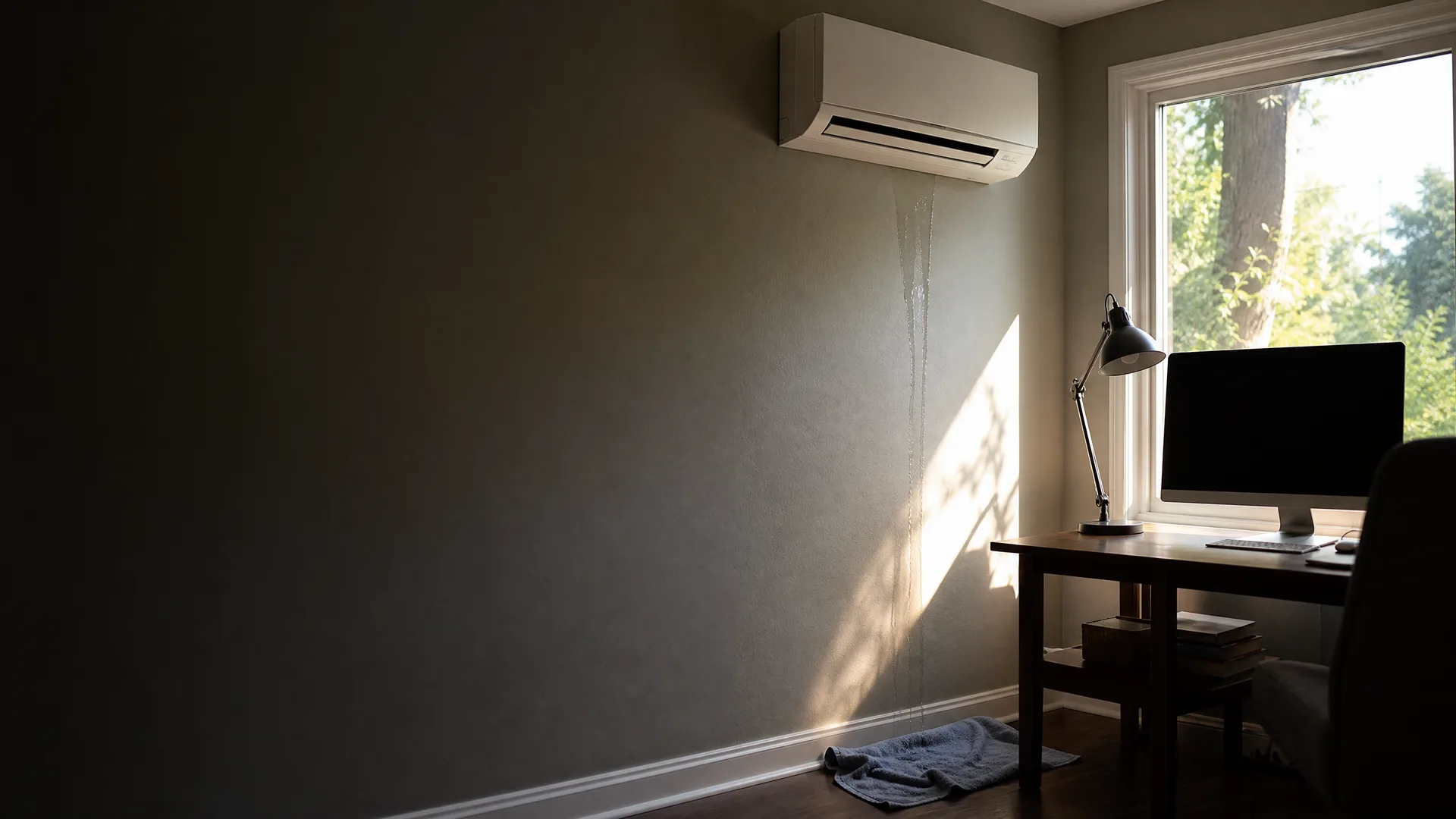
You're at your desk on a July afternoon, the kind where the air outside sits heavy enough that you can feel it through the window glass. The mini split on the wall above you has been running most of the day. You look up and there it is, a dark streak running down the wall under the indoor unit, and you've already set a towel on the floor to catch what's dripping off the bottom edge. The light on the unit blinks the same pattern it has for the last hour. You wipe the wall down, move the towel over an inch, and sit back down, wondering how long the drip has been going before you noticed it. A contractor who handles this equipment around Kansas summers could tell you in a glance whether that's the drain line or something behind the wall.
Your request goes to one pro, not a list of companies.
You only hire the pro if you want to.
The indoor and outdoor units stay in touch through a signal wire running between them, and that connection is a common point of failure. A loose splice or a bit of corrosion at either end can throw a fault code even though the compressor and the indoor coil are both working fine. That matters in Kansas installs especially, since a lot of them run a longer line set than you'd see in a smaller setup, and more line means more chances for a refrigerant leak somewhere along the way. A leak like that often shows up first as a blinking light, well before you'd notice warm air coming out of the vents.
Inside the indoor unit, there's a float switch that watches the condensate drain. If that drain backs up, the switch trips and the light starts blinking, not because of the water itself but because the switch read a problem and shut things down to protect the unit. Outside, the coil can get choked with cottonwood seed in early summer or grass clippings if the unit sits near where someone mows, and the system can overheat and fault before that coil looks blocked to the eye.
Sometimes the light clears on its own after the unit cycles off and back on. If the same code comes back the same day, that's not a fluke, that's a part on its way out. And whatever the count turns out to be, it only means something once it's checked against the manual for that exact model, since every manufacturer numbers its faults differently.


A local contractor who services mini splits all summer sees these blink patterns often and knows what to check first before guessing at a fix.
A blink code pointing to drainage or refrigerant charge needs a gauge set and a look at the line set, not a guess from across the room.
At 14.44 cents per kilowatt-hour, a mini split that keeps cycling on a bad sensor or a dirty coil adds up fast once it's run that way through a Kansas summer. A blinking light caught early keeps your unit from working harder than it should to cool the house.
EIA-861 2025 statewide residential average
You can wait a day or two and watch whether the pattern changes, which sometimes tells you whether it's getting worse or was a one-time fault.
You can have a contractor read the code the same day, which matters most when the blinking shows up on a hot stretch and the house needs the unit running.


Weather data for Kansas puts the summer dew point at an average of 64°F across June, July and August. That's the number that tells you how heavy the air actually feels, more than the temperature does. Your mini split has to pull that moisture out before the room feels cool, not just drop the temperature. On the sticky days, it runs longer to do both jobs at once, and a unit already struggling with a dirty coil or a draining problem gets pushed harder. That's often when the light starts blinking, right in the middle of the muggiest stretch of the day, when you need it working the most.
NASA POWER T2MDEW county cells weighted by homes

A blinking light means the board found a fault and is naming it. Count the blinks, note the pause, and you have what a contractor needs before they even walk in. It might be the drain line, the sensor, the signal wire between the two units, or the charge. You don't have to know which. You just have to know it's not nothing.
A contractor local to Kansas who works on mini splits through every sticky summer has likely seen this exact pattern on a unit like yours. Getting matched with one means someone who already knows what that count usually means shows up looking in the right place first, not running through every possibility from scratch. It's one contractor reaching out to you, not several competing for the job, so you can describe what you're seeing once and go from there.

Get your mini split to the right pro