AC leaking water inside in Kansas City, KS

RepairCentral ACWyandotte County, KS
Step 1 of 2

What ZIP code is the job in?

Why is my AC leaking water inside my house?

Water showing up around your furnace or coming through the ceiling below an upstairs unit is alarming, and in a Kansas City summer when the AC runs for weeks at a stretch, it often shows up fast. Most of the time the cause is simple and the same one shows up again and again, but it still needs attention before it stains a ceiling or ruins flooring.

It's almost always a clogged condensate drain line

Your AC pulls moisture out of the air as it cools your house, and that water is supposed to run out through a drain line to the outside. Algae and dirt build up inside that line over a long cooling season and eventually block it. Once it's blocked, the water backs up into the drain pan and overflows, usually right at the indoor unit. With summers here running long and humid, the line fills with condensation for months at a time, which gives algae more time to grow than it would somewhere drier. A clogged float switch or a cracked drain pan can cause the same thing, but the line is where it usually starts.

A gray outdoor air conditioner condenser unit on a concrete pad beside a house with dark horizontal siding and a stone base, surrounded by gravel, with a flowering shrub at left and a concrete walkway in front.

The drain line is doing its job

Condensation forms on the coil and drips into the pan below, then runs out through the drain line to the outside. A unit set on a level pad, with clear lines running to the wall, moves that water out without you ever seeing it.

An outdoor air conditioner condenser unit sits on a concrete pad beside a stucco wall, with refrigerant lines and conduit running to the wall and a shrub to the left.

Grime and age catch up with the drain

Dirt and grease on the fins point to a coil that is just as dirty inside, where condensation forms. A clogged drain line or a rusted-through pan on an older unit backs water up, and it finds the ceiling or the floor instead of the yard.

A woman in a gray turtleneck sweater stands in a dimly lit room beside a large window, looking out at falling snow and a neighboring house with lit windows.
A woman in a cream turtleneck sweater stands beside a large window looking out at a snowy yard at dusk, with a warmly lit living room, lamp, sofa and shelves behind her.
A woman in a cream cable-knit turtleneck sweater stands in a warmly lit living room with a fireplace and shelves behind her, looking out a window toward snow-covered trees and a railed deck.
A woman in a gray turtleneck sweater stands by a window looking outside at snowy ground, with a dimly lit living room containing a sofa, shelves, lamp and a lit candle behind her.

Your air handler pulls warm house air across the evaporator coil, and the moisture that air is carrying lands on the coil as water, the same way a cold glass sweats on a humid day. That water has somewhere to go. It drips down into a drain pan sitting right under the coil, and from there a PVC line carries it out of the house, sloped so it drains on its own without a pump pushing it. Nothing about that process should ever put water on your floor or your ceiling. When it does, something along that path failed. The line itself can clog with algae or dirt and back up until the pan overflows. The pan can crack or rust through after years of sitting wet. Or the real problem started upstream of all of it, a dirty filter choked the airflow, the coil iced over, and now it's thawing faster than the pan and line were ever meant to handle.

How the water actually moves

  • Warm air inside the house passes over the evaporator coil, and the moisture in that air turns to water on the coil's surface.
  • That water drips into a shallow drain pan mounted under the coil, built to catch exactly this runoff.
  • From the pan, a PVC drain line carries the water outside, usually sloped so gravity does the work.
  • A clog of algae or dirt anywhere in that line backs water up into the pan until it overflows.
  • A dirty air filter can restrict airflow enough to freeze the coil, and the meltwater then overwhelms the pan when the ice thaws.
  • A pan that has cracked or rusted through lets water escape even when the drain line itself is clear.
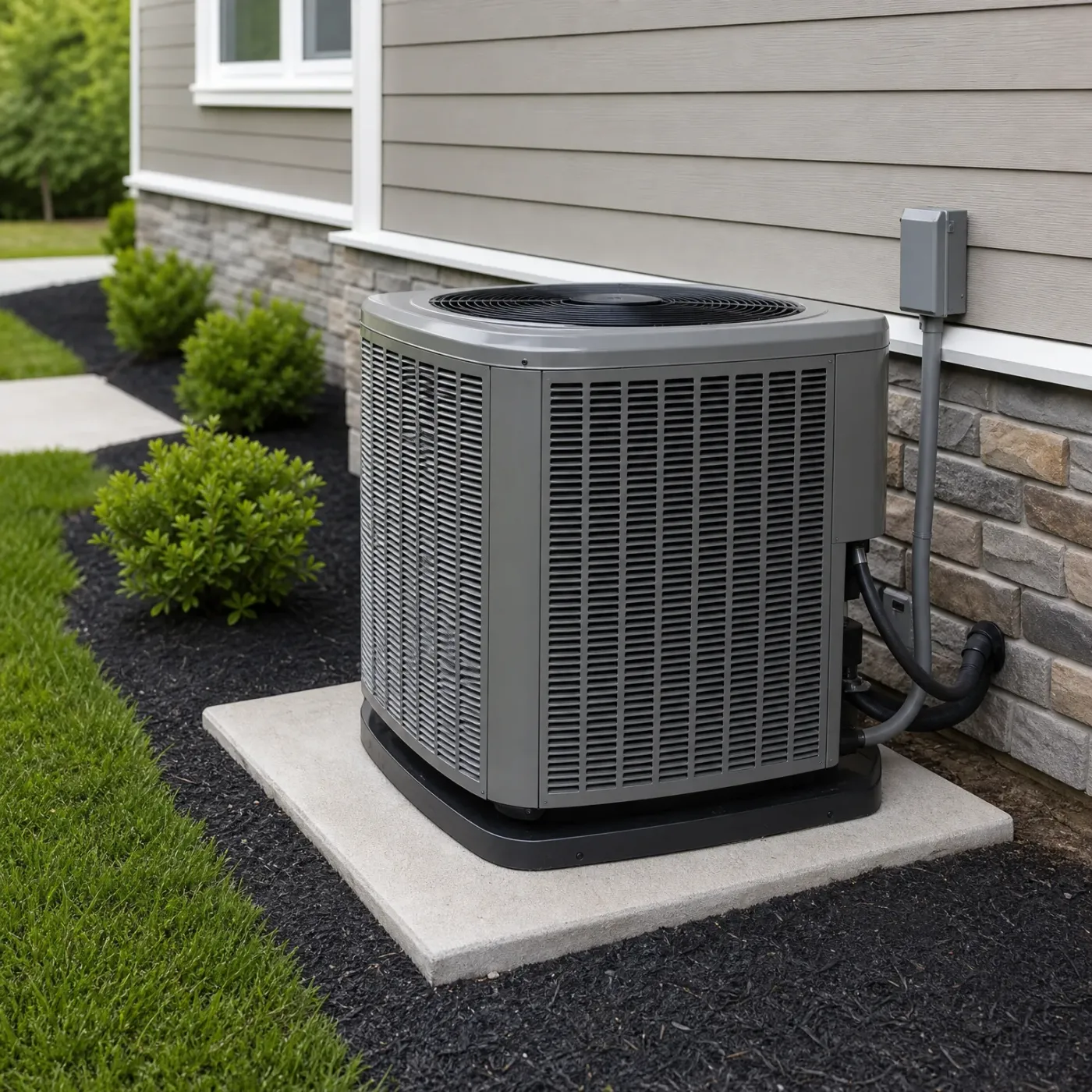
A gray outdoor air conditioner condenser unit on a concrete pad beside a house with horizontal lap siding, with a wall-mounted disconnect box and conduit, mulch bed, shrub, and lawn nearby.
The condenser outside is running quiet, the pad is level, and nothing around it looks out of place.
An outdoor air conditioner condenser unit sits on a gray pad beside a light vinyl-sided wall, on a concrete slab next to a gravel bed.
Here the same outdoor unit sits next to standing water or a stained patch on the concrete pad below it.

What the Leak Puts at Risk

  • A stained or soft patch on the ceiling below an upstairs unit usually means the drain pan is already overflowing.
  • Water pooling near your furnace can reach the blower motor or control board if it sits there long enough.
  • A musty smell near the vents often shows up before you ever see standing water.
  • Drywall and trim soak up moisture fast, and the damage spreads well past where the water first lands.
  • Running the AC while it keeps leaking just adds more water to whatever it's already touching.
  • Swollen baseboards or a warped floor near the unit usually mean the leak has been going on for a while.

If your unit is in the attic or a closet upstairs, the ceiling below it is the first place to check. A brown ring or a soft spot in the drywall means water has already come through, and whatever is above that spot is still wet. A furnace that sits below or beside the AC coil is just as exposed. Water finds its way down into the cabinet, and the blower motor and control board underneath don't hold up well to standing moisture. Before you ever see a puddle, you might catch a musty smell near the vents. That's the first sign the pan or the drain line isn't keeping up, and it's worth acting on even without visible water. Once water does reach drywall, trim or baseboards, it doesn't stay put. It wicks along the material, so the damage you can see is usually smaller than the damage underneath. A floor that's gone soft or baseboards that have swollen near the unit point to a leak that's been running for some time, not something that started today. None of this gets better by leaving the system running. Every hour it operates while the leak continues is more water going into the same ceiling, the same cabinet, the same floor. Turning the AC off until someone can look at it keeps the problem from spreading while you wait.

An outdoor air conditioning condenser unit on a concrete pad beside a house with horizontal lap siding, with a shrub and mulch bed to the left and conduit and a small electrical box on the wall to the right.
Before you get your air conditioner repair
A gray outdoor air conditioner condenser unit sits on a concrete pad beside a house with horizontal lap siding, with conduit and an electrical disconnect box on the wall, dark mulch and a shrub to the left, and a concrete walkway in the foreground.
After you get your air conditioner repair

What are you noticing around your house right now

A wet ring on the ceiling under an upstairs closet. A drip you can hear before you can find it. Carpet near a floor vent that stays damp for no reason you can see. Maybe the furnace closet smells musty, or there's a puddle on the floor beside it that keeps coming back no matter how many times you wipe it up. Some homeowners notice the AC has started shutting off on its own, which usually means a float switch has tripped because the pan underneath is full. Left alone through a Kansas City summer, that water keeps finding the same path, and a ceiling stain spreads or drywall softens the longer it sits.

A man with graying hair and a beard in a plaid flannel shirt looks out a frosted window, with a steaming ceramic mug on the wooden sill and shelves behind him.
A smiling bearded man in a blue-gray t-shirt sits on a gray couch in a living room with wooden shelving and a bright window behind him, looking down toward a device at the lower edge of the frame.
A gray outdoor air conditioner condenser unit on a concrete pad beside a house with horizontal siding and a stone veneer base, with a wall-mounted disconnect box, conduit and refrigerant lines, surrounded by black mulch, shrubs and lawn.

Get matched with an air conditioner pro in Wyandotte County

Send it once and finding someone is no longer on you.

Get matched with a pro who fixes air conditioners in Wyandotte County.

Request a pro

You're not committing to anything by asking.

A woman in a cream sweater and jeans stands in the open doorway of a white stucco house, holding the dark door, while a man in a dark quilted jacket seen from behind walks toward the entry past potted plants.

What a leak like this costs you if it sits

A ceiling stain over the closet where your air handler sits doesn't go away on its own. Left alone, that drywall softens, then sags, and what started as a few drops becomes a patch you have to cut out and replace. If the unit is in an upstairs closet, the subfloor under it takes the same water the ceiling below is showing you. Carpet that stays damp near a vent will start to smell before long, and that smell tends to mean the pad underneath is already ruined.

None of this means tearing into your house. It means getting someone to the drain line or the pan before the water finds a second place to go. Once you send in the details of what you're seeing, that search is off your plate. A contractor who works on systems like yours in Wyandotte County gets your information and follows up, so you're not the one calling around while the stain spreads.

A dark ceramic vase holding a leafy green branch sits on a round wooden table, with a blurred cushioned wooden armchair, woven basket, window and shelving with pottery in the background.
A two-story house with light beige siding, a covered front porch, and gabled roof, set behind a mown lawn, shrubs and leafy trees, with a concrete walkway leading to a wet sidewalk and street in low sunlight.

A summer dew point averaging 65°F across Wyandotte County, per NOAA, means the air feels heavy and wet most days from June through August. That moisture load on a muggy day is exactly what your evaporator coil is pulling out of the air inside your house. More moisture in the air means more water dripping off that coil and down through the drain line. A line that handles a light spring load without trouble can run close to its limit on the stickiest days of summer, so a small clog or a slightly off slope that caused no problem in May can back up and overflow in July.

NASA POWER T2MDEW

What's Behind the Leak

Clogged drain line

  • Algae and dust build up inside the drain line over time, narrowing the path until water backs up into the pan and over its edge.
  • This is the most common reason a drain pan overflows, and it tends to repeat if the line isn't cleared all the way through.
  • A contractor can flush the line or clear it with a wet vac from the outside access point.
  • If the overflow switch on the pan catches it first, the AC will shut off and stop cooling instead of leaking.
  • Algae growth is more likely when the line sits warm and damp for weeks at a stretch, which is normal for a Kansas City summer.

Cracked pan or coil icing

  • A drain pan that's rusted through or cracked lets water drip straight down instead of routing out through the line.
  • Low refrigerant or a dirty filter can freeze the coil, and the pan can't keep up with that much meltwater once the ice lets go.
  • A pan this far gone usually needs replacing rather than patching, since the metal or plastic has already given out.
  • Ice on the coil is a sign something upstream is wrong, not the cause on its own, so the real problem still needs finding.
  • This kind of leak tends to show up all at once when the ice melts, rather than as a slow drip over days.
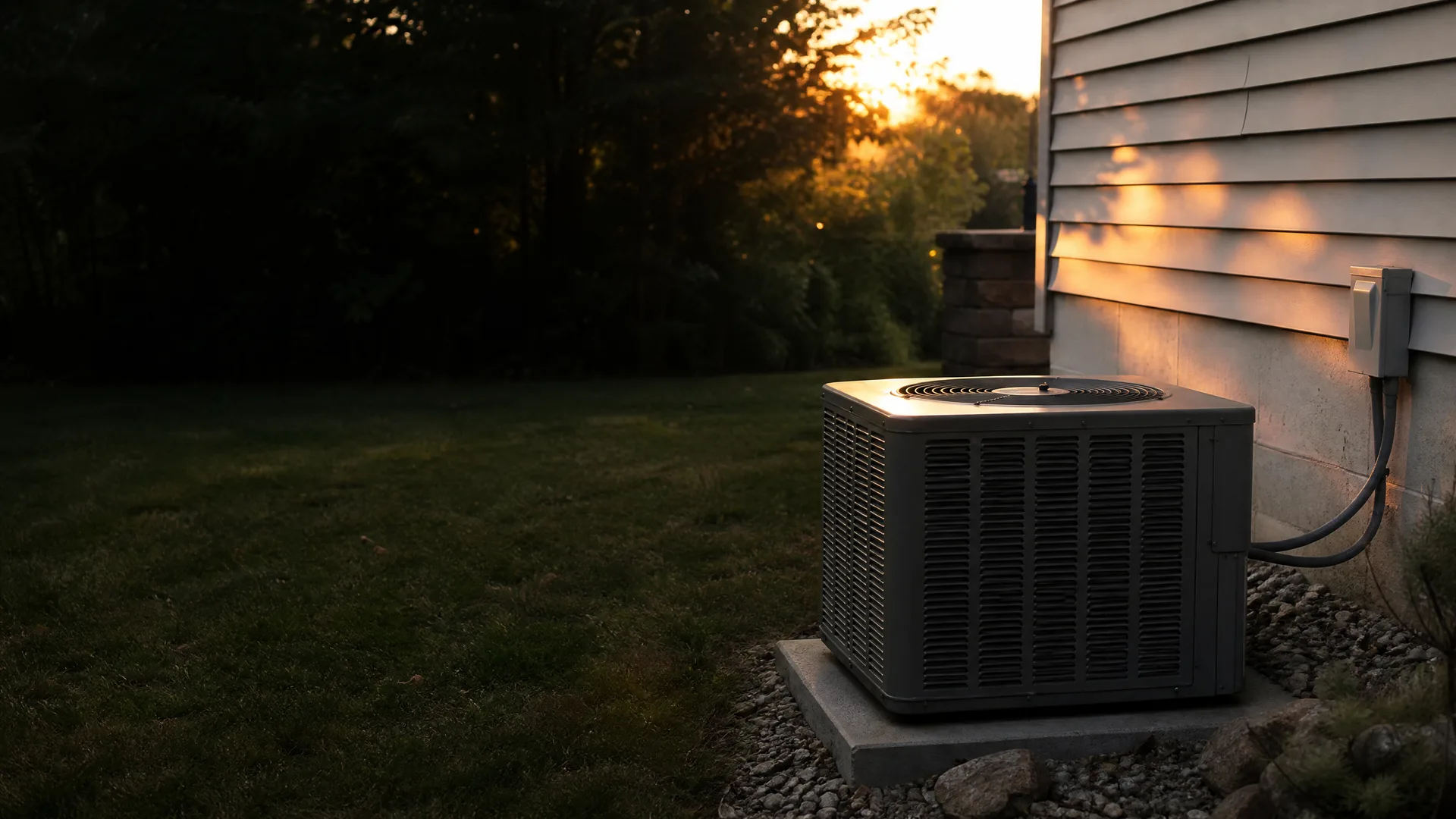
An outdoor air conditioning condenser unit on a concrete pad beside a house with horizontal lap siding, with a gravel bed, refrigerant lines and an exterior electrical disconnect box on the wall, and a lawn and trees at sunset in the background.

You're out back around seven, watering the tomatoes before the light goes, and you notice it's quiet. Too quiet. The condenser isn't running. You walk over and the fan blades are still, no hum from the unit at all, and the pad under it has that dark, wet sheen spreading out from one corner. The grass next to the pad is flattened and soaked. Inside the house a few minutes ago it felt like the air had stopped moving. Out here, in the low gold light, the only sound is a sprinkler two yards over and the cicadas starting up for the evening.


Cooling runs May through September

Five months of steady cooling means five months where that drain line has to keep up, day after day without a break. A clog that would barely matter after a few cool days has all summer to build up and back water into the pan.

NOAA nClimDiv 1991-2020

A clogged drain line, a cracked pan, or a coil frozen from low airflow all end the same way: water where it doesn't belong, and more damage the longer it sits. You don't need to know which one it is before you ask for help. A contractor who works on these units every summer in Wyandotte County can look at the line, the pan, and the coil and tell you within minutes what's backing up and why. Once you send the form, that search is off your plate. Someone who does this for a living takes it from here, matched to what you described, and reaches out to sort out the rest. The water stops being your problem to diagnose the moment you stop trying to figure it out alone. What started as a stain on the ceiling or a puddle by the furnace gets handled by someone who's seen it before, in homes like yours, in summers like this one.

A sunlit room corner with cream walls, white baseboard and window sill molding, a wood floor, and a dark wooden cabinet on the right holding a pale vase with leafy branches below a framed picture.
A round woven basket with a cream fringed throw draped over its rim sits in a corner on a wood floor, beside a dark wooden cabinet holding a stone vessel, with sunlight from a nearby window on the beige walls.
Interior corner of a room with a white-trimmed window and sill, beige walls, white baseboard molding, and a wood floor with sunlight falling across it; green foliage is blurred outside the window.
Interior corner of a room with cream walls, white baseboard molding, a window with a white sill showing blurred green foliage outside, and a wood plank floor lit by sunlight.
Sunlit interior corner showing a beige wall with a small crack above white baseboard molding, wood plank flooring, a patterned rug edge at lower left, and a window with sill at upper left.

Find an air conditioner repair pro in Wyandotte County

Send the request today and let an air conditioner pro reach out to you.

I'm done searching

It costs nothing to send, and you don't have to hire anyone.