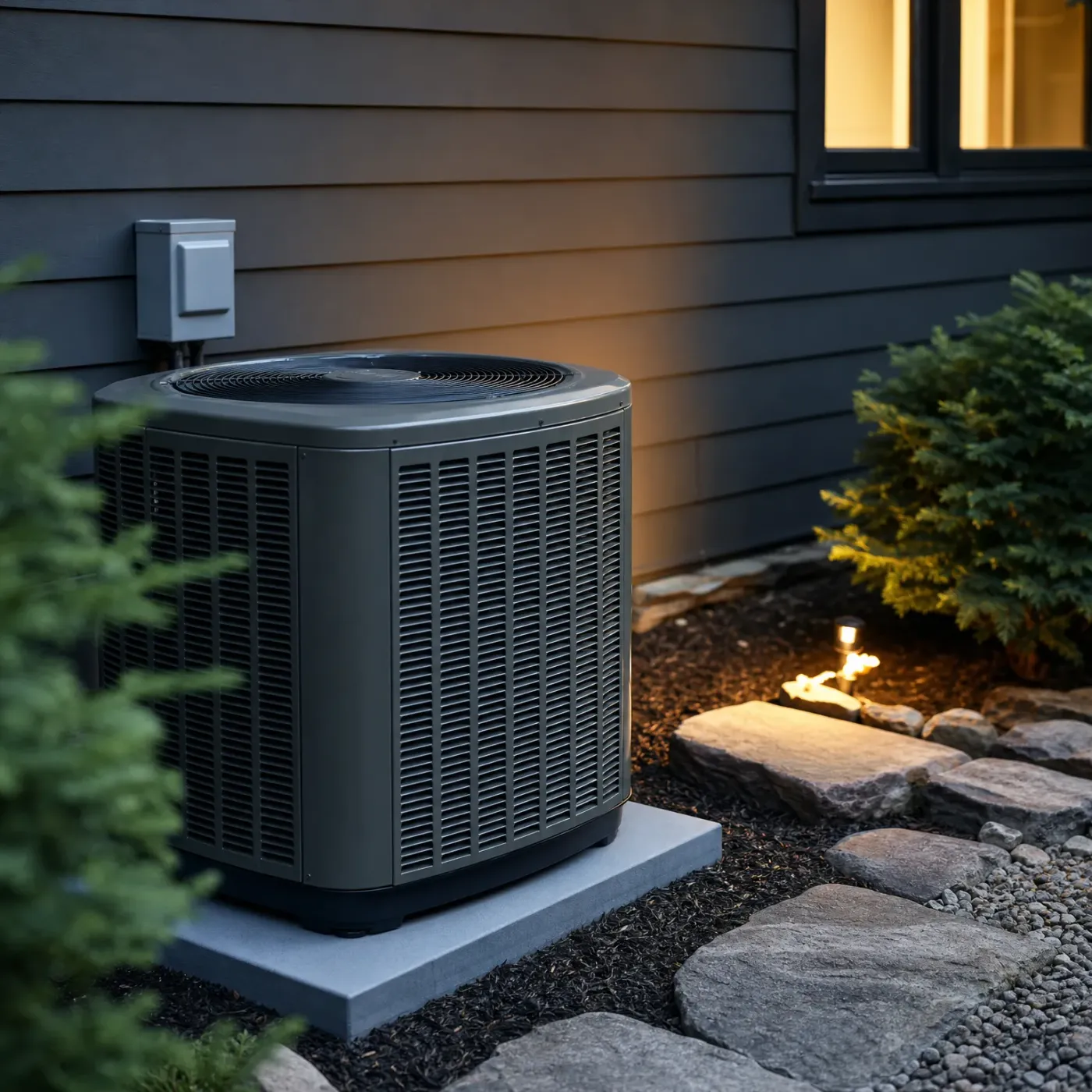









An outdoor air conditioner condenser unit on a concrete pad beside a dark horizontal-sided house, with a gray electrical disconnect box on the wall, shrubs, mulch, stone pavers and a lit landscape light nearby.

Skip the calls to every shop

How often to change your AC filter in Kansas

Kansas summers put a lot of dust and pollen through that filter, and a dirty one makes your AC work harder to keep up. This page covers how often to check and change it based on your system and your home. Skip the search for a contractor to look at the rest of your unit, the back and forth calls, and the pile of quotes to sort through. One licensed local contractor who services AC systems in Kansas all summer can take it from here.

Skip the search

Check your AC filter every month during the summer and plan on changing it every 60 to 90 days, sooner if you have pets or if anyone in the house has allergies. Kansas summers run hot and sticky from June through September, and the dust and pollen that comes with it gets pulled through that filter every time the system runs. A dirty filter chokes the airflow across the coil, so the unit runs longer to cool the same space and pushes your electric bill up for no reason. It can also let the coil ice over, which shuts the whole system down until it thaws. A one-inch filter clogs faster than a thicker four or five-inch filter, so check what size yours takes before you settle on a schedule. Pull it out and hold it to the light. If you can't see light through it, it's past time.

A smiling woman with long brown hair in a dark sweater sits at a light stone kitchen counter with a glass of red wine, with a dimly lit living room in the background.
A smiling woman with dark hair pinned up, wearing a beige sweater, sits looking off to the side in a kitchen with a glass of red wine in front of her, a stainless steel refrigerator, marble counter and a potted plant behind her.
A smiling woman with dark shoulder-length hair in a navy sweater sits at a kitchen counter with a glass of red wine, with a lit living room and pendant lights behind her.
A woman in a dark gray sweater laughs while seated at a white marble counter with a glass of red wine, with a blurred living and dining room behind her.

Air has to move through that filter before the blower can push it anywhere. As dust and pollen build up, the blower has to pull harder to get the same amount of air through, and it ends up running longer each cycle to keep the house cool. That strain lands on the evaporator coil. Without enough airflow moving across it, the coil can't absorb heat the way it should, and in bad cases it ices over. A 1-inch pleated filter traps more of what's in Kansas summer air than a plain fiberglass one, but it also blocks more airflow, which is why it needs more frequent checks. There's a simple test for where you stand. Pull the filter and hold it up to a bare one in the light. If you can't see light coming through it clearly, it's already doing more harm than good. Humid air carries more suspended dust and pollen than dry air does, which is part of why a filter here loads up faster than the same filter would somewhere drier. Left too long, a clogged filter doesn't just cost you comfort. It can wear down the blower motor itself over repeated summers.

What a dirty filter does to your system

  • A dirty filter doesn't stop air flow entirely, it forces the blower to pull harder and run longer to move the same amount of air.
  • That extra strain shows up at the evaporator coil, which can ice over when airflow drops too low for the heat it needs to absorb.
  • A 1-inch pleated filter catches more dust and pollen than a fiberglass one but also restricts airflow more, so it needs checking more often.
  • Hold a used filter up to a bare one, if you can't see light through it clearly, it's already past due.
  • Humid air holds more dust and pollen in suspension, so a Kansas summer loads a filter faster than a dry one would.
  • A filter that's too restrictive for your system can starve the blower motor and shorten its life over several summers.
A gray outdoor air conditioner condenser unit on a concrete pad beside a house with horizontal lap siding, with a flowering shrub at left and a disconnect box with conduit on the wall at right.
A clean filter lets this unit breathe, so it cools your house in the time it's built for and shuts off.
An outdoor air conditioner condenser unit on a concrete pad beside a house with light horizontal vinyl siding, surrounded by bare dirt, gravel and dry leaves, with refrigerant lines and conduit running along the wall.
Dirt and leaves piled around the base choke airflow further, and that strain adds up on the compressor inside.
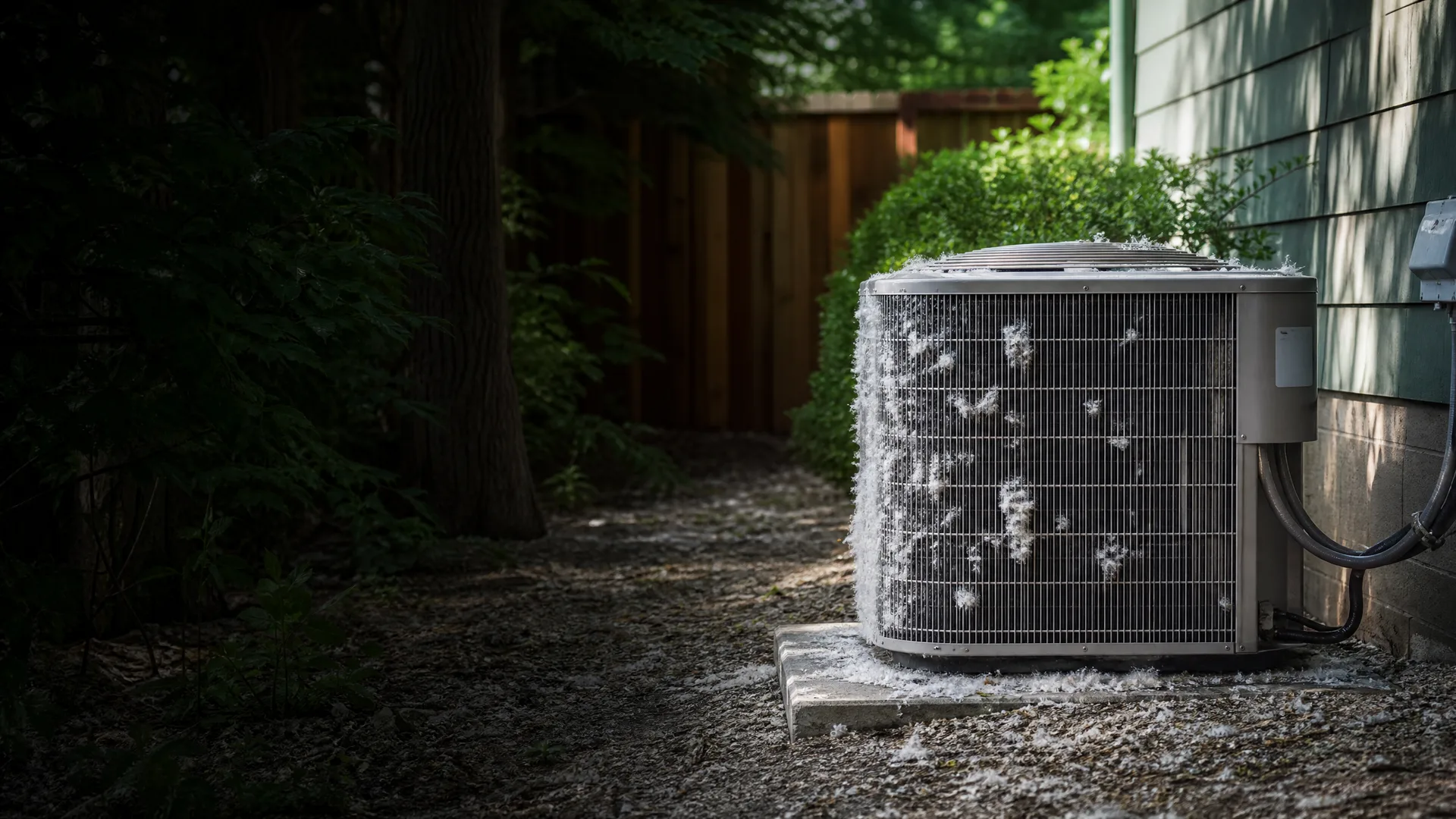
An outdoor air conditioner condenser unit on a concrete pad beside a green clapboard house, with white fluff or debris clinging to its coil grille and scattered on the surrounding gravel, next to shrubs and a wooden fence.

You're out pulling weeds along the fence line in late May when you notice it, the cottonwood fluff drifting across the side yard and catching on everything, including the condenser. You walk over and see the fins packed white with it, thick enough that you can't see the metal underneath. The unit is running, you can hear it, but the air coming off the top feels weak. You already changed the filter inside two weeks ago, so you know this is something else, the outside unit choking on what's blowing through your yard this week. You make a note to hose it down before the heat sets in for good, and to check it again next time the cottonwoods let loose.

Skip calling around

A licensed local pro takes the request for your air conditioner tune-up.

No fee to send it, and nothing to sign.

A one-inch fiberglass filter costs little and does little. A pleated filter rated MERV 8 to 11 catches far more of the dust and pollen moving through a Kansas summer, but it also restricts airflow more as it loads up.

That tradeoff is why the 60 to 90 day window matters more than the filter you buy. A better filter left in too long chokes airflow worse than a cheap one changed on time.

An outdoor air conditioner condenser unit sits on a concrete pad beside a stucco wall, with refrigerant lines and conduit running to the wall and a shrub to the left.
Before you get your air conditioner maintenance
A gray outdoor air conditioner condenser unit on a concrete pad beside a house with dark horizontal siding and a stone base, surrounded by gravel, with a flowering shrub at left and a concrete walkway in front.
After you get your air conditioner maintenance

A 1-inch filter in a dusty month

A standard 1-inch filter in the return sits in the path of everything pulled through the house: cottonwood fluff, mowed grass, the dust that kicks up when the windows have been open. In a dry, dusty stretch it can load up well before 60 days. You'll feel it before you see it, weaker airflow at the vents, the unit running longer to hold the temperature. Pull it and hold it up to a light. If you can't see light through it, it's done, whatever the calendar says. Checking monthly catches this without guessing.


A thicker filter in a mild stretch

A pleated filter rated MERV 8 to 11 holds more before it chokes, and if the house has been shut up with the AC running steady rather than cycling through open windows and yard work, it won't load as fast. Some homes get close to 90 days out of one before airflow drops off. The filter still needs a look each month, because there's no fixed point where a filter is exactly half used. If it still lets light through at 60 days, it's fine. If it's gray and matted at 45, it isn't.

Power costs 14.44 cents per kilowatt-hour statewide

At 14.44 cents a kilowatt-hour, every extra hour your blower runs on a clogged filter shows up on the bill. A clean filter means the compressor and blower aren't working harder than they have to, which keeps that cost closer to what it should be.

EIA-861 2025 statewide residential average

Where That Leaves You

  • Check the filter monthly from June through September and swap it every 60 to 90 days unless pets or allergies push that shorter.
  • A pleated MERV 8 to 11 filter catches more of what a Kansas summer blows around, but it still needs watching as it loads.
  • A clogged filter makes the blower run longer and can ice the evaporator coil, both of which cost more at 14.44 cents a kilowatt-hour.
  • A contractor who services AC units across Kansas summers knows which filter size and rating your system actually needs.
  • Working with one local, licensed contractor means a single visit and a straight answer, not a round of calls to compare.

Check the filter once a month from June through September, and plan to replace it every 60 to 90 days. Pets or allergies in the house push that window shorter. A pleated filter rated MERV 8 to 11 catches more of what a Kansas summer carries in, the cottonwood fluff, the mowed grass, the dust, but it still needs watching as it loads, because a filter that's doing its job is also the one that clogs faster. When it does clog, the blower runs longer to move the same air, the evaporator coil can ice over, and that extra runtime costs more at 14.44 cents a kilowatt-hour. None of that takes a trained eye to understand, but knowing which filter size and rating fits your system, and how your house tends to load one up, is the kind of thing that comes from working on AC units across Kansas summers year after year. A contractor who does that work locally has likely seen your exact setup before and knows what usually goes wrong with it. That's who gets matched to you, one contractor, not a handful of companies calling you back at once. You get a straight answer about your filter and your system from someone who services this equipment in this climate, instead of piecing it together from a search bar or comparing bids from strangers. The answer to how often is simple enough. Getting someone reliable to check the rest of the system while they're at it is the part worth not doing alone.

A dark-clad house with large windows beside a gravel driveway lined with in-ground path lights, ornamental grasses and hydrangeas, with distant hills and an orange sunset sky.

Air Conditioner Maintenance

Describe it once

Tune-up, service, or cleaningCentral ACKansas
Step 1 of 2

What ZIP code is the job in?

  • A beige upholstered armchair with a green cushion and a knitted throw sits beside a window with a rain-speckled pane, with a lit table lamp and bookshelf behind and a wooden side table holding a ceramic mug and a book.
    • A local pro who services air conditioners gets in touch about the tune-up.
    • A local pro who knows air conditioners gets your details and gets in touch.
  • A ceramic table lamp with a wide linen shade and a dark wooden bowl sit on a round wood side table beside a beige upholstered sofa with a chunky knit throw, in front of a curtained window.
    • One request and finding someone for the tune-up is handled.
    • Send the form, and lining up the air conditioner tune-up stops being yours to chase.
  • A living room with a light gray sectional sofa holding brown and cream textured pillows and a knit fringed throw, a rustic wood coffee table with stacked books and a stone vase of olive branches, built-in shelves with pottery, and a tall olive tree beside a curtained window.
    • Skip calling around to set up an air conditioner tune-up.
    • Answer a few questions instead of calling shop after shop.
  • A ceramic urn-shaped table lamp with a mottled gray glaze and beige drum shade sits on a dark wood side table beside a potted green plant, next to a light beige upholstered sofa and a framed artwork on a gray wall.
    • Only one pro gets your request, so you hear from one company.
    • Your request stays with one local pro.