A snow-covered small-town street at dusk, lined with illuminated two-story houses and a grain elevator on the horizon.

Mini Split Installation in Andover, KS

Tell us about the job

Takes about a minute. No obligation.

New system or replacementMini-splitButler County, KS
Step 1 of 2

What ZIP code is the job in?

Bigger isn't better

An oversized mini split cools the room fast, then shuts off before it pulls the damp out of the air. The room ends up cool and clammy, and the compressor keeps short cycling instead of running a steady stretch. Undersized has the opposite problem. It runs constantly and still never quite catches up on the hardest days of the year.

The math behind the sizing

A contractor works out the load room by room, using the floor area, the window area and which way the windows face, the ceiling height, and how well the walls and attic hold heat. Rooms that look the same size on paper can need different sized units depending on sun exposure and exterior wall count. This same math decides whether one outdoor unit can carry several indoor heads or whether a room needs its own dedicated system.

7 months
October through April, your system heats
5 months
May through September, it cools
24°F
the average winter night it heats against
89°F
the average summer afternoon it cools against
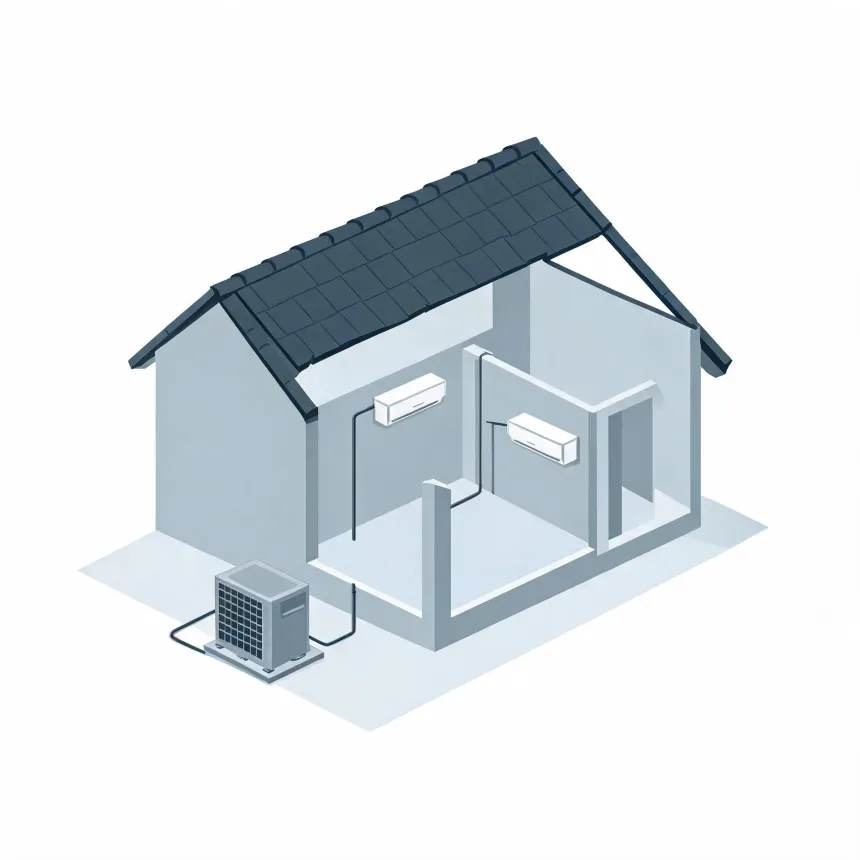
Isometric illustration of a cutaway house with a dark tiled gable roof, showing two wall-mounted indoor split air conditioning units connected by lines to an outdoor condenser unit on the ground outside.
Your system heats October through April and cools May through September.

NOAA nClimDiv, 1991–2020 normals

Homes in Butler County run cooling from May through September.

Get a mini split installed in April and it's ready for that first warm week instead of playing catch-up.

Most homes in Butler County heat with gas, and a mini split works alongside it

55.7% of homes heat with gas
Cooling runs May through September
Summer afternoons average 89°F

Butler County sits in climate zone 4A, which asks real work of both heating and cooling. Any mini split installed here has to meet the federal minimum for that equipment class, which is 14.3 SEER2 for cooling and 7.5 HSPF2 for heating. That rule applies whether the outdoor unit feeds one indoor head or several, since a ductless system is still a split system under the standard. It narrows the field some, but it also sets a floor for how the system handles a humid summer and a cold snap in the same year. A contractor sizing the job already has this minimum in mind before any equipment gets picked.

Replace it before the season

Replace it before the season starts, so it happens on your schedule, not in a hurry.

Find a contractor
A white mini-split air conditioner outdoor condenser unit mounted on metal brackets against a beige stucco exterior wall, with a blue sky and scattered clouds in the background.

Five months of real heat, and weather on top of it

Cooling runs about five months here, May through September, with afternoon highs averaging 89 through the summer stretch. A mini split put in this year earns its keep every one of those months, and most of that work happens on the hottest afternoons, not the mild days on either end. The outdoor unit also sits through wind and hail that this county sees often, so the cabinet and coil fins take a beating beyond what the compressor alone deals with. A unit sized right for the rooms it serves handles that load without straining. One sized wrong starts showing problems sooner than it should.

The line set is part of the cost, not an afterthought

Running refrigerant line between the outdoor unit and each indoor head takes labor, and how much depends on the path. A short run to one head near the outdoor unit goes fast. Multiple heads in different rooms, a longer run, or a line set that has to clear framing or brick all add work that the price of the equipment alone never shows.

What's on the wall isn't the whole system

Every indoor head needs a condensate drain to carry off the water it pulls from the air, and the outdoor unit needs its own disconnect box and usually a dedicated circuit. A system feeding several heads from one outdoor unit also needs a branch box to split refrigerant between them. None of that shows up comparing one unit's price to another, but it is what makes the install correct rather than just working.

SEER2 tells you how much cooling a unit delivers for the power it draws, and HSPF2 does the same for heating. A higher number means more cooling or heating out of the electricity going in, nothing more. It says nothing about how big the system is or how fast it cools a room. Units with the same rating can still be sized completely differently for the same house. That rating also assumes correct sizing and a correct install. A mini split with a strong rating still runs constantly and costs more to operate than it should if it's the wrong size for the room it serves. The number on the label is a starting point for comparing equipment, not a promise about what shows up on a power bill.

Installation day starts outside, not in. The outdoor unit needs clearance on all sides for airflow, a solid pad underneath, and a clear path back to each indoor head. A contractor runs the line set, the condensate drain and the electrical whip together, then seals the wall penetration where they pass through so moisture and pests can't follow that path inside. Each indoor head mounts to a bracket on the wall, gets leveled, then connects to its line set before anything gets charged with refrigerant. Before that happens, the lines get pulled down to a vacuum to clear out air and moisture, since either one left behind turns into a coil problem later. Only after that vacuum holds does the system get charged, powered up and checked head by head for the right temperature split at each one.