A dark modern bedroom with grey bedding, a wall-mounted air conditioning unit, and a cat resting on the bed.

Mini Split Installation in Baxter Springs, KS

Tell us about the job

Takes about a minute. No obligation.

New system or replacementMini-splitCherokee County, KS
Step 1 of 2

What ZIP code is the job in?

The rating tells you the ratio, not the bill

A mini split's efficiency rating compares the heat it moves against the power it draws. A higher rated system wrings more warmth or cooling out of the same electricity. It doesn't promise a certain bill, because that depends on how much the system runs and what temperature it's working against.

The rating only holds at the right size

An oversized mini split cycles on and off instead of running steady, and it never gets the chance to perform the way its rating says. An undersized one runs constantly and still falls short. The rating on the label means something only when the contractor sizes the unit to the space it's actually heating and cooling.

7 months
October through April, your system heats
5 months
May through September, it cools
27°F
the average winter night it heats against
89°F
the average summer afternoon it cools against
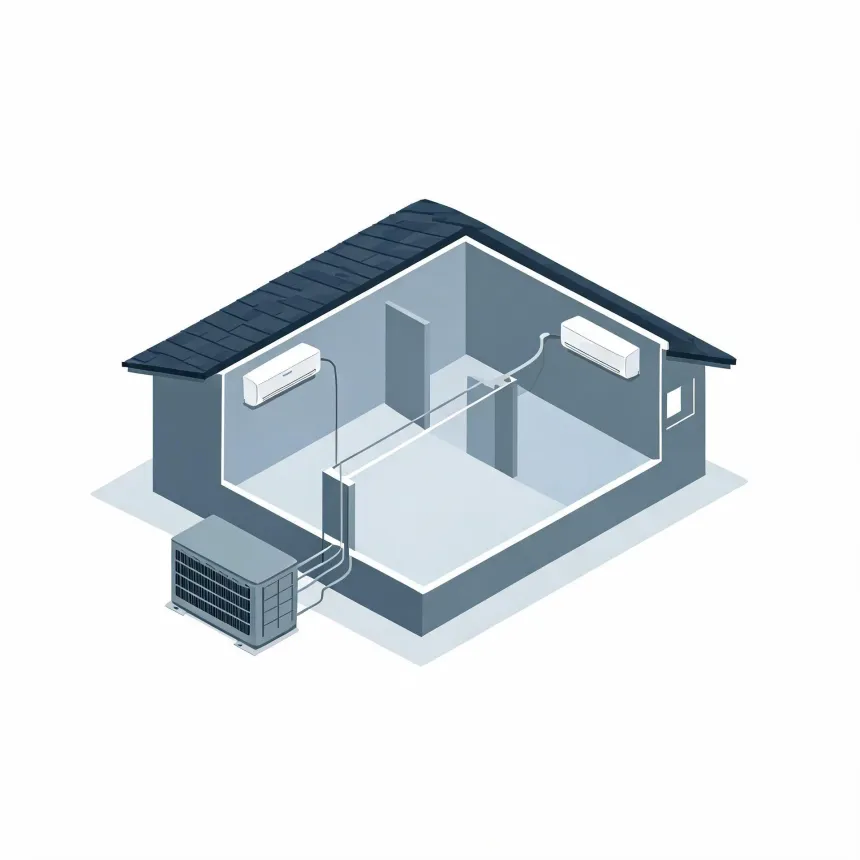
Isometric illustration of a cutaway house showing two wall-mounted mini-split indoor units connected by line sets to a single outdoor condenser beside the exterior wall.
Your system heats October through April and cools May through September.

NOAA nClimDiv, 1991–2020 normals

Baxter Springs runs its mini splits May through September, with afternoon highs averaging 89°F.

A mini split here needs to hold up to five months of real heat every year, not just the spec sheet.

Cherokee County sees its share of storms, so plan for the outdoor unit to take a hit and the power to go out

158 severe weather events from 2015 to 2024
19% of homes statewide lost power a day or more in 2024
76 damaging wind events from 2015 to 2024
Power here costs more, so efficiency pays you backKansas homes paid 14.15 cents per kilowatthour in 2024.

Utility gas heats 45.8% of homes in Cherokee County, more than electricity or propane. A mini split doesn't compete with that furnace. It runs alongside it, handling the cooling load all summer and taking pressure off the furnace in the shoulder months when a full heating cycle is more than the house needs. Homes already set up with gas heat usually don't have central air ductwork sized for cooling, which is part of why a mini split makes sense here. It gives you cooling without tying into a duct system built for something else.

A new mini split here has to meet 14.3 SEER2 and 7.5 HSPF2, and meeting it gets you the federal credit

Cherokee County falls in climate zone 4A, and any mini split installed new here has to meet 14.3 SEER2 and 7.5 HSPF2 at minimum. That floor also qualifies the system for the federal tax credit available on qualifying heat pump equipment. A system already below that line is working harder than it has to, with nothing to show for it at tax time.

Find a contractor
A person in a dark shirt, tan work pants and boots climbs porch steps toward a red door, carrying a worn canvas tool bag beside a potted shrub.
A beige split-system air conditioner outdoor condenser unit mounted on metal wall brackets atop a stucco wall.

Get it in before May, not during it

Cooling here runs May through September, five months of the year. Put a new mini split in during April and it's running steady before the first hot stretch hits. Wait until the season's already underway and the contractor is sizing and installing while the house needs to be cool right now, not after the work is done.

Ask how many zones it actually covers

A mini split system can run one indoor head or several off a single outdoor unit. More zones mean more rooms held at their own temperature, but each zone splits the outdoor unit's total capacity. A contractor comparing systems should say how many heads you need and size the outdoor unit for all of them running at once, not just the biggest room.

Ask what happens to the old equipment

If a furnace or central air system is staying in place, ask how the new mini split ties into the house alongside it, and whether any existing wiring, a disconnect box or a condensate line can be reused. Ask what gets removed, what gets patched, and who handles the refrigerant in a system being taken out. That work is part of the job even though it never shows up on the spec sheet.

Sizing a mini split starts with a load calculation, not a tape measure around the room. A contractor works out how much heat the space gains in summer and loses in winter, factoring in window area, insulation, ceiling height and which way the room faces. Square footage alone leaves out too much to be reliable. Get the size wrong and both directions cause trouble. Too big and the unit cools the room down fast, then shuts off, so it never runs long enough to pull moisture out of the air and the room ends up cool but damp. Too small and it runs flat out all day without reaching the setpoint on the hottest afternoons. Either way the equipment short-cycles or overworks, and that wears out parts long before it should.

Installation day starts with the outdoor unit. It needs a pad or wall bracket, clearance on all sides, and a spot where the line set can reach the indoor head without too many bends. The contractor runs the line set, the conduit carrying refrigerant lines, the power wire, and the condensate drain, usually drilling one hole through the wall where the indoor head is going. Once the lines are connected, the system gets evacuated with a vacuum pump to pull out air and moisture before any refrigerant goes in. That step matters more than it looks. Moisture left in the lines turns to acid and eats at the compressor over time. After the vacuum holds and refrigerant is charged, the contractor checks refrigerant pressure against the line length and tests the system in both heating and cooling before calling the job done.