Electricity here costs more to begin with
Homes in Neosho County paid an average of 14.80 cents per kilowatt-hour in 2025. A mini-split runs on electricity alone, so that rate applies to every hour it works.
Takes about a minute. No obligation.
Homes in Neosho County paid an average of 14.80 cents per kilowatt-hour in 2025. A mini-split runs on electricity alone, so that rate applies to every hour it works.
The dew point in Neosho County averages 67°F across June, July and August, higher than most US counties see. A mini-split has to pull that moisture out of the air as well as cool it, and it does that for months at a stretch here.
NOAA nClimDiv, 1991–2020 normals
Half the homes in Neosho County were built in 1963 or earlier.
A mini-split has to be sized for the house it's going into, not a newer one.




Neosho County sits in climate zone 4A, which asks real work of both heating and cooling and leans humid. Any mini-split manufactured on or after January 1, 2023 has to meet the federal minimum for a split-system heat pump: at least 14.3 Btu of cooling for every watt-hour it draws, and at least 7.5 Btu of heat the same way. That's the floor, not a selling point. A unit below it can't be installed here. A federal tax credit is also available on qualifying systems.
The rate here applies to every hour the system runs, and here that's most of the year. A unit that does the job with less power pays for the difference on every bill after. When you compare systems, put the efficiency rating next to the price.
Find a contractor
A load calculation is what sizes a mini-split correctly, not a square footage chart. In a house built in 1963 or earlier, that calculation matters more, since the place may hold or lose heat differently than a newer build. Ask the contractor for one before you settle on a unit. Oversized and the system short cycles, kicking on and off instead of running steady through the day-into-night stretch it's built for. Undersized and it runs flat out all summer without keeping up. Either way costs more over time to run than getting the size right the first time.
SEER2 compares the cooling a system puts out against the power it draws to do it. A higher number means the compressor and coil are getting more work out of the same electricity. It says nothing about how big a space the unit can handle, so a high rating on an undersized unit still leaves rooms warm.
That number comes from lab conditions, with the system matched and charged exactly right. A mini-split installed with a kinked line set, a low refrigerant charge, or the wrong indoor head for the space will run below its rating every day it operates. The install decides whether the rating on the label is what you actually get.
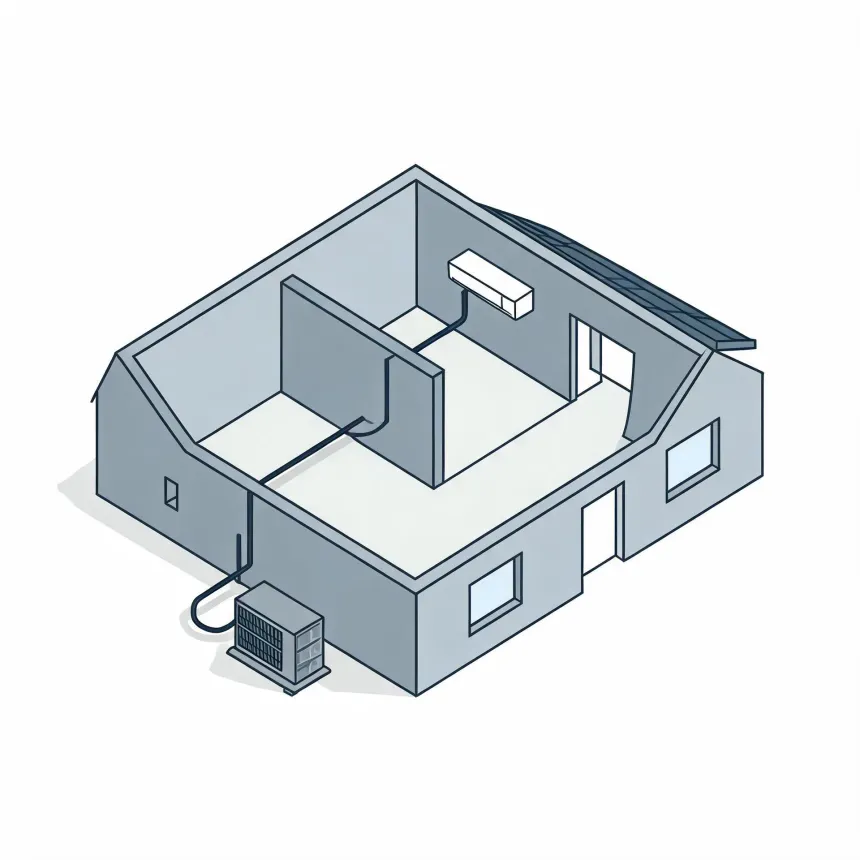
What you pay for an installation comes down to the parts and the labor it takes to get refrigerant moving correctly between outdoor and indoor units. The line set has to be cut, run through the wall, and brazed, not just connected, and a longer run or extra bends adds time and material. Each indoor head needs its own mounting, its own condensate drain, and its own electrical run back to the outdoor unit, so a multi-zone system costs more to put in than a single head, piece for piece. The outdoor unit needs a solid pad and enough clearance to pull air through the coil. After everything is connected, the system has to be evacuated to pull moisture and air out of the lines before refrigerant goes in, and charged to the exact weight the manufacturer specifies for that line length. Skipping that step is what leaves a system running below what it's capable of for as long as it's in the house.
Installation starts with the outdoor unit and the indoor head going up, but the work that decides how the system runs happens in between. Once the line set is run and brazed, the contractor pulls a vacuum on it, drawing out the air and moisture that would otherwise mix with the refrigerant. A gauge shows whether that vacuum holds. If it doesn't, there's a leak in a joint somewhere and it gets found and rebrazed before anything moves forward. Only after the vacuum holds does refrigerant go in, weighed to what the manufacturer specifies for that exact line length. Once it's running, the contractor checks airflow at the indoor head and the temperature split between the air going in and the air coming out, since that tells them the system is actually moving heat the way it should, not just making noise.