




A modern bedroom with dark furnishings, a wall-mounted air conditioning unit, and a cat resting on a large bed.

Mini Split Installation in Coffeyville, KS

Tell us about the job

Takes about a minute. No obligation.

New system or replacementMini-splitMontgomery County, KS
Step 1 of 2

What ZIP code is the job in?

Electricity in Kansas ran 14.15 cents per kilowatt-hour in 2024. A mini split uses that power directly, with no ductwork to leak air out along the way. The efficiency rating on the unit you choose matters more here than in a state where power is cheap, because every point of it shows up on your bill for as long as you run the system. A unit sized right for the room it heats and cools will earn that cost back faster than one that is oversized or undersized for the space.

7 months
October through April, your system heats
5 months
May through September, it cools
26°F
the average winter night it heats against
89°F
the average summer afternoon it cools against
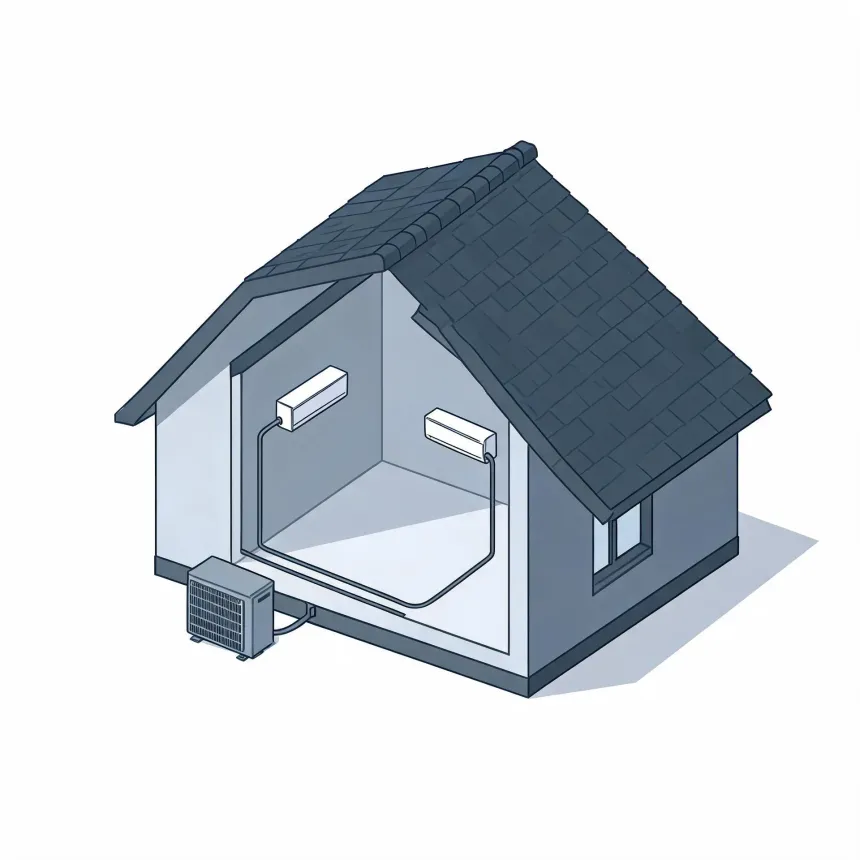
Isometric cutaway illustration of a small house with a shingled gable roof, showing two wall-mounted indoor air conditioning units connected by refrigerant lines to an outdoor condenser unit on the ground outside.
Your system heats October through April and cools May through September.

NOAA nClimDiv, 1991–2020 normals

Half the homes in Montgomery County were built in 1958 or earlier.

A mini split going into a house that old has to match the rooms as they are now, not a duct layout from decades back.

Gas heats most homes here, so a mini split usually adds to a system already in place

64.2% of homes heat with gas
Climate zone 4A
Power costs 14.15 cents a kWh statewide

Cooling here runs May through September. April is the month to have a mini split in and running, not mid-May with the first hot week already on you. Installing before the season also gives the contractor time to work out where the outdoor unit sits, how the line set runs, and which rooms get their own head. Wait too long and you're choosing from whatever crew and equipment are free that week. Get it done in spring and the system is already broken in and working the way it should once the heat sets in.

Efficiency pays here

Power costs more here, so an efficient system pays you back on every bill.

Find a contractor
A man in a dark shirt and tan work pants, seen from behind, carries a worn canvas tool bag up concrete steps toward a red front door, with a potted evergreen shrub beside the entry.
A white mini-split air conditioner outdoor condenser unit mounted on metal brackets against a beige stucco exterior wall, with a blue sky and scattered clouds in the background.

Five months of heat, every year, on a unit that sits outside

Cooling runs May through September here, and afternoons in June, July and August average 89 degrees. That's five months of the outdoor unit cycling most days, not a handful of hot weeks. Montgomery County also sees damaging wind and hail most years, and the outdoor unit sits through all of it, season after season. A mini split sized to the room holds up to that load better than one pushed past what it's built for. Get the sizing right at install and you're not asking an undersized unit to run flat out all summer just to keep up.

How many rooms get their own head

Each indoor head needs its own run of line set back to the outdoor unit, plus a mounting spot with clear airflow and a path to drain condensate. More heads means more mounting, more wiring, and an outdoor unit sized to run all of them at once, so the room count drives the job more than the brand or model does.
What the outdoor unit sits on and how far the lines run

The outdoor unit needs a pad or mount and a clear path for refrigerant lines and wiring back to each indoor head. A short, straight run costs less to install than one that has to cross framing, go up an exterior wall, or route around where the electrical panel sits. A longer line set also holds more refrigerant, and that charge has to be measured right for the system to run the way it's rated to.

Whatever heated or cooled those rooms before usually stays. A mini split is an add-on in most houses, not a swap, so there's no old furnace or window unit that has to come out for the new heads to go in. If a system is being retired instead, the refrigerant in it has to be recovered before anything gets disconnected. That's not a step a homeowner can skip or do themselves, and it's not optional under how these systems are handled. Once it's out, the line set and any abandoned wiring should come out too, not just get capped and left in the wall.

Install day starts with the outdoor unit going on its pad or wall bracket, then a crew runs the line set from there to each indoor head. Those lines get connected, then the whole system is pulled down to a vacuum before any refrigerant moves, which clears out moisture and air that would otherwise ruin how it runs. Each indoor head gets mounted, leveled, and tied into the drain path so condensate has somewhere to go. Once everything is connected, the system gets charged, powered up, and run through its paces, heating and cooling, checking that every head responds and the temperature holds where it's set. A tech will usually walk the remote and settings with whoever's there before calling it done.