Weather here does damage
Lyon County logged 194 severe weather events between 2015 and 2024, including 90 damaging wind events, 85 hail events and 6 tornadoes. An outdoor condenser sits outside through all of it.
Takes about a minute. No obligation.
Lyon County logged 194 severe weather events between 2015 and 2024, including 90 damaging wind events, 85 hail events and 6 tornadoes. An outdoor condenser sits outside through all of it.
Nearly one in five Kansas households went at least 24 hours without power in 2024. A mini split won't run through that any more than a furnace blower will, so an outage still means no heat or cooling until the power comes back.
NOAA nClimDiv, 1991–2020 normals
Half the homes in Lyon County were built in 1970 or earlier.
An install in a house that age has to work with the walls and wiring already there, not the other way around.



Lyon County sits in climate zone 4A, a mixed zone where both your furnace and your mini split have real work to do most of the year. Any split-system heat pump sold new has to meet the same federal minimum no matter where it's installed: at least 14.3 Btu of cooling for every watt-hour it uses, and at least 7.5 Btu of heat for every watt-hour in winter. That's not a Lyon County rule, it's the floor everywhere, so a contractor quoting you a mini split should already be working above it. A system that clears that bar by a wide margin will cost less to run through both the sticky summers and the cold stretches here. Ask what efficiency rating the unit you're getting actually carries, not just that it qualifies.
Pick a spot for the outdoor unit where hail and wind debris are less likely to reach it. Ask the contractor how the system handles a power cut, since a mini split stops the same as a furnace blower does until power is back. If a backup plan for heat or hot water matters to you, raise it now, while the install is being planned, not after the lines go down.
Find a contractorCooling in Lyon County runs June through September. May is the month to get a mini split installed, not after the heat has already settled in. Install it before June and the contractor has time to size it right, pick a sensible spot for the outdoor unit, and test the system before it has to work. Wait and you take whatever schedule is open. Winter asks just as much of it. Overnight lows average 23°F across December, January and February, and a mini split rated for heat still has to pull hard against that every night those months. Installed early, it's already checked and running before that load hits.
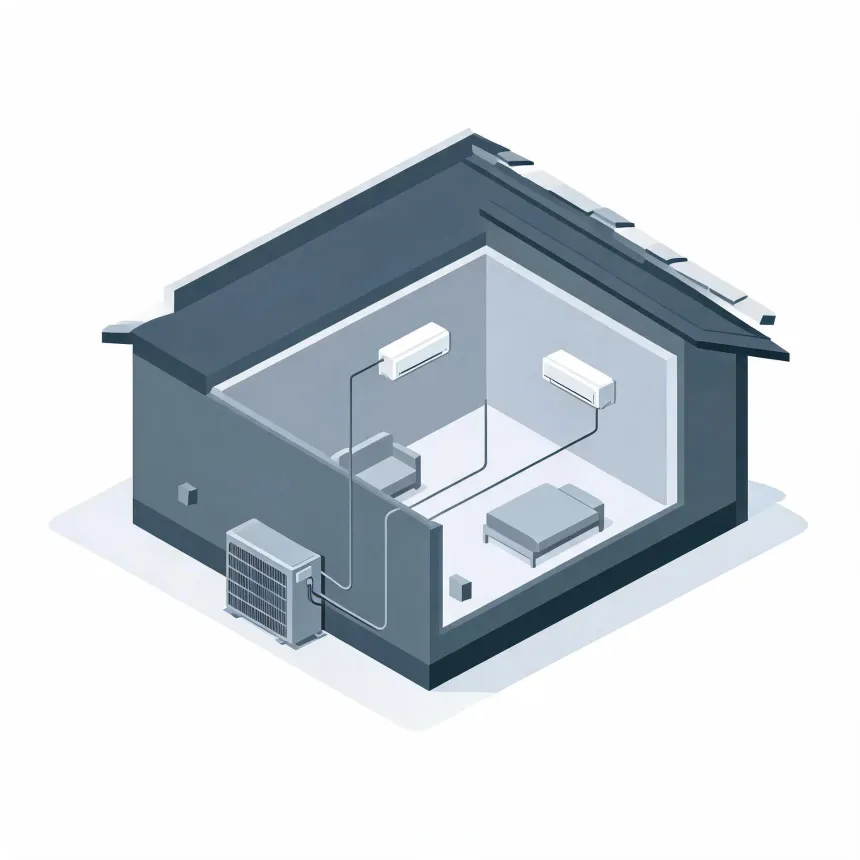
Where the line set has to run, how far the outdoor unit sits from the indoor head, and whether a wall can take the penetration clean all change what the install involves. A straight run through one wall is quick work. A run that has to snake around framing or climb further than the line set wants to go adds labor and sometimes a bigger line set entirely.
A mini split needs its own dedicated circuit, and whether that circuit already exists or has to be run from the panel changes the job more than the equipment choice does. An older panel with no open breaker slots means panel work before the mini split work even starts, and that's a different job than running wire to a panel with room to spare.
The rating on the label is only true at one set of conditions. SEER2 gets measured at a mild outdoor temperature, and HSPF2 the same way on the heating side, so both numbers describe best-case performance, not what the unit does on the hardest day of the year. That's not a trick, every manufacturer tests the same way, but it means the number on two different units tells you more about them than either number alone tells you about your bill. A higher rating usually means a variable-speed compressor that can throttle down and run longer at low output instead of switching on and off, and that steadier run time is part of why it uses less power over a season. It also tends to mean better dehumidification, since a compressor running longer at low speed pulls more moisture out of the air than one that blasts cold air and shuts off. None of that shows up on the label, only the number does, so ask the contractor what's actually inside the unit before you compare two quotes on rating alone.
Gas heats more homes in Lyon County than anything else, at 53.6 percent. Electricity comes in well behind that, at 32.9 percent, and LP gas covers another 10.8 percent. That split matters for a mini split, because most houses here were set up to heat with gas, not with an electric system sized for winter. Adding a mini split alongside the furnace keeps the gas heat doing the hard work on the coldest nights and lets the mini split carry the cooling and the shoulder seasons. Going mini split only as the main heat source is a bigger change, since it asks the electrical panel to carry a load the house was never wired for. Either way, ask the contractor to check the panel before deciding which path this install takes.