





A snow-covered residential street at twilight with illuminated houses, bare trees, and an orange horizon glow beneath a deep blue sky.

Mini Split Installation in Garden City, KS

Tell us about the job

Takes about a minute. No obligation.

New system or replacementMini-splitFinney County, KS
Step 1 of 2

What ZIP code is the job in?

Finney County saw 363 severe weather events between 2015 and 2024. Most of that was wind and hail: 252 damaging wind events and 75 hail events in that same stretch, with 15 tornadoes on top of it. An outdoor condenser sits outside through all of it, exposed to whatever blows through or falls out of the sky. Winter storms hit here too, 21 times over that same period, which matters because a mini split is often doing your heating as well as your cooling. Statewide, 19% of Kansas households lost power for a day or more in 2024. Worth thinking through before the unit goes in, not after.

7 months
October through April, your system heats
4 months
June through September, it cools
20°F
the average winter night it heats against
91°F
the average summer afternoon it cools against
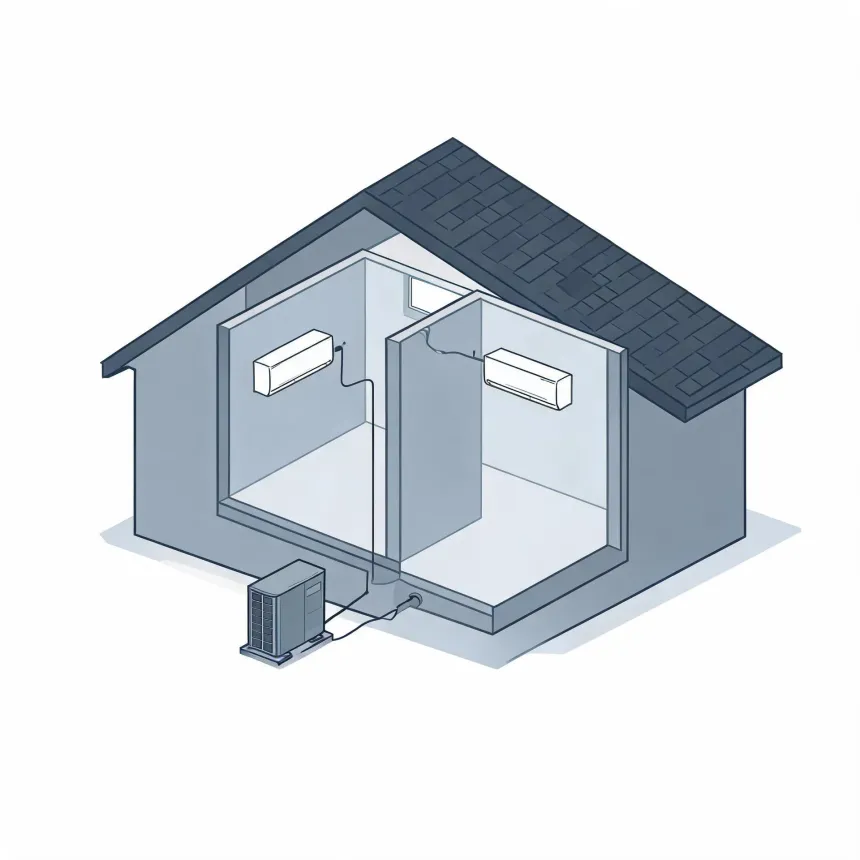
Isometric line illustration of a cutaway house with two rooms, each with a wall-mounted indoor air conditioning unit connected by lines to an outdoor condenser unit on the ground outside.
Your system heats October through April and cools June through September.

NOAA nClimDiv, 1991–2020 normals

Gas heats almost three out of four homes in Finney County.

A mini split here is likely going in as a second system for cooling and shoulder season, not the only thing standing between your house and a Garden City winter.

Install before June, while the weather is still something you can plan around

Cooling runs June through September
Summer afternoons average 91°F
252 damaging wind events from 2015 to 2024

Summer here is short but it runs hot. Cooling season is four months, June through September, with afternoon highs averaging 91°F through the peak of it. The air isn't as heavy as a lot of places, dew points average 58°F, lower than most of the country, but that heat still means the outdoor unit is working close to its limit most afternoons it runs. A mini split sized too small for that load will run flat out and still lose ground on the hottest days. Get the sizing wrong on the low side and you feel it every June through September, not just once.

Plan the outdoor unit's spot and your backup for heat before install day

Where the outdoor unit sits and how it's protected should get decided now, while it's still part of the install plan and not an afterthought. Same with what happens to your heat if the power drops. That's part of the job too.

Find a contractor
A man in a gray t-shirt and tan work pants, seen from behind, carries a worn canvas tool bag up wooden steps toward a red front door of a gray clapboard house with a potted plant beside it.
A white mini-split air conditioner outdoor condenser unit mounted on metal brackets against a beige stucco exterior wall, with a blue sky and scattered clouds in the background.

What comes out when the new system goes in

If this is replacing a window unit or baseboard heat, whoever installs the new system has to deal with what's already there. A window unit comes out easy, just pull it and patch the opening. Baseboard heat means capping the old lines and patching the wall where they ran. If there's an older central system getting replaced or supplemented, the ductwork question matters: a mini split doesn't use ducts at all, so any existing duct system either stays for another purpose or gets abandoned in place. None of that is hard, but it's work a contractor should walk through with you before install day, not discover halfway into it.

The outdoor unit sets the price

A mini split system is priced by the condenser's capacity and how many indoor heads it has to run. One head on one zone costs less than a multi-zone setup feeding several rooms. The compressor inside that outdoor unit is the most expensive part in the system, and a larger one costs more before anyone touches the installation itself.
What it takes to get the lines in

The refrigerant lines, the wiring and the drain line all have to run from the outdoor unit to each indoor head, usually through an exterior wall. A short, straight run through one wall costs less labor than a run that has to go up through an attic or snake across the house to reach a second or third zone. Every extra head means another line set, another mounting point, and more time on the ladder.

The efficiency rating on a mini split, the SEER2 number, tells you how much cooling you get out of the electricity you put in over a full season, not just at one moment. A higher number means the compressor is doing more work for less power across a whole summer of starts and stops, not just when it's brand new and the coils are clean. That rating is measured on the whole matched set, the outdoor condenser and the indoor head together, so swapping one piece down the line for a cheaper part undoes the number on the sticker. It also assumes the system is sized right for the space and installed the way it's supposed to be. A unit with a strong rating that's oversized for the room will still short-cycle, switching on and off faster than it should, and you lose the efficiency you paid for. The rating is a ceiling for what the equipment can do, not a promise about what it will do in your house.

Finney County falls in climate zone 4A, which asks real work of both your heating and your cooling. Any mini split installed here, if it's a split-system heat pump manufactured from 2023 on, has to clear federal minimums for that: at least 14.3 Btu of cooling for every watt-hour it uses over the summer, and at least 7.5 Btu of heat for every watt-hour over the winter. That's a floor, not a model number, so it narrows what a contractor can offer you but doesn't pick the unit for you. There's also a federal tax credit available for qualifying heat pump installations, worth asking about when you're comparing systems.