A white wall-mounted split air conditioning unit in a dimly lit modern room, with a full moon visible through the window at night.

Mini Split Installation in Great Bend, KS

Tell us about the job

Takes about a minute. No obligation.

New system or replacementMini-splitBarton County, KS
Step 1 of 2

What ZIP code is the job in?

This county gets hit often

Barton County recorded 295 severe weather events between 2015 and 2024, including 126 damaging wind events, 146 hail events, and 13 tornadoes. Ten winter storms brought heavy snow, ice or blizzard conditions in that same stretch.

Outages last longer than people expect

Nearly one in five Kansas households went at least 24 hours without power in 2024. An outdoor condenser sits exposed to wind and hail, and a mini split, like any electric system, stops running the moment the power does.

7 months
October through April, your system heats
4 months
June through September, it cools
21°F
the average winter night it heats against
90°F
the average summer afternoon it cools against
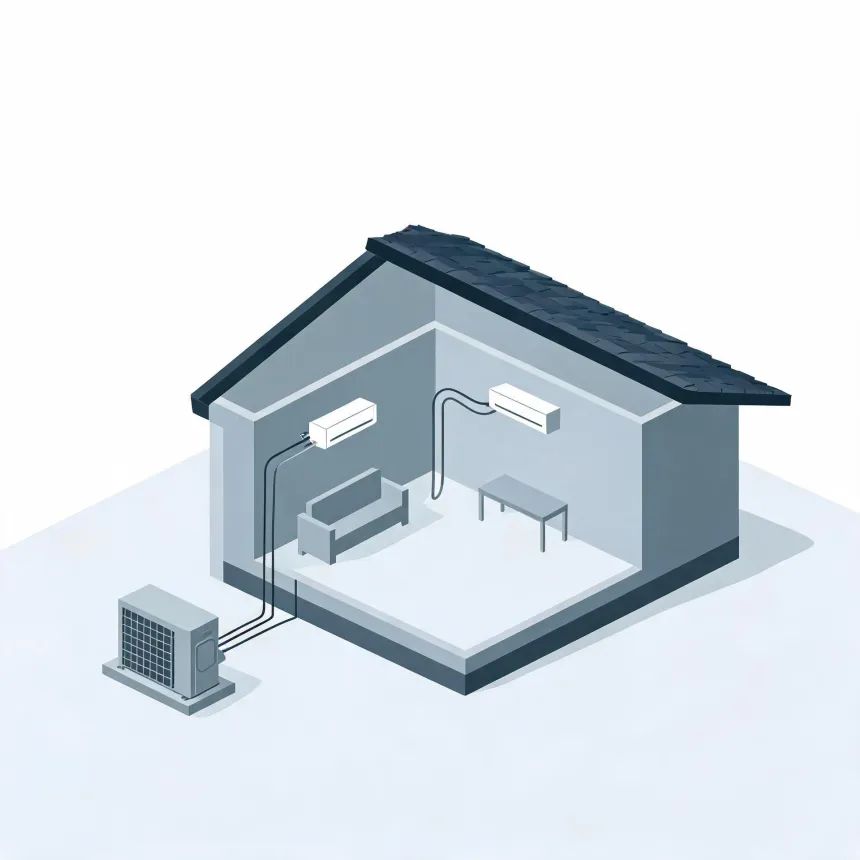
Isometric illustration of a cutaway house showing two wall-mounted indoor air conditioning units connected by line sets to an outdoor condenser unit, with a sofa and table inside the room.
Your system heats October through April and cools June through September.

NOAA nClimDiv, 1991–2020 normals

Cooling season in Barton County runs June through September.

Installing before May gives a crew room to work before the first hot stretch hits.

Most homes here already heat with gas, and that changes what a mini split's job is

68.7% of homes heat with gas
Cooling runs June through September
Summer afternoons average 90°F
This is an older countyHalf the homes in Barton County were built in 1959 or earlier.

Installation day starts before anyone touches the wall. The crew checks where the line set will run, confirms the spot for the outdoor unit, and makes sure the breaker panel can take the new circuit. Mounting the indoor head comes next, then a hole gets drilled through the wall for the line set, the wiring, and the condensate drain to pass through together. The line set connects to the outdoor unit, and the system gets pulled down to a vacuum to clear out any air and moisture before refrigerant ever enters it. That vacuum step matters more than people expect. Trapped moisture in the line set causes corrosion and poor performance down the road, and there's no fixing it once the system is sealed and charged. Once the vacuum holds, the installer opens the valves, lets refrigerant into the lines, and checks the charge against what the equipment calls for. The last part is testing: running the system in both modes, checking the temperature split at the indoor head, and confirming the drain is clearing condensation the way it should.

Plan for the outage before you need it

Talk to the installer about where the outdoor unit will sit before it goes in. A spot with some cover from wind and hail beats one that takes the weather head on. If the mini split is carrying heat or hot water for part of the house, ask what happens to it when the power goes out, and whether a backup is worth setting up now while the crew is already there.

Find a contractor
A man in a brown jacket, cap, dark pants and work boots walks up concrete steps toward a red front door, carrying a waxed canvas tool tote with a hammer inside.
A white mini-split air conditioner outdoor condenser unit mounted on metal brackets against a beige stucco exterior wall, with a blue sky and scattered clouds in the background.

This unit doesn't get an easy year

Run the clip forward and the outdoor unit doesn't get a break. Four months of cooling means the compressor is working most afternoons from June to September, and summer here isn't mild: afternoon highs average 90°F with the dew point near 62°F, so the unit is pulling long hours, not short cycles. Winter asks something different of it but doesn't let up either. Add in 126 damaging wind events and 146 hail events over the past decade, all landing on a box that sits outside by itself, and the wear isn't just hours on the compressor. It's whatever the weather throws at the cabinet while it runs. Parts built to a lower spec show strain sooner here than they would somewhere milder. That's the case for paying attention to the equipment, not just the install.

The outdoor unit and line set drive the number

A mini split's price moves with how far the line set has to run between the outdoor unit and the indoor head, and how much wall or roofline the installer has to get through to route it. A straight shot through one wall costs less labor than a run that climbs a floor or snakes around framing. More zones means more indoor heads, more line set, and more spots that need their own electrical and mounting work.

What's already in the wall matters as much as what's going in

An installer has to work with the electrical panel, the wall construction and whatever's already routed through that part of the house. A panel with room for a new circuit is a simpler job than one that needs upgrading first. Walls that are easy to open up cost less labor than ones that take extra care to get a line set through clean.

The efficiency rating on a mini split's label tells you how much heat it can move for the power it draws over the course of a season, not a guarantee of what it'll do on any one day. A higher rating means the compressor is doing more work per unit of electricity it pulls, which matters most on the days it runs longest. That rating is measured under set conditions in a lab, so the number on the label assumes a properly sized unit, a clean line set, and correct refrigerant charge. Undersize the unit or leave the charge off and the real efficiency drops well below what the label promises, no matter how high the rating is. The rating also isn't something you can compare straight across brands or models without checking it covers the same test standard. A contractor sizing the system to the house and installing it correctly has more effect on your actual running cost than the difference between two close ratings on paper.

Barton County falls in climate zone 4A, which the energy code treats as mixed: humid enough that summer is real work, cold enough that winter is too. Any mini split installed here has to meet the federal minimum for that job. For a split-system heat pump built from 2023 on, that means pulling at least 14.3 Btu of cooling for every watt-hour it draws over the summer, and at least 7.5 Btu of heating per watt-hour over the winter. That's the floor, not a target to hit exactly. Manufacturers publish ratings well above it, and a federal tax credit is available for equipment that clears a higher efficiency bar than the minimum. Ask the installer which models on their lineup qualify before you settle on one.