This county sees real storms
Ellis County logged 315 severe weather events between 2015 and 2024, with hail hitting 141 times and damaging wind 136 times. Nine tornadoes touched down in that same stretch.
Takes about a minute. No obligation.
Ellis County logged 315 severe weather events between 2015 and 2024, with hail hitting 141 times and damaging wind 136 times. Nine tornadoes touched down in that same stretch.
Nearly a fifth of Kansas households went at least a day without power in 2024. A mini split depends on electricity for both heat and cooling, so a storm that knocks out power stops the system until it's back.
NOAA nClimDiv, 1991–2020 normals
Gas heats 64% of homes in Ellis County.
A mini split runs on electricity alone, so pairing it with the gas furnace already in place is usually simpler than replacing that heat source too.




Summer here only runs four months, but the afternoon high averages 90°F for all of June, July and August, with the dew point near 61°F. That's real, sticky heat, not a few spikes to push through. A mini split sized too small will run flat out those afternoons and still lose ground indoors. Sizing it to the house, not to the lowest bid, is what keeps it from straining every summer it's installed. The same unit has to hold up through hail and wind too, so what's mounted outside matters as much as what's rated inside.
Where the installer puts the outdoor unit and what guards it matters as much as the model you pick. Ask what happens to heat and hot water if the power drops, and for how long that's reasonable to plan around here. Settling that now, while the system is being designed, is easier than working it out after a storm has already passed through.
Find a contractorCooling here runs June through September, four months a year. May is when to get a mini split installed, before the first hot stretch hits and before installers are booked solid with emergency replacements. A system put in during a June heat wave gets set up under pressure, on whatever timeline is left open. One put in during May gets sized and placed properly, with time to check the work before it has to run.
A mini split is sized by working out how much heat each room gains in summer and loses in winter, counting windows, walls, insulation and ceiling height. Square footage alone skips all of that. Two houses the same size can need different size units once that math is done.
A unit too big for the space cools the air fast, shuts off, then starts again a few minutes later. It never runs long enough to pull moisture out, so the room feels cold and damp instead of just comfortable. Undersized has the opposite problem: it runs constantly and still can't keep up when the heat is worst. Right sized runs long, steady stretches and holds the temperature without cycling on and off all day.
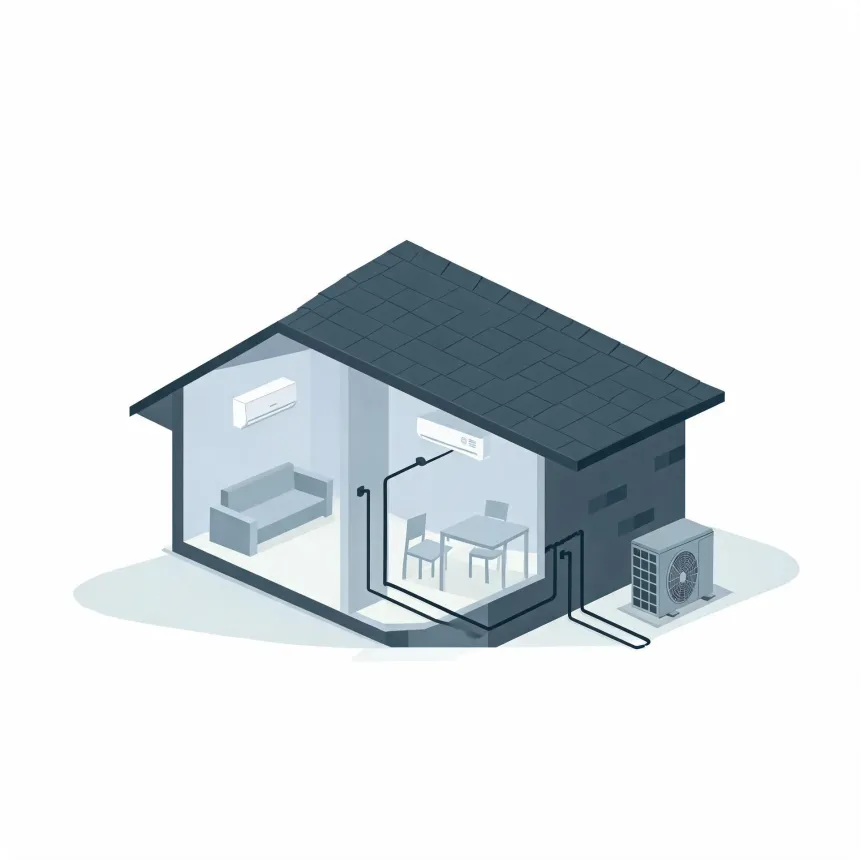
If the gas furnace is staying, the old central air is what comes out, and that's a job in two parts. The outdoor condenser gets disconnected and hauled off, along with the line set that ran refrigerant between it and the indoor coil. That coil usually sits in the plenum right above the furnace, and it has to come out too, since a mini split doesn't use it. Whoever pulls the system should recover the refrigerant properly rather than vent it, which is standard practice and the law. Once that coil and line set are gone, the furnace still heats the house on its own, same as before, and the mini split takes over cooling and whatever heating it's sized to handle.
Ellis County falls in climate zone 4A, which asks real work of both heating and cooling systems. Under the federal standard, a mini split installed here has to pull at least 14.3 Btu of cooling from every watt-hour of electricity it uses, and deliver at least 7.5 Btu of heat per watt-hour on the heating side. That's the floor, not a target, and it applies to any split-system heat pump manufactured from January 1, 2023 onward. A unit that doesn't meet those numbers can't legally go into this house, no matter the price quoted. Worth asking whether the federal tax credit applies to the system you're considering, since that can offset part of the cost.