A snow-covered suburban street at dusk with lit houses and bare trees under a twilight sky.

Mini Split Installation in Hiawatha, KS

Tell us about the job

Takes about a minute. No obligation.

New system or replacementMini-splitBrown County, KS
Step 1 of 2

What ZIP code is the job in?

Gas heats most homes here

Utility gas heats 54.3% of homes in Brown County, with bottled or LP gas heating another 22.6%. A mini split works alongside a gas furnace rather than replacing it, handling cooling and shoulder season heating while the furnace covers the coldest months.

What that means for the install

If your home runs on gas or propane, the mini split is an addition to the system you already have, not a swap. The job is sizing the unit and placing the outdoor and indoor parts, not rerouting how the house gets its heat.

7 months
October through April, your system heats
4 months
June through September, it cools
20°F
the average winter night it heats against
86°F
the average summer afternoon it cools against
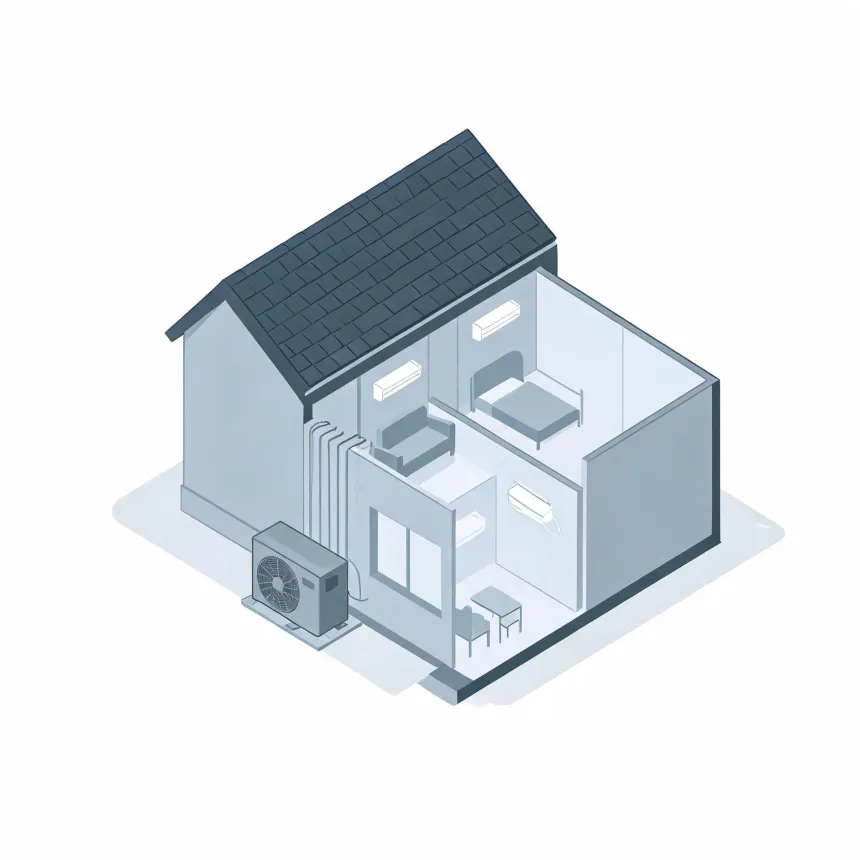
Isometric illustration of a cutaway house with a dark shingled gable roof, showing interior rooms with a bed, chairs and table, three wall-mounted mini-split indoor units connected by line sets to an outdoor condenser unit on a pad outside.
Your system heats October through April and cools June through September.

NOAA nClimDiv, 1991–2020 normals

A mini split sized by square footage alone is guessing.

A contractor works out room size, window area, insulation and layout before picking a unit, because too big or too small both cause problems.

May is the month to get it installed, before June's heat and hail season arrive together

Cooling runs June through September
Summer afternoons average 86°F
35 hail events from 2015 to 2024
A mini split sized to fit HiawathaKansas electricity ran 14.15 cents per kilowatt-hour in 2024

Half the homes in Brown County were built in 1964 or earlier. A house that age can take a mini split well, but it usually means older windows, older insulation, and walls that lose heat differently than a house built last decade. That changes the load a contractor has to work with when sizing the unit. A mini split picked for the square footage alone might ignore a drafty window wall or a room that was added on later without matching insulation. In a house this old, sizing has to account for what the house actually does with heat, not just how many square feet it has.

A new system here has to meet zone 4A's standard

Brown County sits in climate zone 4A, which asks real work of both heating and cooling through the year. Any mini split installed here, manufactured from 2023 on, has to meet 14.3 SEER2 for cooling and 7.5 HSPF2 for heating under the federal standard. That sets a floor on what a contractor can install. A federal tax credit is available on qualifying equipment, worth asking about when you compare units.

Find a contractor
A beige split-system air conditioner outdoor condenser unit mounted on metal wall brackets atop a stucco wall.

The old system does not just disappear

Whatever is heating and cooling the house now does not come out the day the mini split goes in. If it still runs, most people keep it as backup, something to lean on in the coldest or hottest stretch, or in a room the new system does not reach well. An old furnace or window unit left in place does not owe you anything anymore. It can sit idle for long stretches and still fire up fine, or it can fail the first time you ask it to work hard, and there is no way to know which until you need it. If the plan is to retire it for good, someone has to deal with the refrigerant, the gas line, or the electrical it was running on. None of that is part of the mini split installation itself, so it is worth asking the contractor directly what happens to the old equipment, before the new one gets mounted.

Ask how many zones the house needs

Each indoor head is its own zone, set and controlled on its own. More zones cost more and take up more wall or ceiling space, but a single zone covering rooms with different sun exposure or different uses tends to leave one of them always a bit too warm or too cold. A contractor should walk through the rooms and say which ones can share a zone and which can't, not just quote a head count.

Ask where the lines will run

An indoor head needs a refrigerant line and a condensate drain running out to the outdoor unit, and that path has to go somewhere, through a wall, up through a closet, along the outside of the house. Where it runs affects how the wall looks afterward and how easy the unit is to service down the road. Get that path decided before install day, not after holes are already cut.

SEER2 and HSPF2 on the label tell you how much cooling or heating the unit produces for the electricity it draws. A higher rating means it gets more done per unit of power, nothing more than that. It says nothing about how big a space the unit can handle, that question gets answered separately, by sizing the rooms it serves. A pair of mini splits can carry the same rating and still behave differently in the same house, depending on how the lines are run and whether the unit was matched to the load. The rating is a tool for comparing equipment side by side, not a promise about what your power bill will do.

Install day starts with the outdoor unit and indoor heads going up, not the power getting turned on right away. The mounting bracket goes on the wall first, then the indoor head hangs on it once the hole for the line set is drilled through. That hole gets the refrigerant lines, the condensate drain and the electrical run through it, so it's usually the first real cut made in the house. Outside, the condenser sits on a pad or wall bracket, away from the dryer vent and clear of anything that blocks airflow around it. Once everything is connected, the lines get pressure tested and then pulled down to a vacuum to clear out any moisture or air before the refrigerant is released into the system. Only after that test holds does the unit get powered on and checked for proper airflow and temperature at each head.