Most homes here run on gas
Gas heats 60.2% of homes in Leavenworth County. Electricity comes next at 24.3%, with propane heating another 12.7%.
Takes about a minute. No obligation.
Gas heats 60.2% of homes in Leavenworth County. Electricity comes next at 24.3%, with propane heating another 12.7%.
A mini split works alongside an existing gas furnace, handling a room or zone the main system doesn't reach well. Most homes here don't need to replace their primary heat to get one installed.
NOAA nClimDiv, 1991–2020 normals
Cooling runs May through September here, five months straight.
April is the time to get a mini split in, before that first warm week asks it to work.



A mini split sized for the room it covers is the right call here. Summer afternoons average 87 degrees across June, July and August, which is warm but not extreme, and the unit doesn't need oversizing to keep up. What matters more in this county is how it's mounted. Leavenworth County has seen frequent damaging wind and a fair number of hail events over the past decade, and the outdoor unit sits through all of it. A contractor who installs here knows to anchor the condenser well and place it somewhere it isn't catching the brunt of a storm. That's a question of placement and mounting, not horsepower.
Kansas sits in climate zone 4A, and any split-system heat pump manufactured from 2023 on has to clear 14.3 SEER2 for cooling and 7.5 HSPF2 for heating, the same minimums that apply to a ductless system here. A unit that meets that standard also qualifies for the federal tax credit on efficient heat pumps. Worth settling before you're comparing quotes.
Find a contractorA brochure number only tells you how the system performs under one set test. It doesn't tell you how it runs on the coldest morning of the year, which is when a heat pump earns its keep. Ask what the unit's heating capacity does as the temperature drops outside. Some compressors hold up well into cold weather. Others fall off hard long before that. Ask about line set length too. Run the lines past what the manufacturer allows and the system loses capacity that no amount of careful installation elsewhere can bring back. Ask who sets the refrigerant charge and how they check it. A charge that's off shortens the compressor's life, and it shows up later as a system that runs long and never quite gets the room where you want it.
SEER2 and HSPF2 come from a lab test, run under fixed conditions. A unit with a higher rating uses less energy to do the same job than one with a lower rating. What that means for the bill depends on the room it's covering, how the outdoor unit is mounted, and how the installer sets the refrigerant charge. The rating tells you about the equipment. It doesn't tell you what your installation will do with it.
Systems that clear a high efficiency rating generally do it by running the compressor at a steady low speed instead of switching fully on and off. That's why they hold a room's temperature evenly and run quiet. It isn't a sign of a stronger unit. It's a sign of one that spends less energy holding the room where you set it.
If this mini split is covering a room the furnace doesn't reach, there's no old system coming out at all. It's new equipment, new lines, nothing to remove. Where it is replacing something, that's usually a window unit or an older ductless head on the same wall. A window unit just comes out and gets hauled off. An old ductless system takes more work. The indoor head, the outdoor condenser and the line set between them all have to come down, and any refrigerant left in those lines gets recovered, not vented. The electrical disconnect feeding the old condenser gets checked too, since the new unit may need different wiring at that same spot. None of that is a reason to size the replacement bigger. It's just groundwork.
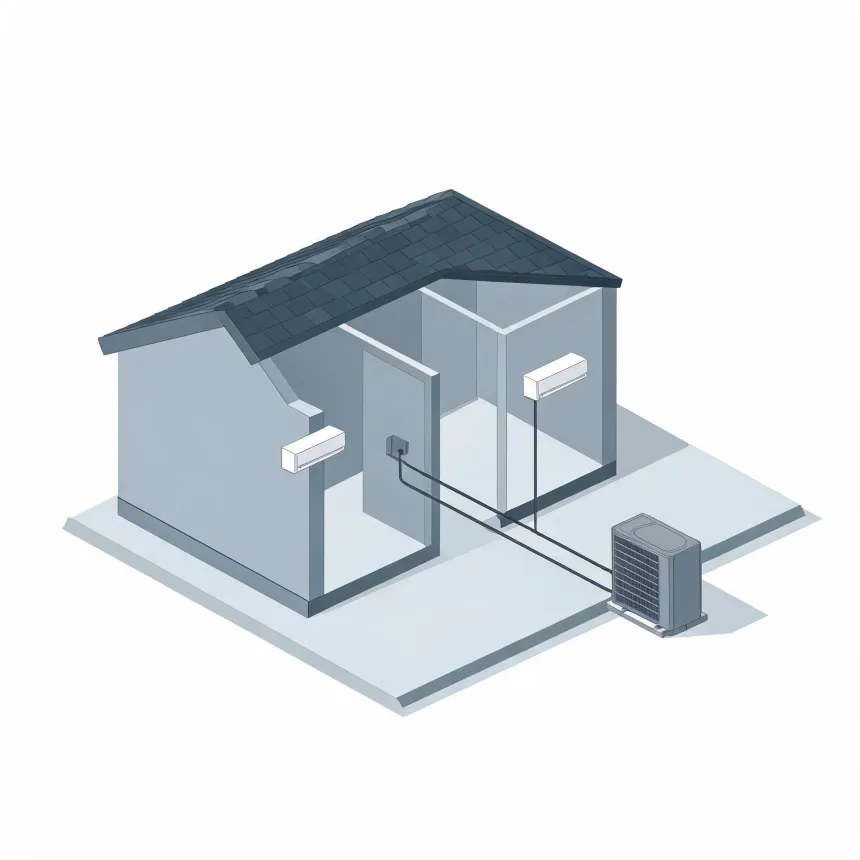
Install day starts outside with where the lines run. The outdoor unit needs a spot with clear airflow on all sides and a straight-enough path to drill through the wall for the line set, the refrigerant lines, power wire and condensate drain bundled together. That hole gets sealed once the lines are through, so water and air don't follow them back in. Inside, the mounting plate goes up first, level, with enough clearance above and below for the head to pull air through and push it back out. The lines get connected at both ends, then the whole system gets pulled down to a vacuum before any refrigerant moves, which clears out moisture and air that would otherwise sit in the lines and cause problems later. Once that holds, the refrigerant charge gets set, the head gets powered up, and the installer checks that it's actually cooling and heating before calling it done.