





A snow-covered small-town street at dusk, with lit white clapboard houses, bare trees, and a grain elevator silhouetted against an orange and blue twilight sky.

Mini Split Installation in Newton, KS

Tell us about the job

Takes about a minute. No obligation.

New system or replacementMini-splitHarvey County, KS
Step 1 of 2

What ZIP code is the job in?

A mini split here earns its keep from May through September, five months of cooling with afternoon highs averaging 90 across June, July and August. That's steady, hard running, not a few hot weeks. Size it right for the rooms it covers, because an undersized unit just runs longer at that load and an oversized one cycles too much to dry the air properly. Harvey County also sees damaging wind and hail most years, so where the outdoor unit sits and how it's mounted matter as much as the indoor head. Buying the cheapest system on the list isn't the same as buying the right one for this climate.

7 months
October through April, your system heats
5 months
May through September, it cools
23°F
the average winter night it heats against
90°F
the average summer afternoon it cools against
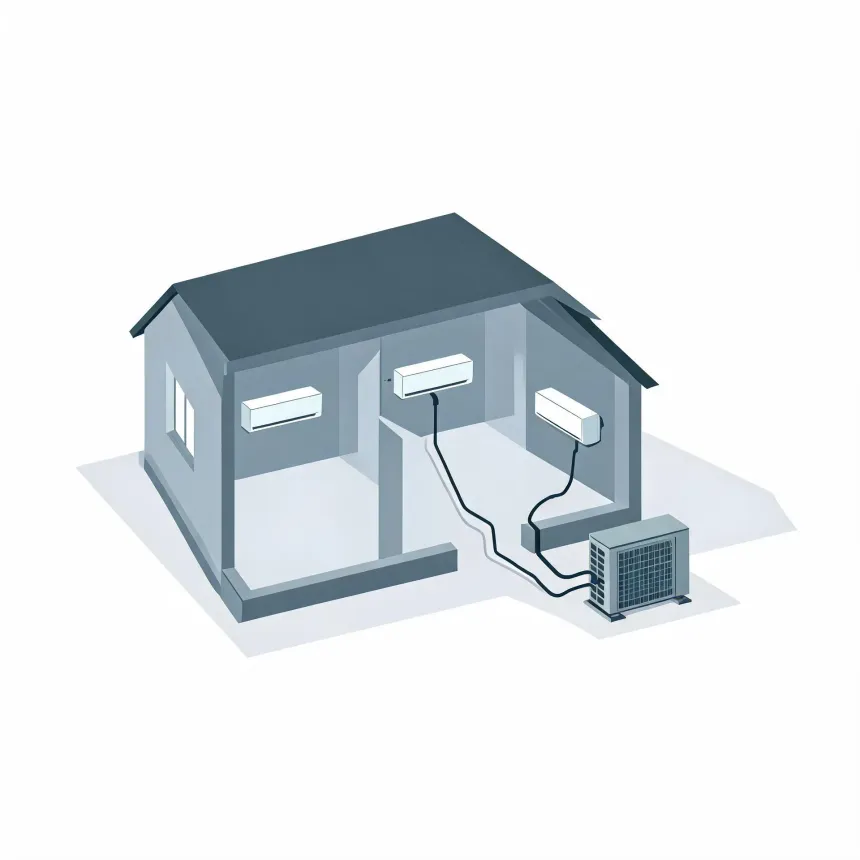
Isometric illustration of a cutaway single-story house with three wall-mounted indoor air conditioning units connected by lines to an outdoor condenser unit on the ground outside.
Your system heats October through April and cools May through September.

NOAA nClimDiv, 1991–2020 normals

Half the homes in Harvey County were built in 1970 or earlier.

An older home carries its own wall types and layout, so a mini split has to be sized and mounted for the house you actually have.

April is the month to get this done, before May asks the system to work

Cooling runs May through September
Summer afternoons average 90°F
91 damaging wind events from 2015 to 2024

If your house was built in 1970 or earlier, the contractor needs to see it, not just size it off a spec sheet. Wall construction and layout from that era vary enough that a load calculation done for a newer house down the street won't carry over to yours. Mounting matters the same way. The bracket for the indoor head has to anchor into whatever is actually behind that wall, and the hole for the line set has to account for what it's passing through to get outside. Ask the contractor to base the sizing and the mounting plan on your house as it stands, not on square footage alone.

Here, an efficient mini split pays you back on every summer bill

Kansas electricity runs 14.15 cents per kilowatthour. A mini split that's sized and mounted right earns that back every month it runs, through the stretch of hot afternoons this page already laid out. An oversized or poorly placed unit just turns those same months into a bigger bill.

Find a contractor
A man in a cap, dark T-shirt and tan work pants walks up porch steps toward a red front door, carrying a worn canvas tool bag, with a potted plant beside the door.
A white mini-split air conditioner outdoor condenser unit mounted on metal brackets against a beige stucco exterior wall, with a blue sky and scattered clouds in the background.

Right-sized now runs steady for years

Five months of cooling a year adds up to a lot of hours on the compressor. Get the sizing right at install and that workload stays steady and predictable instead of turning into short cycles or long ones. This is the month to have someone measure the rooms and the wall before anything gets mounted, not after.

Ask what the load calculation found, not just the room size

Square footage alone doesn't size a mini split. Window placement, ceiling height and what's on the other side of each wall all change how much the room gains in heat. A contractor should be able to tell you the number that calculation produced and which unit matches it, not just hand you a price for the biggest head on the lot.
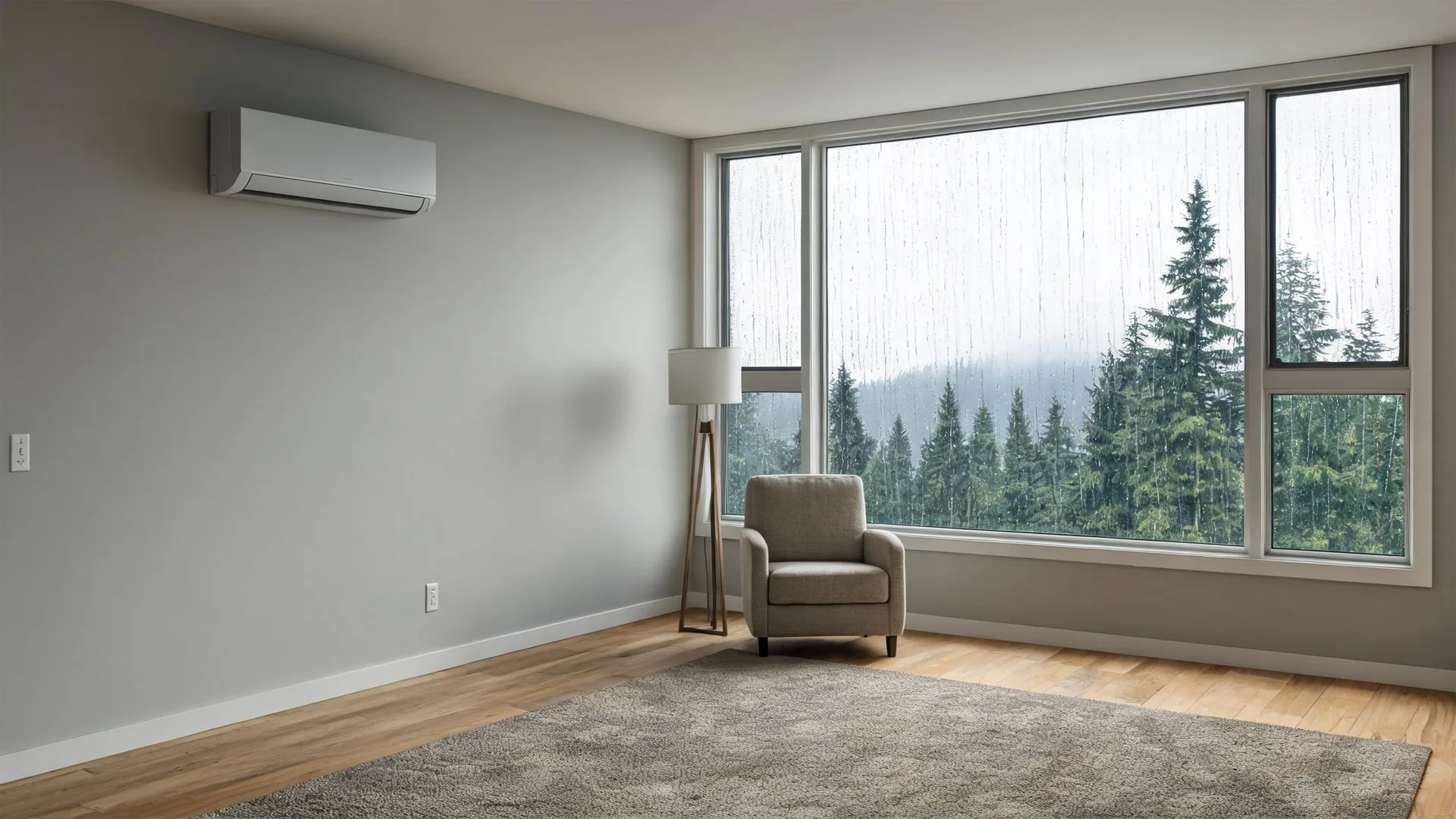
Ask where the line set runs and how many turns it makes

The line set carries refrigerant between the outdoor unit and the indoor head, and every extra foot or bend in it changes how the system performs. A long or twisted run can cost you capacity the spec sheet promised. Get a straight answer on the path it takes through the wall before you compare one quote against another.

If the gas furnace stays, the old cooling setup is usually a window unit, sometimes more than one. Those come out of the window and go wherever window units go once they're retired. If this is a swap for an older mini split, the job looks different. The outdoor unit gets disconnected and the refrigerant recovered rather than vented, since letting it out isn't legal or safe. The indoor head comes off the wall, and the old line set either gets reused if it's sound or pulled and replaced. A contractor should tell you which one they're planning and why, because reusing a line set that's the wrong diameter or full of old oil will hold the new system back no matter how well it's sized.

Install day starts outside and in at the same time. One person mounts the bracket for the indoor head, levels it, and drills through the wall for the line set. Outside, the other sets the pad or wall bracket for the condenser, since it needs to sit level and clear of anything that blocks airflow around it. The line set, drain line and power wiring all run through that single wall penetration, then get connected at both ends. Once the lines are connected, the system gets pulled into a vacuum to clear out air and moisture before any refrigerant moves through it. Skip that step and moisture sits in the lines, and that shows up later as a system that won't hold its charge. After that it's a leak check, a power-on, and running the unit long enough to see that it hits the temperature it's set to and the head responds to the thermostat or remote.