




An orange cat sleeps on a neatly made bed with dark grey bedding in a minimalist bedroom with wall sconces and a mounted air conditioner.

Mini Split Installation in Osage City, KS

Tell us about the job

Takes about a minute. No obligation.

New system or replacementMini-splitOsage County, KS
Step 1 of 2

What ZIP code is the job in?

Osage County saw 157 severe weather events between 2015 and 2024. Seventy of those were hail, seventy-one were damaging wind, and seven were tornadoes. A mini-split's outdoor unit sits outside year-round, exposed to all of it, so where it goes and what shields it are worth real thought before install day. Power cuts follow the same storms. Across Kansas, almost one in five households went at least a full day without power in 2024. A mini-split needs electricity to run in either direction, heat or cool, and so does most gas furnace equipment here, since the blower and controls still draw power even when gas does the heating.

7 months
October through April, your system heats
5 months
May through September, it cools
23°F
the average winter night it heats against
88°F
the average summer afternoon it cools against
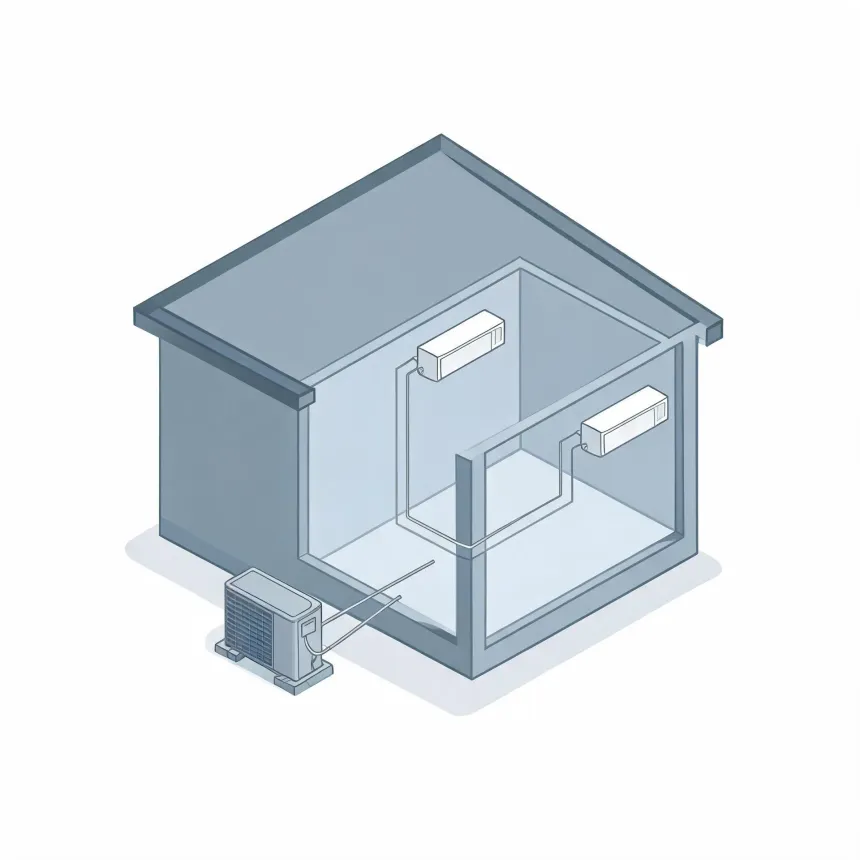
Isometric line illustration of a cutaway building interior with two wall-mounted indoor air conditioning units connected by piping to an outdoor condenser unit on the ground outside.
Your system heats October through April and cools May through September.

NOAA nClimDiv, 1991–2020 normals

Cooling here runs May through September.

April is the month to get a new mini-split installed, before the first hot stretch finds any problem with it.

Gas heats half the homes here, so a mini-split usually joins a furnace instead of replacing it

48.6% of homes heat with gas
Cooling runs May through September
Summer afternoons average 88°F
A System Built for the Load It Will CarryJune through August runs 88°F in the afternoon with a dew point near 66°F, five months of that a year

Osage County sits in climate zone 4A under the 2021 energy code, a mixed zone that asks real work of a system in both directions. A mini-split counts as a split-system heat pump under federal rules. Any unit built from January 2023 onward has to clear set minimums: at least 14.3 Btu of cooling for every watt-hour it draws, and at least 7.5 Btu of heating for every watt-hour in return. That floor applies everywhere, not just here, but it still narrows the field to equipment built to handle both sides of the year. A federal tax credit is available for qualifying heat pump installations, worth checking against the specific unit going in.

Pick the outdoor unit's spot before the next storm does

The outdoor unit will sit through hail, wind and whatever winter brings, so give installation day time to settle where it goes and what shields it. Plan the same day for what happens if the power drops: how heat and hot water hold up while the lines are down.

Find a contractor
A beige split-system air conditioner outdoor condenser unit mounted on metal wall brackets atop a stucco wall.

Five Months of Running, Outside in the Weather

Five months of cooling means the outdoor unit logs real hours every summer, working against afternoons that average 88 degrees. That's the load side. The other side is what it sits through while doing that job. Hail and damaging wind both hit this county around seventy times between 2015 and 2024, and the outdoor unit takes that exposure directly since it has to sit outside year-round. A unit sized for the load it actually carries runs less per hour to hit the same temperature, which matters over five months of long days. Buy on price alone and you tend to get a smaller compressor working harder to keep up, and equipment working harder outside is where early wear shows up first.

Labor Depends on What's Already There

Running new line set and a condensate drain to a wall that has neither takes more time than tying into a stub that's already roughed in. Where the outdoor unit lands relative to the indoor head matters too. Every extra foot of line set is more refrigerant, more insulation, more wall to get through, and electrical can add its own cost if the breaker panel doesn't already have room for a dedicated circuit.
The Equipment Itself Is a Range, Not a Price

A single-zone system costing less than a multi-zone setup feeding several rooms off one outdoor unit. Capacity matters too: a unit sized to the room it's serving costs less than oversizing it, and oversizing doesn't make it heat or cool better. It can short cycle instead, running in bursts that wear the compressor faster than a steady run would.

Whatever else is going in, something was heating and cooling that space before. If it's a window unit or a few of them, those come out, and the wall or sill they sat in needs to be sealed up properly so it isn't just leaking air after the fact. If it's a central system getting replaced outright, the old outdoor condenser gets disconnected and hauled off, and the indoor coil and air handler come out too if nothing else is using that ductwork anymore. If the mini-split is joining a furnace rather than replacing anything, there may be nothing to remove at all, just a new line set and head going in alongside what's already there. Refrigerant in the old system has to be recovered properly rather than vented, which is the law regardless of what the system is. Worth asking directly what happens to the old equipment and whether removal and disposal are part of the quote or billed separately.

Install day starts outside. The crew picks the spot for the outdoor unit, mounts it on a pad or brackets, and runs line set from there to each indoor head. That line carries refrigerant in both directions, so every joint gets flared and pressure tested before anything gets charged. Once the lines are in, the system gets evacuated with a vacuum pump to pull out moisture and air, because either one left behind will cause problems later. Only after it holds vacuum does the refrigerant go in. Inside, each head needs a condensate line to carry off the water it pulls from the air, so that gets run to a drain or outside the same day. The last step is powering it up and checking that each zone actually heats and cools before the crew leaves.