A tabby cat sleeps curled up on a dark grey bed in a modern bedroom equipped with a wall-mounted air conditioning unit.

Mini Split Installation in Parsons, KS

Tell us about the job

Takes about a minute. No obligation.

New system or replacementMini-splitLabette County, KS
Step 1 of 2

What ZIP code is the job in?

Five months of real heat

Parsons runs its cooling May through September, and June, July and August average 89°F in the afternoon. A mini split here isn't running occasionally to take the edge off. It's working most days for the better part of the year.

Size it for the load, not the square footage

A unit sized too small for Parsons summers will run constantly trying to keep up. Look for a contractor who sizes the system to the cooling load this area actually sees, and don't pick based on the lowest quote alone.

7 months
October through April, your system heats
5 months
May through September, it cools
27°F
the average winter night it heats against
89°F
the average summer afternoon it cools against
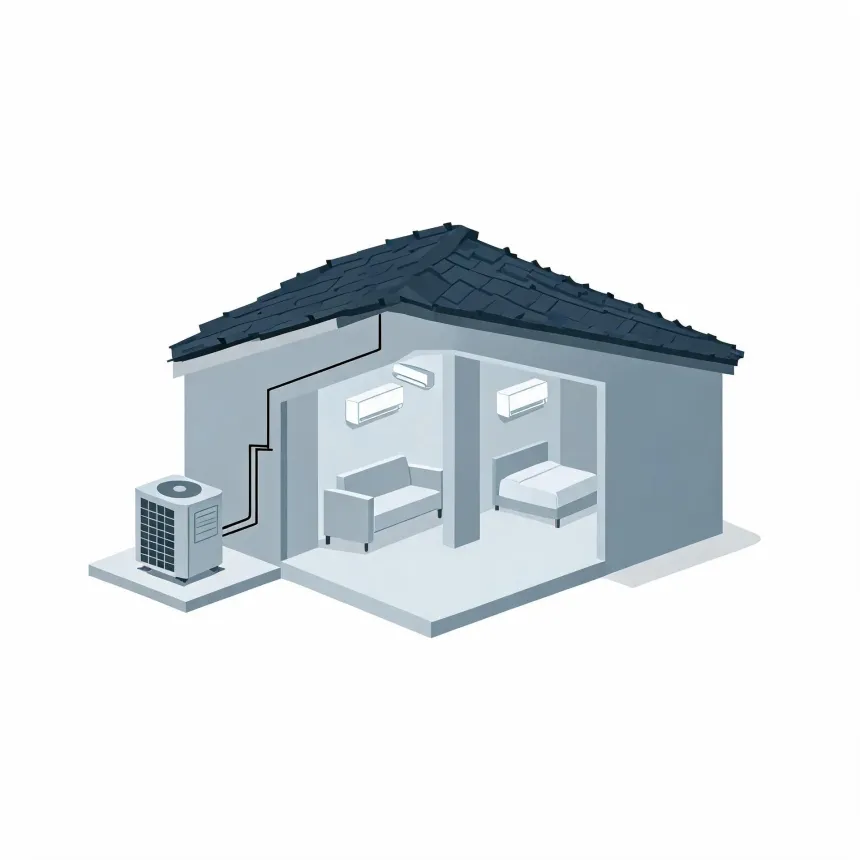
Isometric illustration of a cutaway single-story house with a dark shingled roof, showing three wall-mounted indoor air conditioning units in two rooms connected by lines to an outdoor condenser unit on a pad outside.
Your system heats October through April and cools May through September.

NOAA nClimDiv, 1991–2020 normals

Half the homes in Labette County were built in 1958 or earlier.

An older house like that wasn't built with a mini split in mind, so the wall and the path for the line set need a look before anyone quotes the job.

At 14.15 cents a kWh, efficiency is what keeps the bill down

Power costs 14.15 cents a kWh statewide
Cooling runs May through September
Summer afternoons average 89°F
Most of Parsons heats with gasGas heats 56.4% of homes in Labette County, more than any other fuel

Labette County is zone 4A, a climate that asks real work of both heating and cooling. Any mini split installed here now has to clear the federal minimum for a split system. That means 14.3 SEER2 for cooling and 7.5 HSPF2 for heating. The standard doesn't treat ductless any differently, it's held to the same split-system number as a central unit. A system that beats that minimum by enough may also qualify for a federal tax credit.

Have it in before May

Cooling in Parsons starts in May and runs through September. Installing before April ends means the job happens on your schedule, with time to size and place the unit right, instead of during the first hot week when you need it working.

Find a contractor
A white outdoor air conditioner condenser unit mounted on metal wall brackets against gray horizontal siding, with a blue sky and white clouds behind it.

Five months a year, every year

Five months of running hard, every year, is not light duty. A unit that's sized right cycles on and off, and gets a break between runs. A unit that's undersized just stays on through those 89 degree afternoons, trying to keep up. A compressor that rarely shuts off wears sooner than one that cycles the way it's supposed to. That's the case for asking a contractor to show the load calculation behind their recommendation, not just take the number they quote on faith.

A room by room count, not a guess

Sizing a mini split means adding up heat gain and loss for the actual space it covers. A contractor looks at the windows and which way they face, the insulation in the walls, the ceiling height, what's on the other side of each wall. That gets measured and run through the numbers rather than priced off square footage alone. Rooms that look the same size on paper can carry a different load if one has a wall of west facing glass and the other doesn't.

Oversized fails a different way than undersized

A unit that's too big cools the room fast, shuts off, then starts again soon after. That short cycling never gives the system time to pull moisture out of the air, so the room ends up cool but damp. A unit that's too small just runs without ever catching up to the thermostat setting. Matching the unit to the load avoids both, which is the whole point of doing the calculation instead of rounding up to be safe.

The price of a mini split job comes down to more than the unit itself. How many zones you're covering changes the cost, since each indoor head needs its own line set run and its own mounting spot. The length of that line set matters too. A condenser sitting right outside the wall from the indoor head costs less to connect than one that has to run line through an attic or along an exterior wall to reach the other side of the house. Electrical work can add to the job if the panel doesn't already have the capacity or the right circuit for a new unit. Where the condenser sits outside matters as well. It needs clearance to pull air through the coil and drain condensate away, and a spot that requires a pad or extra mounting work costs more than a straight slab. The brand and tier of equipment is part of it too, but so is the work to get that equipment running the way it's rated to.

Installation starts with the condenser and the line set path, not the indoor unit. The crew runs refrigerant line, a drain line, and a power whip from the outdoor condenser to each indoor head, usually through a small hole drilled in the wall behind where the head will hang. That line set gets charged with refrigerant, pressure tested, and checked for leaks before anything gets powered on. The indoor head mounts to a bracket, not straight to the wall, so it can be pulled off for filter cleaning later without touching the line set. Once everything is connected, the system gets vacuumed down to pull moisture and air out of the lines before the refrigerant charge is released into them. Only after that does the crew run the system through both heating and cooling to confirm each zone hits the temperature it's set to.