Two illuminated single-story brick ranch houses photographed at night, framed by large oak trees and a wide concrete driveway.

Mini Split Installation in Pittsburg, KS

Tell us about the job

Takes about a minute. No obligation.

New system or replacementMini-splitCrawford County, KS
Step 1 of 2

What ZIP code is the job in?

Electricity here runs 14.15 cents a kilowatthour

Kansas power costs more than it does in a lot of states. A mini split that moves heat instead of generating it will cost less to run than electric resistance heat, and that gap shows up every month on the bill.

The SEER2 and HSPF2 numbers decide your bill

Two mini splits can cost the same to install and cost different amounts to run for years after. Ask what SEER2 and HSPF2 rating you're getting quoted, not just the brand or the size.

7 months
October through April, your system heats
5 months
May through September, it cools
26°F
the average winter night it heats against
88°F
the average summer afternoon it cools against
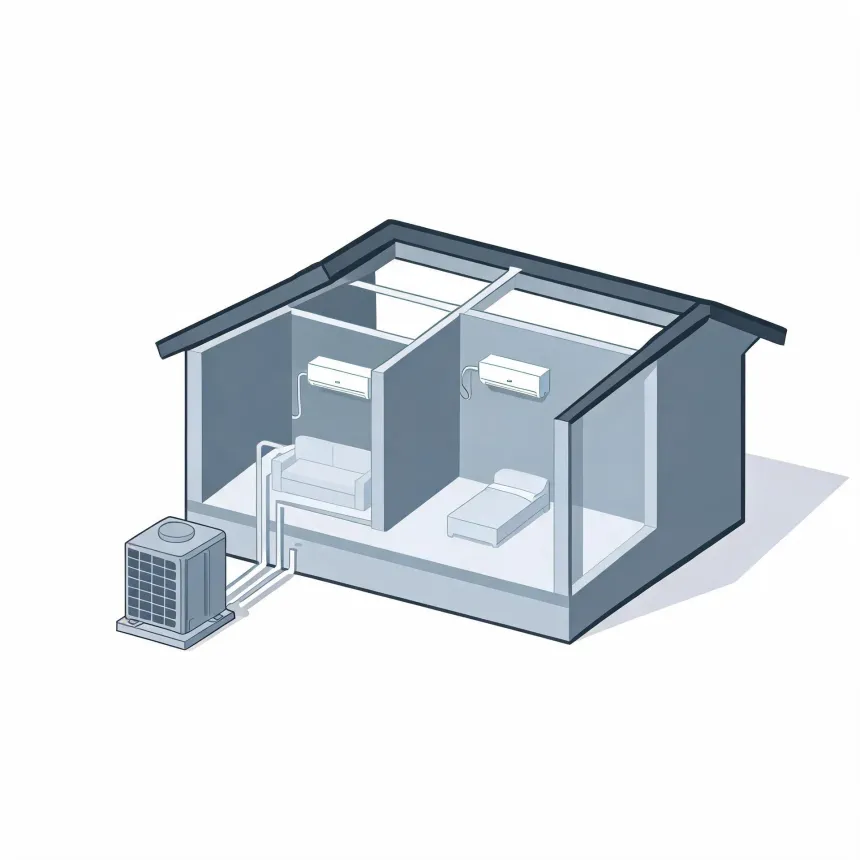
Illustrated cutaway of a two-room house showing two wall-mounted indoor air conditioning units connected by pipes to an outdoor condenser unit on the ground outside.
Your system heats October through April and cools May through September.

NOAA nClimDiv, 1991–2020 normals

The number of zones changes the price more than the brand does.

Each indoor head needs its own line set and its own spot on the outdoor unit, so adding zones adds cost before anyone talks equipment.

Half the homes here were built by 1972, so a mini split has to fit the house it's going into

Half the homes here were built by 1972
Cooling runs May through September
Summer afternoons average 88°F
Most homes here heat with gas, not with a heat pumpGas heats 59.2% of homes here, electricity heats 30.8%

Cooling here runs May through September. April is the month to get a mini split installed, before the first warm week sends everyone else's system into overdrive. Installers book up fast once the season starts, and a system put in ahead of time gets tested and adjusted before it has to carry a full load. Wait too long and you're choosing a contractor from whoever still has an opening, not whoever does the best job on your house.

Any system you install has to meet this region's minimum efficiency

Crawford County falls in climate zone 4A, which asks real work of both heating and cooling here. A mini split installed now has to meet the federal minimum for this equipment. That floor is 14.3 SEER2 for cooling and 7.5 HSPF2 for heating. A system that just meets it qualifies. The choice left to you is how far above that floor to go, and the federal credit is there either way.

Find a contractor
A man in a dark long-sleeve shirt and tan work pants, seen from behind, steps onto a porch toward a red front door while carrying a worn leather tool bag, with a shrub in a red planter beside him.
A white outdoor air conditioner condenser unit mounted on metal wall brackets against gray horizontal siding, with a blue sky and white clouds behind it.

Five months of 88 degrees is what this system signs up for

Cooling runs May through September here, and the afternoon high averages 88°F through those summer months. That's a long season pushing a high load, day after day. A mini split sized right for the house carries that without strain. One that's undersized runs flat out trying to catch up, and that wears down the compressor sooner than it should. This county also sees its share of damaging wind and hail most years, so the outdoor unit needs a spot that keeps it clear and protected, not just a spot that's convenient.

SEER2 is a seasonal average, not a peak number

SEER2 measures cooling output against the electricity it takes over a whole season of changing conditions, not at one ideal moment. HSPF2 does the same for heating. A unit with a higher rating moves more heat per unit of electricity across the range of mild days and hard days it actually faces, not just in a lab test on a mild one.

A higher rating only pays off if the rest of the install is right

The rating on the label describes the equipment, not the system once it's in the wall. A mini split sized wrong for the room, or installed with a line set that's too long or poorly sealed, won't deliver the number on its label no matter how high that number is. The rating tells you what the unit is capable of. The installer's work decides whether the house actually gets it.

If this is replacing a furnace or a window unit, that old equipment doesn't just get left in place. A furnace gets disconnected from the gas line and the ductwork, and the gas line gets capped off properly, not just shut at the valve. A window unit comes out of the sleeve, and the sleeve gets sealed or trimmed so the wall isn't left with a gap to the outside. If the old system is a central air unit, the outdoor condenser and the indoor coil both come out, along with whatever line set ran between them. Refrigerant in an old system has to be recovered, not vented, so that part of the removal is its own step and it's worth asking who handles it. None of this is hard work, but it's work, and it's part of the job even though it has nothing to do with the new mini split going in.

Installation starts with deciding where the indoor head and outdoor unit go, and that gets settled before anyone drills anything. The indoor head needs a clear path across the room for the air, not a spot behind a door or over a couch. A hole gets drilled through the wall for the line set, the refrigerant lines, power wire and drain line bundled together, and that hole is the only real opening made in the house. The outdoor unit gets mounted on a pad or brackets, the line set gets connected at both ends, and the whole system gets pressure tested before any refrigerant moves through it. Once that holds, the lines get evacuated to pull out moisture and air, because either one left behind will keep the system from running the way its rating says it should. Only after that does the unit get charged, powered on, and checked against the manufacturer's numbers for that specific setup.