






A two-story black-clad house with a covered porch stands in front of a dense line of deciduous trees, behind a wire fence, with a wide mown lawn in the foreground.

Mini Split Installation in Wamego, KS

Tell us about the job

Takes about a minute. No obligation.

New system or replacementMini-splitPottawatomie County, KS
Step 1 of 2

What ZIP code is the job in?

Electricity in Pottawatomie County ran 15.36 cents per kilowatt-hour in 2025. That number matters more once a mini-split is doing the work of heating and cooling your home, since every degree it moves runs through the meter. A unit that's sized wrong for the room, or installed with a bad line set connection, works harder than it should to hit the temperature you set. You end up paying the local rate for cycles the system didn't need to run. The installation itself, not just the equipment, decides how much of that rate you feel every month.

7 months
October through April, your system heats
4 months
June through September, it cools
20°F
the average winter night it heats against
87°F
the average summer afternoon it cools against
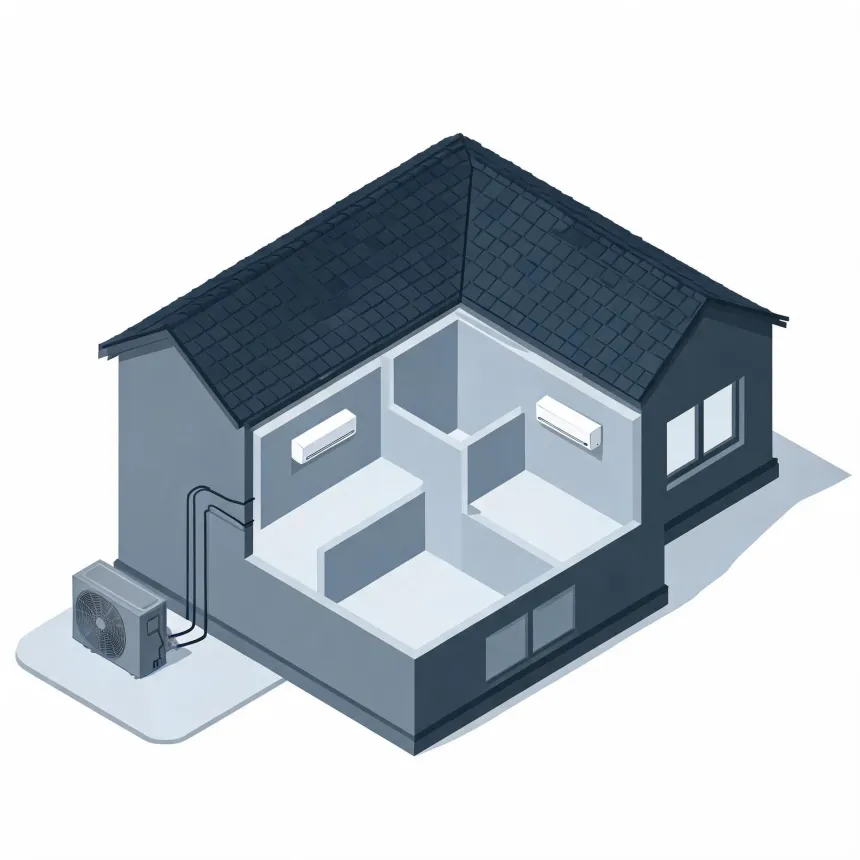
Isometric illustration of a cutaway single-story house with a dark shingled roof, showing two wall-mounted indoor air conditioning units connected by lines to an outdoor condenser unit on a pad beside the building.
Your system heats October through April and cools June through September.

NOAA nClimDiv, 1991–2020 normals

Cooling in Pottawatomie County starts in June.

Get a mini-split installed by May and it's running from day one, not during the first hot week.

Most homes here run on gas, so a mini-split usually joins the system rather than replacing it

52.8% of homes heat with gas
Cooling runs June through September
Summer afternoons average 87°F
Summer Here Leans on a Mini-Split HardAfternoon highs average 87°F in Pottawatomie County through summer, with the dew point near 64°F.

Pottawatomie County saw 82 hail events and 68 damaging wind events between 2015 and 2024, and 8 tornadoes touched down in that same window. The outdoor unit sits outside through all of that. Where it goes matters: close to the wall, clear of the roof line where ice and snow shed, away from a spot that catches wind-blown debris. Winter storms hit the county 13 times in those years, and ice is part of what comes with them. Statewide, close to one in five households lost power for a full day or more in 2024. A mini-split won't run without power, so if you're counting on it for heat, it's worth asking what happens in your house when the power goes out and the gas furnace can't fire either.

The Install Decides What You Pay Every Month After

What you pay to run this system gets decided during the install, not after. A unit sized to the room and set up with a clean line set connection will hit your temperature without running longer than it has to. Ask the installer to walk through the sizing before the work starts.

Find a contractor
A man in a dark beanie, navy long-sleeve shirt and tan work pants climbs porch steps toward a red front door, carrying a waxed canvas tool bag in his right hand.
A beige split-system air conditioner outdoor condenser unit mounted on metal wall brackets atop a stucco wall.

What Happens to the System Already Running

The old system doesn't have to come out for a mini-split to go in. Most of the time it stays, still handling the job it always did, with the new unit covering the room or rooms it's assigned to. What changes is how often the old system has to run. A furnace that used to cycle on for every cold snap now shares that load, or skips it entirely in rooms the mini-split covers well. A window unit, if that's what's being replaced, usually does come out, and the wall or window opening it left behind needs to be sealed properly or that gap undoes a lot of what the new unit is trying to do. If the old equipment is on its way out anyway, worn compressor, refrigerant leaks that keep coming back, this is the point to decide whether it's worth repairing at all once something else is covering part of its work.

Ask what the load calculation found

A mini-split should be sized off a room by room load calculation, not a guess based on square footage or what was in the room before. Ask the installer to show you the numbers and explain how they got there. A unit sized this way matches the heat the room actually gains in summer and loses in winter, so it runs in full cycles instead of short bursts.
Ask where the line set will run and how it will be sealed

The line set carries refrigerant between the outdoor unit and the indoor head, and every joint in it is a place a leak can start. Ask how many joints the install will need, where the line penetrates the wall, and how that penetration gets sealed against air and moisture. A shorter run with fewer joints holds a charge longer and gives the system less to work against.

A mini-split's price comes down to what the installer has to do to get refrigerant moving correctly between the outdoor unit and the indoor head, and how well the system matches the room. Running new line set through a wall takes more work than connecting to a line set that's already there, and every extra foot of line and every added joint is more labor and more places a connection has to hold. Multi-zone systems, where one outdoor unit feeds several indoor heads, cost more to install than a single zone because each head needs its own line set run and its own mounting work. The brackets and pad for the outdoor unit, the wall sleeve for the lines, the condensate drain that carries moisture away from the indoor head: all of it has to be done correctly for the system to run the way it's rated to. A straightforward install with a short line run and one zone takes less labor than one with a long run, tricky access, or multiple zones.

Pottawatomie County falls under zone 4A in the 2021 energy code, a mixed climate that works both the heating and cooling side of a system rather than favoring one. That's part of what sets the floor for what can be installed here. Any split-system heat pump manufactured from January 1, 2023 on has to remove at least 14.3 Btu of heat per watt-hour over summer and deliver at least 7.5 Btu per watt-hour over winter, and a ductless mini-split falls under that same standard. There's no lower bar for ductless specifically. A unit that clears that minimum is built to handle both sides of this climate, not just the season that feels harder.